
What Is Porcelain Tile? Clay, Quartz Sand, and the Vocabulary Buyers Need
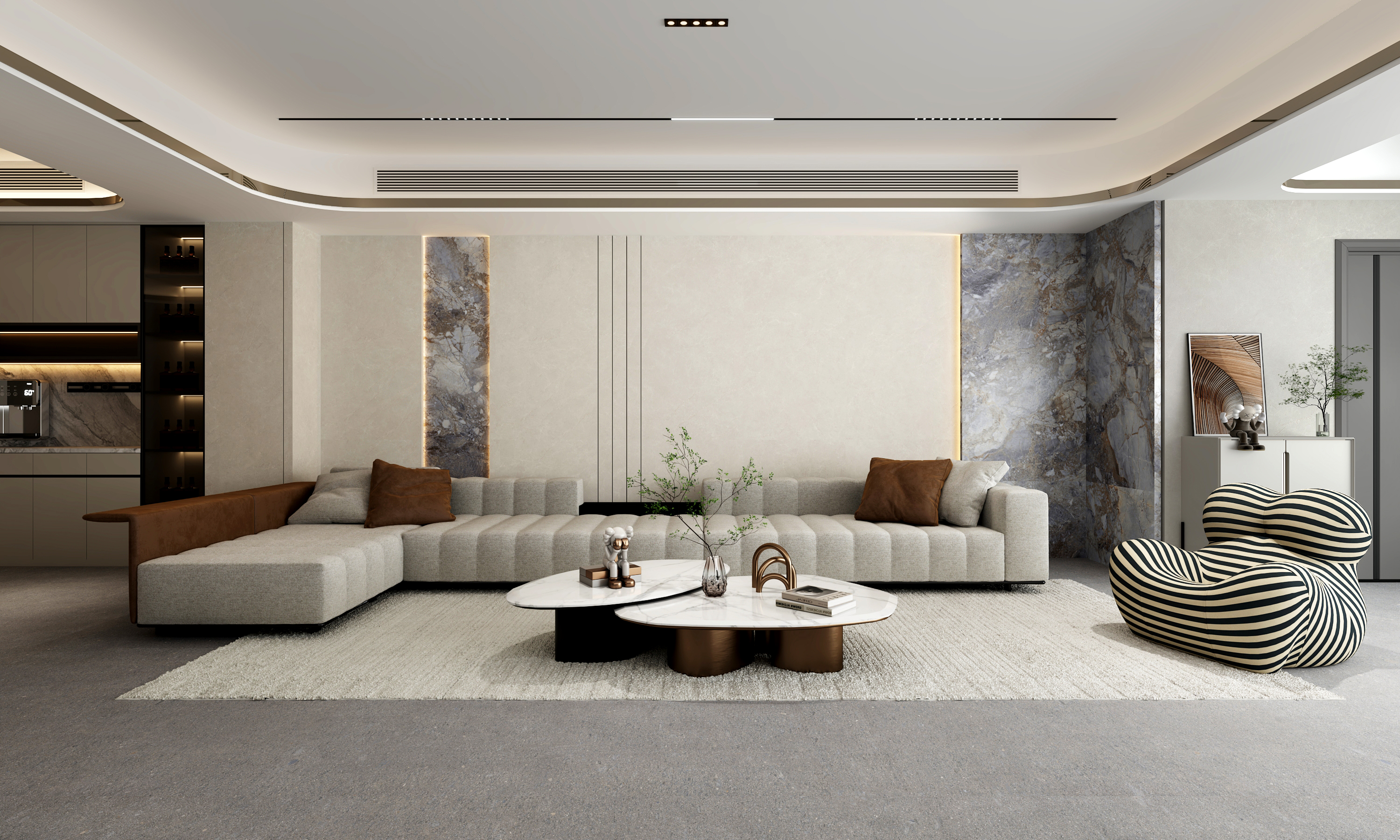
Porcelain tile is a material class first, and a surface look second. Body composition and density set the performance vocabulary buyers need to read.
Porcelain tile is a fired ceramic tile made from a prepared body that contains clay and quartz sand and is densified enough to meet a low water-absorption threshold. In the international vocabulary, the key reference point is ISO 13006 Group BIa: water absorption (E) of 0.5% or less, with average mechanical resistance above 40 N/mm². That definition is narrow, but the buying language around it is not. A showroom label may add 'homogeneous body', 'double-zero', 'PEI 4', 'R10', 'matte', 'marble look', or a large-format size such as 1200x2700x12mm. These terms describe different layers of the same product decision.
This guide separates those layers. It starts with the body, explains why density matters, then decodes the ratings that appear on datasheets. Model 120-270FEG12207M is used as a concrete example because its product data brings several terms together: homogeneous body porcelain tile, 1200x2700x12mm, matte / natural stone face, and clay/quartz sand material.
Why porcelain tile vocabulary is hard for new buyers
The difficulty is not that porcelain tile is mysterious. It is that one product label mixes material, process, appearance, and test results. A buyer may compare two tiles by color and size, then discover later that one is porcelain and the other is semi-porcelain, or that one meets a commercial abrasion target while the other was intended for lighter use. The same word can also mean different things in different markets: 'full body', 'homogeneous body', 'double-zero', and 'porcelain' are not always used with the same precision.
The practical fix is to read a tile in four layers: the body, the density behind the body, the surface finish, and the rated performance. Appearance belongs to the surface layer. Water absorption, PEI, and R ratings belong to the performance layer. A buyer who keeps those layers separate can ask better questions and avoid comparing a visual sample with a technical datasheet as if they were the same thing.
A dense product in a changing tile market
The vocabulary matters because tile is a large, mature industrial category. MECS / Acimac Research Centre reported that world tile production fell to 14.95 billion m² in 2024, a 6.2% decrease from 2023. In a market with that much capacity, buyers meet many product families and many labels. Clear definitions are more useful than showroom shorthand.
One manufacturer working in this category is Monalisa Group Co., Ltd. ('Monalisa'), a manufacturer established in 1992. Its disclosed background includes a 100-engineer R&D team, four modern production bases with 37 production lines, and an annual production capacity of about 100 million square meters. Those facts are context for how a manufacturer organizes body development and production; they do not replace a product-level test report for a specific tile.
The four layers behind a porcelain tile label
A useful reading order is: body type → density and absorption → surface finish → rated performance. Body type tells you whether the product is designed as porcelain, semi-porcelain, or another ceramic class. Density and absorption tell you how tight the fired body is. Surface finish tells you whether the face is matte, polished, natural-stone-like, marble-like, or textured. Rated performance tells you what the product has been tested to do in abrasion, slip, stain, frost, and fire conditions.
This order prevents a common mistake: treating a decorative name as a performance grade. 'Marble look porcelain tiles' and 'stone look porcelain tiles' describe appearance. They do not, by themselves, tell you the water absorption, PEI, or R rating. Those values must come from the product's technical data.
What clay and quartz sand actually do
The product data for model 120-270FEG12207M lists clay/quartz sand as the material. In broad ceramic terms, clay is the plastic component that helps the body hold its shape before firing, while quartz sand is a silica-bearing filler that contributes to the fired body's structure and dimensional stability. The exact recipe is not disclosed in the available product data, and buyers should not infer a formula from a label.
What matters is that the body is engineered and fired to a target density. Porcelain tile is not simply 'clay tile with a nicer surface'. The body preparation, pressing, drying, and firing sequence all influence how much open porosity remains after firing. Lower open porosity is the material reason behind the low water-absorption figure that separates porcelain from semi-porcelain in common specification language.

Large-format porcelain tile is a body-and-surface system; the commercial setting adds slip, abrasion, and installation requirements.
Homogeneous body: a body decision, not a surface trend
A homogeneous body tile is intended to carry a consistent body through the tile thickness, rather than relying only on a surface layer for its visual character. In product vocabulary, this is a statement about the body, not a guarantee that every homogeneous body tile is unglazed or that every glazed tile is inferior. The model 120-270FEG12207M is listed as a homogeneous body porcelain tile with a matte / natural stone face and a 1200x2700x12mm format.
That combination matters for large-format porcelain tiles. A 1200x2700x12mm panel gives fewer joints and a broad visual field, but it also places more demand on substrate flatness, handling, and joint planning. The body still has to meet the absorption and mechanical expectations of the project. The matte face changes how light reflects and how the surface feels underfoot; it does not change the definition of porcelain by itself.
Why density is the quiet variable
Density is the quiet variable because it is usually not printed as a single showroom number. It is an outcome of formulation, pressing, drying, and firing. A denser fired body tends to have less open porosity, which supports low water absorption and makes stain penetration and freeze-thaw exposure easier to manage. That is why density is a useful first-principles idea: it connects the raw materials to the measured performance a buyer sees later.
Density is not the whole story. A dense body does not automatically guarantee a specific PEI rating, R rating, or stain grade. Surface finish, test method, and product design also matter. The correct reading is conditional: density helps explain why a porcelain body can meet a low absorption threshold, but the buyer still needs the actual test values for the exact product and application.
Water absorption: porcelain, semi-porcelain, and double-zero
Water absorption is the clearest material threshold in porcelain tile vocabulary. ISO 13006:2018 classifies porcelain tile in Group BIa with water absorption (E) of 0.5% or less and average mechanical resistance above 40 N/mm². In the broader buying language used for this category, semi-porcelain is associated with a water absorption of 3% or less. The gap between 0.5% and 3% is not cosmetic; it signals a different body density and a different level of specification control.
'Double-zero' is a project term rather than a separate ISO class in the supplied evidence. It signals a tighter absorption target than the standard porcelain threshold and is required for certain projects. The exact pass value, test method, and sampling rule should be read from the project specification. A buyer should not assume that the phrase means the same thing on every datasheet.
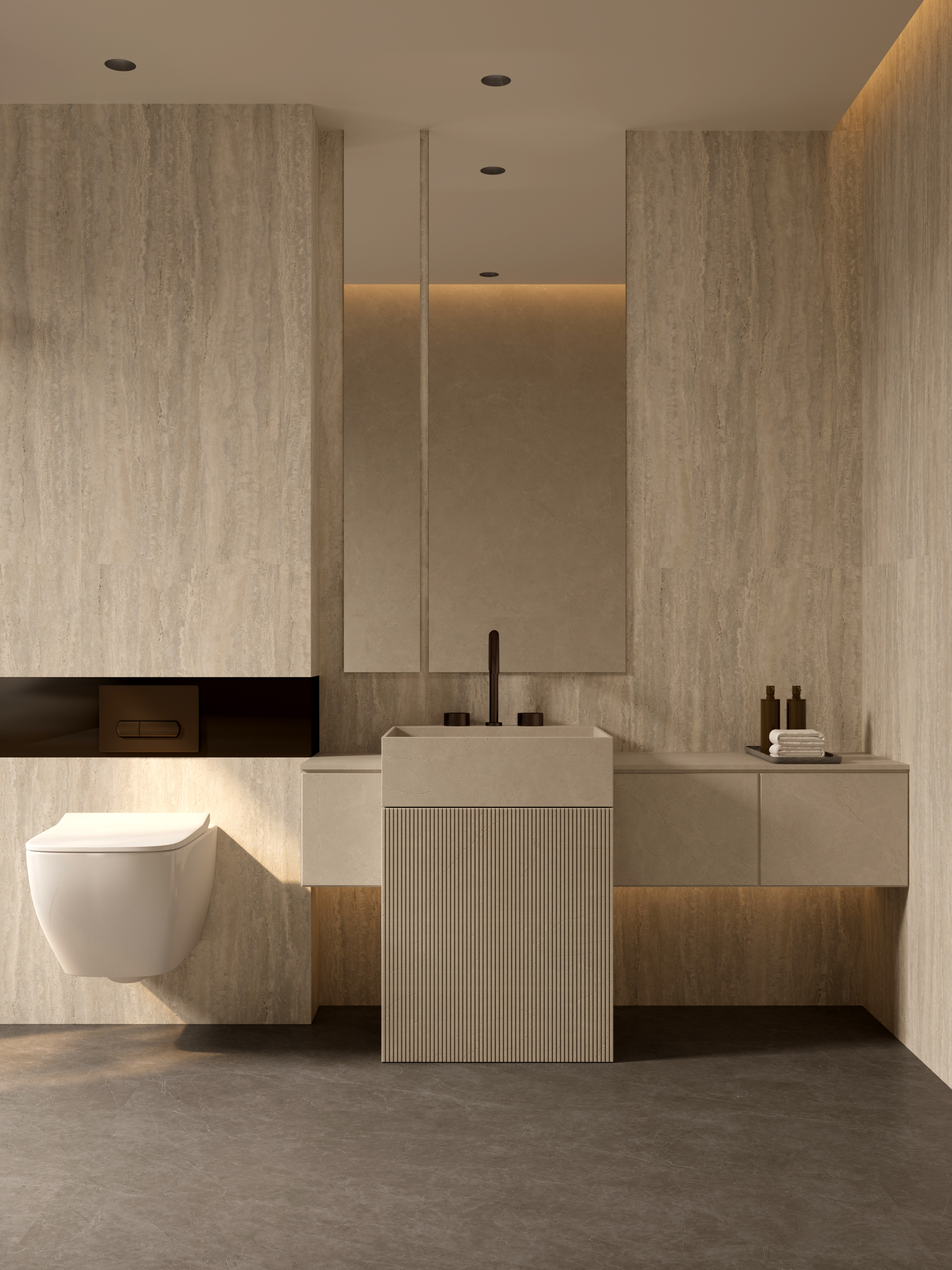
Travertine-look porcelain tile illustrates the surface layer: the look is a design choice, while absorption and ratings remain technical questions.
PEI ratings: abrasion, not slip
PEI ratings are often quoted without explanation. In this category's application criteria, abrasion resistance is listed as PEI 3 to 5, with PEI 4 or higher for commercial and public areas. PEI is an abrasion-resistance vocabulary. It is not a slip rating, and it is not a stain rating. A tile with a high PEI value can still be unsuitable for a wet ramp if its slip performance is wrong for that condition.
For a new buyer, the useful question is not 'Is PEI 5 better than PEI 4?' in isolation. The useful question is 'What traffic and cleaning regime will this floor see, and what PEI value does the specification require for that use?' A residential living room and a busy commercial corridor do not place the same demand on the surface. The rating should match the application, not simply reach the top of a scale.
R ratings: slip resistance is a separate question
Slip resistance is expressed with R ratings in many project specifications. The application criteria for this product category list R9 to R11, with R10 or higher for bathrooms. These values are not interchangeable with PEI. R ratings address slip resistance under defined test conditions; PEI addresses abrasion resistance. A datasheet that gives one but not the other is incomplete for a wet-area decision.
For anti-slip porcelain tiles, the test condition matters. A bathroom floor, a pool surround, and an outdoor terrace may all be wet, but they are not the same exposure. The buyer should ask for the R rating, the test method, and the intended wet or dry condition. 'Anti-slip' is a useful search phrase, but it is not a substitute for a stated rating and a project requirement.
Surface language: marble look, stone look, and the finish
Surface vocabulary is where appearance and performance are most often confused. Marble look porcelain tiles, stone look porcelain tiles, concrete look porcelain tiles, and wood look porcelain tiles describe the visual target. Digital printed porcelain tiles describe a decoration method used to build that visual target. None of those phrases, by itself, tells you whether the tile is porcelain or semi-porcelain, or whether it meets a commercial abrasion or slip requirement.
Performance language is different. Scratch resistant porcelain tiles and stain resistant porcelain tiles make claims about surface behavior. The application criteria list stain resistance Grade 5 for common stains such as tea, oil, and ink. Scratch resistance should be supported by a test method and result; PEI does not measure scratch resistance. For kitchen porcelain tiles and commercial porcelain floor tiles, those surface questions sit alongside absorption and slip, not instead of them.
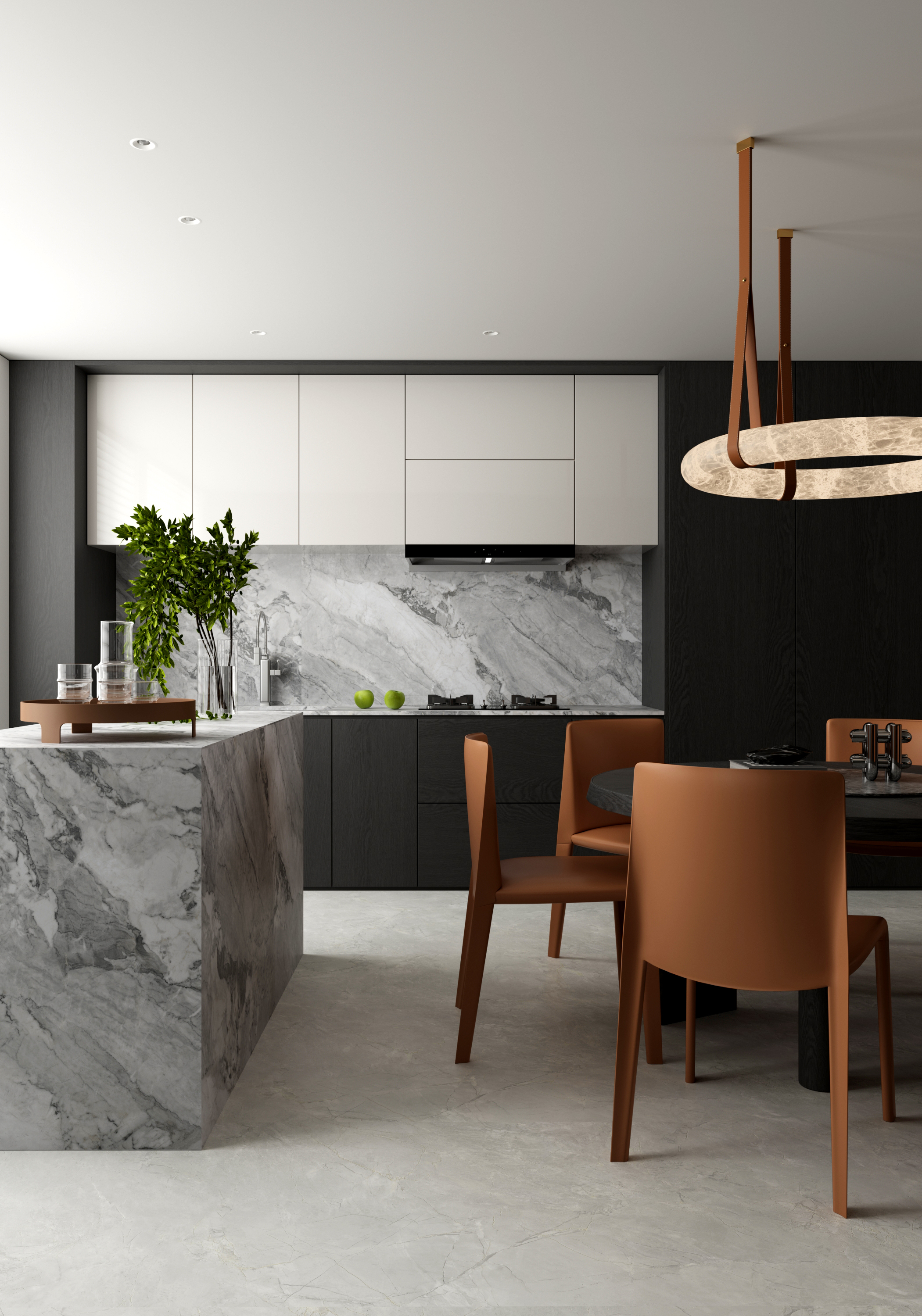
Stain resistance is a surface-performance claim. Ask for the grade and test method, not only the descriptive label.
A seven-step read of a porcelain tile datasheet
- Start with the body type. Confirm whether the product is described as porcelain, semi-porcelain, or another ceramic class. For porcelain, look for the ISO 13006 Group BIa reference or an equivalent project standard.
- Check the size and thickness. The model 120-270FEG12207M is listed at 1200x2700x12mm. Large-format porcelain tiles require installation planning; size is a handling and design variable, not a performance grade by itself.
- Read water absorption. Porcelain is 0.5% or less under the ISO reference; semi-porcelain is often stated at 3% or less in category vocabulary. If the project calls for double-zero absorption, confirm the tighter value in the project specification.
- Read the abrasion rating. Check the PEI value and the intended traffic. The category criteria list PEI 3 to 5, with PEI 4 or higher for commercial and public areas.
- Read the slip rating. Check the R value and the wet or dry condition. The category criteria list R9 to R11, with R10 or higher for bathrooms.
- Read the surface finish. Confirm matte, polished, natural stone face, or another finish. Separate the look from the technical rating. A marble look or stone look is not a performance class.
- Verify the documents. Ask for the test report, certificate scope, and product model. A logo or a general certificate does not prove that a specific SKU meets a specific rating.
Where the vocabulary meets the room
Bathroom porcelain tiles
Bathroom porcelain tiles need a wet-area reading. The application criteria list R10 or higher for bathrooms and porcelain water absorption at 0.5% or less. The phrase waterproof porcelain tiles should be handled carefully: the tile body, grout, movement joints, substrate, and waterproofing system all contribute to the finished wet-area performance.
Kitchen porcelain tiles
Kitchen porcelain tiles place more emphasis on cleaning and surface behavior. Stain resistant porcelain tiles and scratch resistant porcelain tiles are useful search terms, but the buyer should ask for the stain grade and the scratch test method. A matte surface can be practical, but it should still match the cleaning routine and the project's slip requirement.
Living room porcelain tiles
Living room porcelain tiles often prioritize appearance, joint layout, and large-format continuity. A 1200x2700x12mm panel can reduce visible joints, but the substrate and installation system must be planned for that format. The look may be marble, stone, concrete, or wood; the technical data still decides the body class and rating.
Outdoor porcelain tiles
Outdoor porcelain tiles add freeze-thaw and slip questions. The application criteria list freeze-thaw stability as no cracks after 100 freeze-thaw cycles for outdoor projects in cold climates, and they list R9 to R11 slip ratings. Frost resistant porcelain tiles and anti-slip porcelain tiles should be verified with the project's actual climate and test conditions.
Commercial porcelain floor tiles
Commercial porcelain floor tiles and heavy duty porcelain tiles usually require a higher abrasion class and a slip rating matched to traffic. The application criteria list PEI 4 or higher for commercial and public areas. Fire resistant porcelain tiles may also be specified where the project requires a Class A fire rating; that rating should be confirmed on the product document, not inferred from the word 'porcelain'.
Porcelain tile vocabulary cheat sheet
| Term | What it tells you | Reference point in this guide |
|---|---|---|
| Porcelain tile | A dense ceramic tile class defined by low water absorption and mechanical resistance. | ISO 13006 Group BIa: E ≤0.5%; average mechanical resistance >40 N/mm². |
| Semi-porcelain | A category between standard ceramic and porcelain in common buying language. | Often stated at water absorption ≤3% in this category's vocabulary. |
| Double-zero | A tighter project absorption target than standard porcelain. | Required for certain projects; confirm the exact value in the project specification. |
| PEI 3–5 | Abrasion resistance for the surface; not slip resistance. | PEI 4 or higher is listed for commercial and public areas. |
| R9–R11 | Slip resistance under defined test conditions; not abrasion resistance. | R10 or higher is listed for bathrooms. |
| Homogeneous body | A body designed to be consistent through the tile thickness. | Model 120-270FEG12207M is listed as a homogeneous body porcelain tile. |
FAQ for first-time porcelain tile buyers
Is porcelain tile the same as ceramic tile?
Porcelain tile is a subset of ceramic tile. The difference is mainly the fired body and its measured water absorption. ISO 13006 places porcelain tile in Group BIa at 0.5% water absorption or less, with average mechanical resistance above 40 N/mm². A ceramic tile outside that class may still be useful, but it should not be compared with porcelain as if the words meant the same thing.
What does homogeneous body mean?
Homogeneous body means the tile body is intended to be consistent through its thickness rather than relying only on a surface layer for its character. It is a body description, not a complete performance rating. The model 120-270FEG12207M is listed as a homogeneous body porcelain tile with a matte / natural stone face, but its absorption, PEI, and R values still need to be checked for the application.
What water absorption should I look for?
For porcelain tile, look for 0.5% or less under the ISO 13006 Group BIa reference. Semi-porcelain is often stated at 3% or less in category vocabulary. If the project calls for double-zero absorption, confirm the tighter value and test method in the project specification. The number should come from a product test report, not from the word 'porcelain' alone.
What do PEI and R ratings mean?
PEI ratings describe abrasion resistance; the application criteria here list PEI 3 to 5, with PEI 4 or higher for commercial and public areas. R ratings describe slip resistance; the criteria list R9 to R11, with R10 or higher for bathrooms. They answer different questions. A floor may need both a suitable PEI value and a suitable R value for its traffic and wet exposure.
How can I verify CE certified porcelain tiles or ISO certified porcelain tiles?
Ask for the exact product model, the standard, the test method, the result, and the scope of the document. CE marking is a declaration tied to the applicable requirements, while ISO 13006 is a classification standard; 'ISO certified porcelain tiles' is loose language. A management-system certificate such as ISO9001 is also not the same as a product test report. The document must match the tile being purchased.
What should I ask before requesting a sample?
Ask for the model, size, thickness, finish, water absorption, PEI, R rating, stain grade, and any frost or fire rating relevant to the project. For model 120-270FEG12207M, the listed format is 1200x2700x12mm with a matte / natural stone face. For a sample or technical datasheet, contact Monalisa through its official website or at joanna_wang@fs-monalisatiles.com and +86 18605191548.
Conclusion: read the body before the brochure
Porcelain tile is best understood from the material up. Clay and quartz sand form a body that is pressed and fired toward a dense, low-absorption result. Homogeneous body describes how that body is designed through the thickness. Density helps explain why porcelain can meet a 0.5% water-absorption threshold, while semi-porcelain is commonly associated with 3% or less. PEI and R ratings then describe two different performance questions: abrasion and slip.
The vocabulary is not decoration. It is the shortest path from a showroom sample to a specification that fits the room. Read the body type, confirm the absorption, match the PEI and R ratings to the use, and verify the documents for the exact model. That is how a newcomer can compare porcelain tile with confidence rather than relying on a surface name alone.
For the full product brochure, download the Monalisa product brochure (PDF).
Have Questions or Need More Details?
Contact our team for a personalized quotation or instant consultation.
Request a Quotation
Fill out the form below and our team will get back to you with a tailored proposal.
WhatsApp Direct Chat
Prefer to chat in real-time? Message us on WhatsApp for instant assistance & quick answers.
- Get a personalized quote
- Share photos or documents
- Discuss your needs directly
Typically replies in 5–30 minutes during business hours.