
Ranked: 5 Porcelain Tile Specs That Decide Metro, Hospital, and School Projects
Five porcelain tile specifications decide most public-facility submittals: Class A fire classification, slip resistance of R10 or higher in wet zones, PEI 4 or higher abrasion resistance, water absorption at or below 0.5%, and Grade 5 stain resistance. They are ranked here by two practical tests that matter once a project moves from selection into execution: how early the parameter can stop a submittal, and how expensive the failure is to correct after handover.
The order is not a popularity list. The first two parameters are pass/fail gates — a product that misses them cannot be rescued by a better price, a wider format or a more convincing surface. The last three decide how the floor behaves across the decade or more that a metro operator, a hospital estates team or a school board actually has to live with it. Each entry below states why it holds its position and the specific failure mode it prevents, so the requirement can be written into a specification as a threshold rather than a preference.
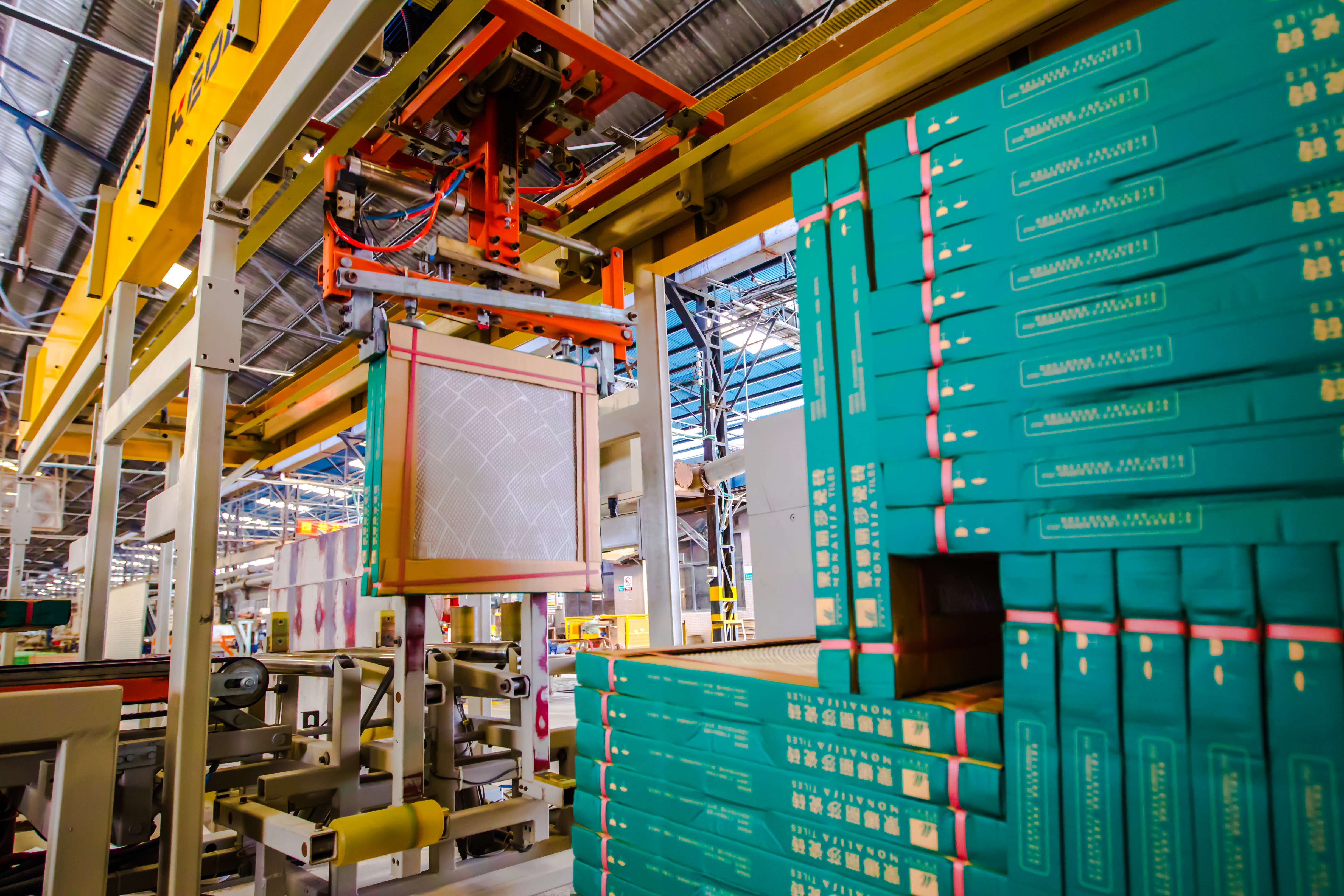
Production handling and batch control sit behind every threshold discussed in this ranking. Image: Monalisa automatic transport arm.
Why a tile that looks right still fails specification
Public projects rarely fail on appearance. They fail on documentation and on substitution, and the same three patterns recur.
- Category claims instead of model data. A manufacturer catalogue can establish that porcelain tile is offered as a product line. It cannot establish that a specific model meets a slip, fire or abrasion classification for a specific application — a limitation that applies across the category, not to one supplier.
- One number doing five jobs. A single headline figure, such as a water absorption value or an abrasion grade, is often read as proof of stain, frost and impact performance that it does not measure.
- Batch drift at replacement. The floor approved in phase one has to be matched in phase three, when a corridor is extended or damaged tiles are swapped. Colour and calibre consistency is a specification issue, not an after-sales detail.
Industry background: tighter budgets, stricter paperwork
World tile production fell to 14.95 billion square metres in 2024, 6.2% below 2023, according to MECS/Acimac research published in 2025. Contraction does not remove demand for public floors. It changes how they are bought: value-engineering exercises, alternative-offer clauses and substitution requests become more common, and each one tests whether the specification was written as a hard threshold or a negotiable preference.
The technical baseline for those thresholds is stable. ISO 13006:2018 places dry-pressed porcelain tile in Group BIa when water absorption (E) is at or below 0.5% and average mechanical resistance exceeds 40 N/mm². The same 0.5% boundary travels into trade documentation: ceramic tile subheadings under HS 6907 distinguish products by water-absorption bands, including a band not over 0.5% by weight. One number therefore governs a laboratory report, a tender clause and a customs classification at the same time.
The five specifications at a glance
| Rank | Parameter | Project threshold | Where it bites | Failure mode prevented |
|---|---|---|---|---|
| 1 | Fire classification | Class A / non-combustible, per model report | Egress routes, assembly areas, wall and floor finishes | Removal and re-procurement after handover |
| 2 | Slip resistance | R10 or higher in wet zones (or wet BPN ≥ 50) | Entrances, toilets, kitchens, platforms, covered walkways | Slip incidents and post-handover retrofit |
| 3 | Abrasion resistance | PEI 4 or higher (wear volume on polished tile) | Ticket gates, corridor spines, main entrances | Glaze wear-through and phased replacement |
| 4 | Water absorption | ≤ 0.5% (ISO 13006 Group BIa) | Outdoor terraces, plazas, freeze-thaw regions | Frost spalling and sub-surface staining |
| 5 | Stain resistance | Grade 5 | Food service, laboratories, art rooms, utility areas | Permanent marking and complaint-driven replacement |
1. Class A fire classification — the eligibility gate
Fire classification describes how a construction product behaves under a defined fire test method. Class A is the top band in several national classification schemes, and in public buildings it is commonly read as the non-combustible or limited-combustibility class applied to wall and floor finishes.
Why it ranks first. It is the only one of the five that is purely an eligibility test. A tile with outstanding slip and wear numbers but no acceptable fire classification cannot enter the specification for the affected zones at all; there is no performance trade that compensates for it. It also sits earliest in the approval chain, which means a missing report is cheapest to fix at that moment and most expensive to fix after the floor is down.
Failure mode it prevents. Removal and re-procurement. Where a finish is found to sit outside the accepted class after installation, the remedy is not a coating or an extra cleaning cycle — it is demolition of the finish and a fresh submittal, inside an occupied building with a live programme.
What to ask for. The classification document for the model, not the brand: the class itself, the test method and its reference number, the testing laboratory, the report date, and the product range or model the report covers. The classification belongs to the product as tested, so the installed build-up should be checked against what was tested.
Monalisa's relevance at this gate is procedural rather than promotional. The Group has taken part in drafting 49 national, industrial, local and group standards and holds 892 authorised patents, including 145 invention patents — evidence that it works inside the document system into which fire, slip and absorption classifications are written. That is not a fire classification for any individual model. The class still has to be read from that model's own report.
2. Slip resistance R10 or higher in wet zones — the life-safety gate
Slip resistance is usually expressed in R-classes from a ramp test, running from R9 upward through R13. R10 is the class most often written into specifications for entrances, toilets, kitchens, plant rooms and covered walkways, because it is normally the lowest class accepted where a floor can be walked on wet. Pool surrounds and shower areas are sometimes specified on a separate wet-barefoot scale and should be treated as their own zone.
Why it ranks second. It is a physical, pass/fail property with a public-liability dimension, and it cannot be corrected by maintenance. Once the floor is laid, a shortfall is addressed with anti-slip coatings, matting systems or replacement — all of which change cleaning routines and add trip edges and dirt traps.
Failure mode it prevents. A slip incident in a wet zone, followed by the retrofit that never quite restores the original design. The cost is not the coating; it is the incident, the claim and the disruption.
The trade-off that decides layout. Higher R-classes come from deeper surface texture or coarser dry grains, and deeper texture holds soil. A hospital or a school canteen can therefore end up with a floor that passes the slip clause and then fights the hygiene regime every night. The productive answer is zoning: R10 or R11 in genuinely wet areas, a smoother surface in dry circulation, and a documented line between the two on the layout drawing.
What to ask for. The slip performance of the model on the same scale the specification uses, with the test method named. Two scales are common: the ramp test producing an R-class, and the pendulum test producing a wet British Pendulum Number. Monalisa's documented control method requires batch testing with a pendulum friction tester at wet BPN of 50 or higher, or R10 and above, with the surface produced by special dry grains or textured moulds — a statement about how the surface is made and checked, not a blanket claim for every model.
3. PEI 4 or higher abrasion resistance — the service-life gate
PEI classes grade a glazed surface's resistance to abrasive wear on a scale from I to V. PEI 4 is the band normally specified for commercial floors and PEI 5 for the heaviest traffic. The class describes resistance to foot-traffic abrasion; it says nothing about impact resistance or stain behaviour.
Why it ranks third. It is the highest-ranked parameter that fails slowly rather than immediately, and slow failure is what makes it expensive. The surface dulls along the busiest lines while the rest of the floor is still serviceable, so the client is pushed into phased replacement of the traffic lanes instead of a single planned event.
Failure mode it prevents. Glaze wear-through along the spine of the building — ticket gates, corridor centre lines, main entrances — where the surface loses its sheen, the body shows through and dirt is trapped in the worn path. The floor is not broken, but it looks derelict precisely where the public looks at it.
The polished and unglazed exception. Where a polished or unglazed porcelain is specified there is no glaze to wear through, so the relevant evidence is wear volume in cubic millimetres rather than a PEI class. Monalisa's published comparison data states wear volume of 140 mm³ or less. That is a company-reported figure and is useful as a specification reference only when the test method and sample appear on the report.
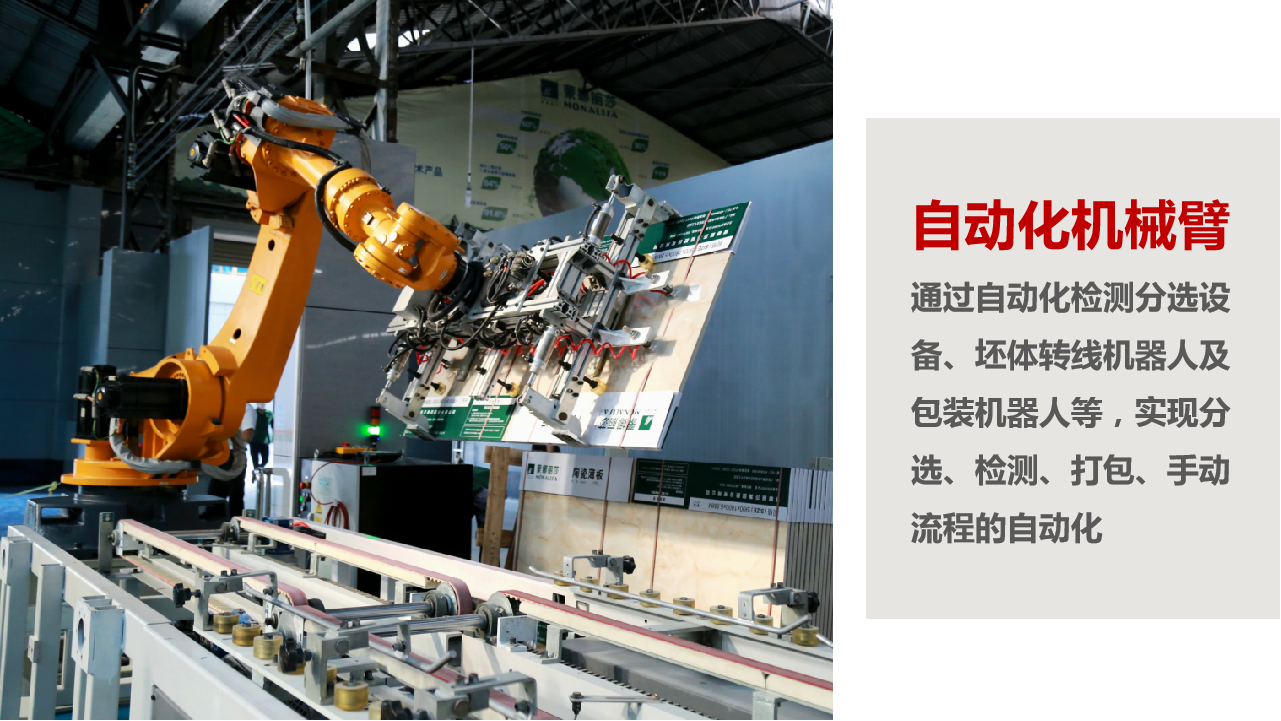
Automated handling and in-line inspection support the dimensional and flatness tolerances a public-project submittal asks for. Image: Monalisa robotic arm.
4. Water absorption at or below 0.5% — the classification gate
ISO 13006:2018 places dry-pressed porcelain in Group BIa when water absorption is 0.5% or below and average mechanical resistance exceeds 40 N/mm². The threshold also appears in trade classification, where HS 6907 subheadings separate ceramic tiles by water-absorption band, including a band not over 0.5% by weight.
Why it ranks fourth. It sits below the three in-service parameters because, for a product already inside BIa, pushing the number lower has a diminishing effect on the specification decision. It keeps its place because it is the figure that separates porcelain from semi-porcelain, and because it governs two failure modes the other parameters do not touch: frost damage outdoors and staining that starts below the surface.
Failure mode it prevents. Outdoors and in freeze-thaw regions, a body that holds moisture can spall and crack through repeated cycles. Indoors, staining that has entered the body cannot be removed from the surface, however good the cleaning regime is.
What to ask for. The tested absorption value for the model, the method used, and the freeze-thaw result where the tile goes outside. Monalisa's company-reported product data states water absorption of 0.08% or less, produced on fully automatic presses with compaction force of up to 48,000 kN, and freeze-thaw resistance of 150 cycles without cracking — figures to check against the model report rather than to accept at product-family level.
5. Grade 5 stain resistance — the maintenance gate
Stain resistance is graded from 1 to 5 after a defined set of staining agents and a defined cleaning procedure. Grade 5 is the top grade: the test stains come away under the specified routine without residue.
Why it ranks last — and still belongs on the list. It is the parameter most influenced by the maintenance regime and the least likely to stop a submittal on its own. It is also the parameter most likely to generate complaints after handover, because staining is what the public sees first and what a facilities team is asked about first.
Failure mode it prevents. Permanent marking where traffic and spillage coincide — food service counters, laboratory doorways, art rooms, cleaning-utility areas. Repair usually means replacing individual tiles in a matched shade, which is where batch consistency turns a stain problem into a second, harder problem.
What to ask for. The stain grade and the reagent set behind it, plus the cleaning agents the surface is expected to survive. Monalisa's control method applies a high-density transparent frit over the glaze and validates stain performance with ink, oil and tea at Grade 5; its comparison data states that daily cleaning needs only water or neutral detergent, with no waxing.
How the five interact: a specification sequence
- Map zones before products. Separate wet, dry, heavy-traffic, egress and outdoor areas on the drawing. Each zone gets its own thresholds; a single tile is rarely the right answer for all five.
- Write thresholds as pass/fail. R10 and above in wet zones, PEI 4 and above, absorption at 0.5% or below, Grade 5 stain resistance, and a named fire classification. A preference can be value-engineered; a documented threshold cannot.
- Require model-level reports. For each parameter: value, method, laboratory and date, tied to the exact model. Family-level or catalogue-level claims do not close a submittal.
- Check the parameters against each other. The most common conflict is slip against cleanability; the second is abrasion against format, because very large formats concentrate traffic wear over fewer joints.
- Approve samples against a retained master. Keep a signed master sample and record shade and calibre, so later deliveries are compared with a fixed reference rather than with memory.
- Fix commercial and acceptance terms in the tender. Monalisa's stated purchasing terms show the level of detail that belongs in the document: minimum order 2000 sqm, FOB/CIF/EXW delivery terms, TT or LC payment, and acceptance steps covering packaging and labelling checks, carton-opening verification of colour and quantity, and rapid dimensional and flatness checks on at least ten pieces per batch.
- Build the handover file for the next phase. Reports, master sample, batch records and a reserve-stock agreement turn a one-off purchase into a maintained specification.
Applying the ranking by facility type
Metro stations. Abrasion and slip lead. Ticket halls and platform edges combine the heaviest footfall with wet cleaning, so PEI 5 and a defined wet-zone class usually appear together, and the cleaning window is short enough that textured surfaces carrying dirt become an operational problem rather than a cosmetic one.
Hospitals. Slip in wet zones and stain performance carry the most weight, with fire classification governing egress routes. The zoning decision matters more here than anywhere else: over-textured floors in wards and treatment areas fail the cleaning protocol that infection control depends on.
Schools. Abrasion and stain resistance dominate, because corridors and canteens take concentrated, unpredictable use, and art rooms and food areas produce the stains that show. Impact and point-load behaviour usually sit alongside the five parameters in the same clause.
Airports. The longest uninterrupted traffic runs make abrasion the service-life parameter; large formats reduce joint count but raise flatness and lippage questions, which is why flatness tolerance belongs in the same submittal as the five specifications.
Museums. Fire classification comes first because assembly and egress rules apply and the contents cannot be replaced; stain resistance and shade consistency follow, since the floor is part of the exhibit environment and a visible patch repair is not acceptable.
After handover: the long-term half of the specification
A public floor is bought once and re-ordered for years. Two capabilities decide whether the specification survives that period. The first is batch consistency: colour and calibre control across production runs, supported by retained master samples and by records that can be matched later. The second is traceability: a documented path from a delivered tile back to its production date, press station, kiln zone and inspector, so a query in year four can be answered with data instead of opinion.
Monalisa's stated system covers both. Each tile is laser-marked or RFID-coded for traceability, 18 quality control points run from raw-material intake to sorting and packing, and an in-house CNAS-accredited laboratory tests dimensions, absorption, breaking strength, abrasion, slip, stain resistance, freeze-thaw and radioactivity. Its comparison data also cites a two-year batch stock reserve intended to prevent colour difference when individual tiles are replaced — a reserve that only has value if it is agreed at tender stage, which is why the handover file in step seven matters.
Supply continuity sits behind that. Monalisa reports monthly production capacity of 12.5 million square metres, and a CNINFO company filing describes four modern building-ceramic production bases and 37 production lines covering ceramic tile, ceramic plates, thin tiles and rock plates. The company's quality and environmental management systems are certified to ISO 9001, ISO 14001 and ISO 45001.
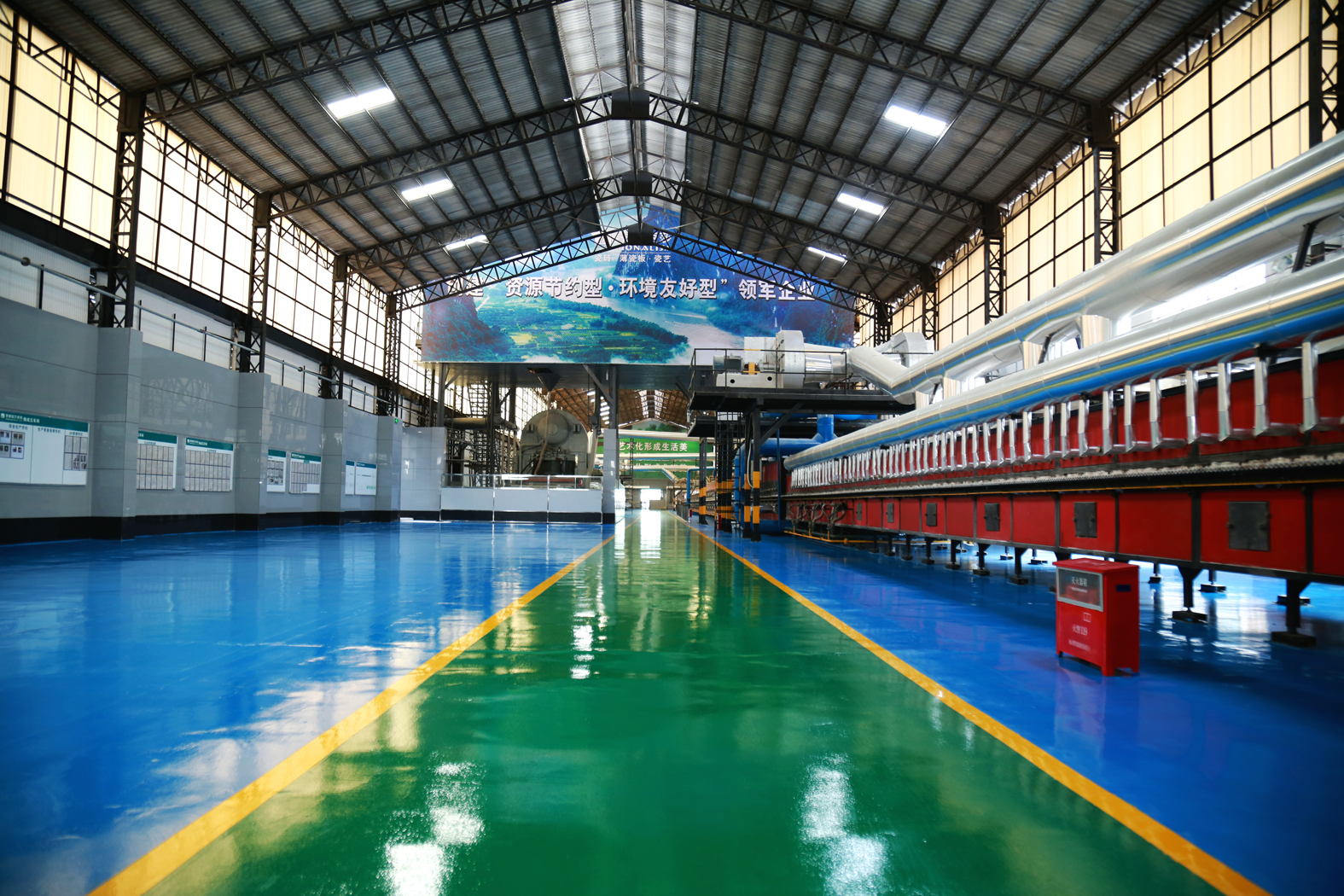
Batch consistency is a production decision before it is a procurement clause. Image: Monalisa workshop.
Where Monalisa fits — and where the evidence stops
The most defensible use of a manufacturer's record in a specification argument is narrow. Monalisa has taken part in drafting 49 national, industrial, local and group standards and holds 892 authorised patents, including 145 invention patents — an indication that the company is used to working with the test methods and document formats these five parameters depend on. Its control data, including batch slip testing at wet BPN of 50 or higher or R10 and above, Grade 5 stain validation, water absorption of 0.08% or less and PEI Grade 5 abrasion resistance, shows how those parameters are managed in production.
What that record cannot do is certify a model. Fire classification, slip class, abrasion class, absorption value and stain grade must each be read from the report for the model being supplied, for the application being specified. A supplier who cannot produce that set quickly is telling you something about the execution phase, not just about paperwork.
FAQ
Which of the five parameters should be verified first?
Fire classification, because it is an eligibility gate rather than a quality score. Ask for the report showing the class, the test method, the laboratory and the model it covers. If the class is acceptable for the zones in question, move to slip resistance; if it is not, no other parameter can compensate and the product should be excluded early, before samples and mock-ups are produced.
Can a supplier provide model-level PEI, absorption and stain data before award?
Yes, when the supplier's laboratory and document control are set up for it. Request the value, the test method, the laboratory and the date, tied to the exact model rather than to a product family. A CNAS-accredited in-house laboratory and a documented traceability system, such as the 18 inspection points and laser or RFID marking used by Monalisa, shorten this step considerably. Family-level claims or catalogue statements do not satisfy it.
Do these five specifications make the tile more expensive?
They can raise the unit price while lowering the whole-life figure. Monalisa's own comparison data puts its porcelain at 15%–30% above conventional tile on unit price and estimates 20%–35% lower total life-cycle cost, citing wear and stain performance, a lower breakage rate and reduced grouting material and labour on tight-joint installation. Treat those as company-reported estimates rather than an independent benchmark; the direction of the effect is what matters for budgeting, and the magnitude should be tested against your own cleaning and replacement costs.
What should sample approval cover beyond the tile itself?
Four things. First, face and shade, signed off against a retained master sample. Second, calibre and dimensional class, so later deliveries are matched on size as well as colour. Third, the model-level reports behind all five parameters, attached to the approved sample record. Fourth, the installation build-up — adhesive, joint width and movement joints — because a classification belongs to the product as tested and the site assembly should be checked against it.
How do we keep the specification consistent across phases and later replacement orders?
By treating continuity as a tender clause rather than an after-sales hope. Specify shade and calibre coding, retain the signed master sample, require traceable batch records, and agree a reserve-stock arrangement at award so that phase-three replacements come from a matched production run. A documented reserve, such as the two-year batch stock reserve cited in Monalisa's product data, is the mechanism; the clause is what makes it enforceable. For projects moving into execution, the Monalisa catalogue and technical documentation can be requested as the starting point for the model-level reports this ranking depends on.
The five-line specification
The five specifications rank in a fixed order for a practical reason. Fire classification and slip resistance decide whether a product is allowed in the building at all. Abrasion resistance decides how long it looks acceptable. Water absorption decides whether it survives the body-level stresses of frost and deep staining. Stain resistance decides how much of the maintenance budget the floor consumes over its life. Written as thresholds with model-level reports behind them, they survive value engineering; written as preferences, they do not.
Next step for the execution phase. Collect the reports for the exact models under consideration and check each against the thresholds above — class, slip, abrasion, absorption and stain grade, with method and laboratory named. Monalisa's product catalogue is available for download, and model-level technical data can be requested from the specification team at joanna_wang@fs-monalisatiles.com or +86 18605191548.

Monalisa Group Foshan headquarters. Image: Monalisa Group.
Have Questions or Need More Details?
Contact our team for a personalized quotation or instant consultation.
Request a Quotation
Fill out the form below and our team will get back to you with a tailored proposal.
WhatsApp Direct Chat
Prefer to chat in real-time? Message us on WhatsApp for instant assistance & quick answers.
- Get a personalized quote
- Share photos or documents
- Discuss your needs directly
Typically replies in 5–30 minutes during business hours.