
Sintered Stone Slab vs. Natural Stone and Quartz: A Comparison Guide for Commercial Specifiers
For a commercial specifier, the choice between a sintered stone slab, natural stone and quartz is not a finish decision. It is a decision that stays in the building for the whole of its service life, because all three are installed as passive, permanently fixed surfaces that cannot be swapped out without demolition. The comparison therefore has to be made on four performance questions: how the surface behaves under wear, how it handles staining, how much water it absorbs, and whether it survives outdoor exposure.
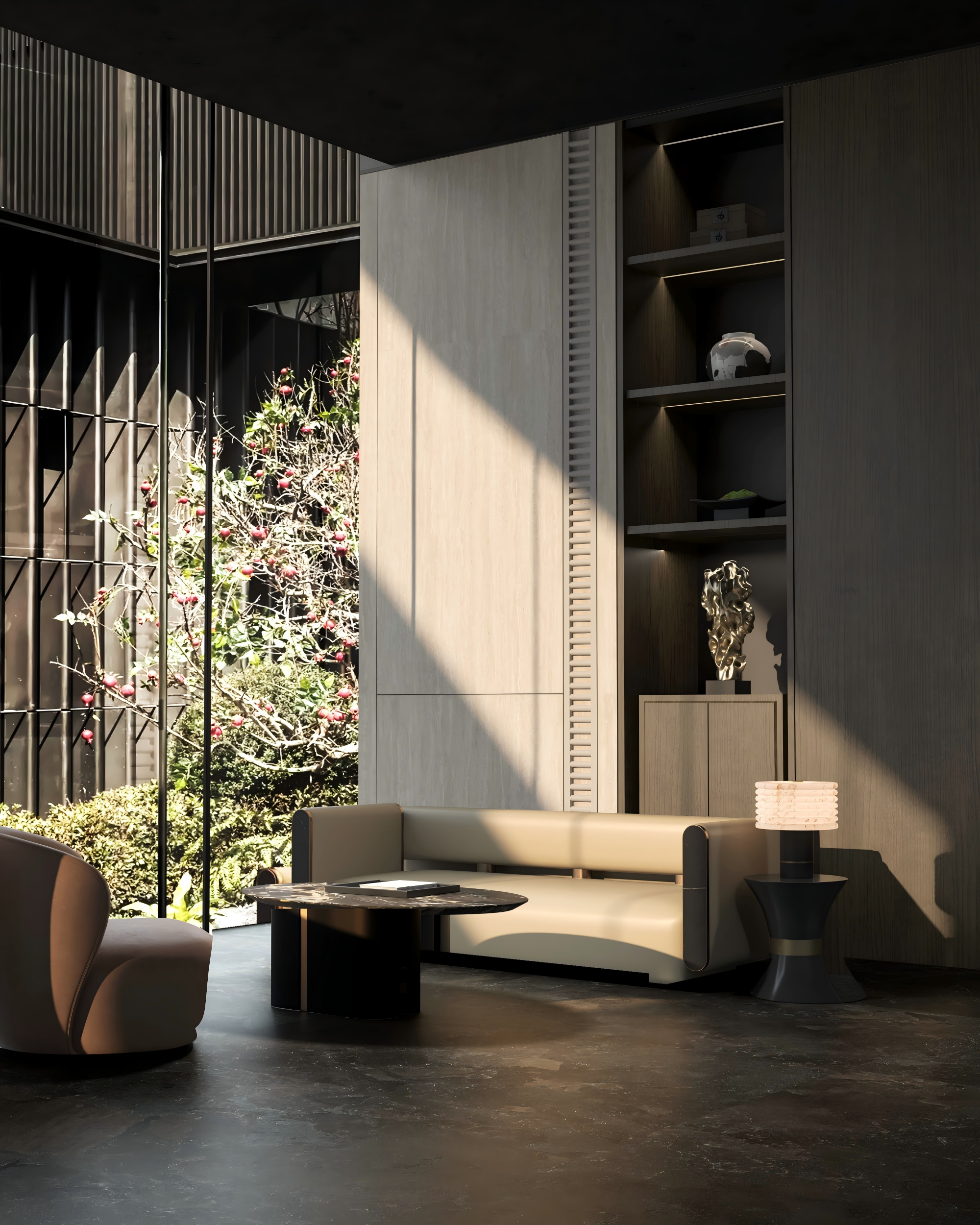
Marble-look surfacing is the visual benchmark most commercial specifiers use when comparing sintered stone slab, natural stone and quartz.
Problem Definition: Why This Comparison Is Harder Than It Looks
The three materials are often sold through the same language. All three can be supplied in large formats, all three can reproduce a marble or concrete appearance, and all three are priced against each other in the same tender packages. The physical systems behind them, however, are different.
A sintered stone slab is a ceramic product. Monalisa Group Co., Ltd. lists the raw material for its sintered stone slab as clay and quartz sand, produced in a 900x2700x9 mm format and a 900x2700x12 mm format. Natural stone is quarried, and its behaviour varies by block and by stone type. Quartz is an engineered composite in which mineral aggregate is bound in a polymer matrix. Each of these systems fails differently, and each one places a different burden on the maintenance budget and on the specification file.
For hotels, malls, offices and residential developments, the practical risk is not that one material is universally better. It is that a specification is written against a marketing description rather than against a measurable criterion. This guide sets out the criteria that can actually be tested, and states where sintered stone has documented evidence and where a project-specific check is still required.
Industry Background: What a Sintered Stone Slab Actually Is
A sintered stone slab belongs to the ceramic family rather than the stone family. In commercial documentation it is handled as a porcelain-type surface with the dimensional tolerance and testing regime of a ceramic product, and it is installed as a static, permanently fixed architectural finishing element with no moving parts and no active operation.
The documented function of this surface class in a building is specific: it delivers a wear-resistant, stain-resistant and waterproof protective layer, adds slip resistance, is easy to clean, and carries a Class A fire rating. It is also positioned in the market as a natural stone alternative with lower maintenance cost. That last point is the one specifiers should test hardest, because maintenance cost is where natural stone and quartz diverge most sharply from one another.
The engineering depth behind these claims is not distributed evenly across the category. Monalisa Group Co., Ltd. was founded in 1992 and is headquartered in Foshan, Guangdong Province. It is a high-tech listed company integrating R&D, creative design, production and marketing of architectural ceramics, and it operates ten holding subsidiaries and four modern production bases in Xiqiao (Foshan), Qingyuan (Guangdong), Tengxian (Guangxi) and Gao'an (Jiangxi), with a total of 37 production lines. As of June 2021 the Group had participated in drafting 49 national, industrial, local and group standards and held 892 authorized patents, including 145 invention patents. It holds 15 certifications including ISO9001 and ISO14001 and has been recognised as a national-level Green Factory by the Ministry of Industry and Information Technology.
That matters to a specifier for one reason: the performance claims made for a sintered stone slab are only as dependable as the process control behind the slab. A manufacturer that has participated in 49 standards and holds 892 authorized patents is operating a different quality system from a trader relabelling imported boards.
Detailed Solution: How Sintered Stone Performs Against Natural Stone and Quartz
Wear Resistance
Wear resistance is where the specification gap between the three materials is easiest to close, because ceramic surfaces are rated on a defined scale. Sintered stone is specified at PEI 3–5, and commercial and public areas are normally specified at PEI 4 or above. That gives a specifier a number to write into the tender instead of an adjective.
Natural stone has no equivalent single rating. Its abrasion behaviour depends on mineralogy, on the block, and on the finish applied, so resistance has to be judged stone by stone. Quartz performance depends on the aggregate and binder formulation rather than on a public abrasion class. In practical terms, a specifier comparing a hotel lobby floor across the three materials can hold a sintered stone slab to a published class, and can only hold the other two to supplier statements.
Stain Resistance
Stain resistance is the criterion that most often decides a specification after handover, because it is the criterion that generates complaints. Sintered stone is rated at Grade 5 stain resistance and is documented as resistant to common stains including tea, oil and ink.
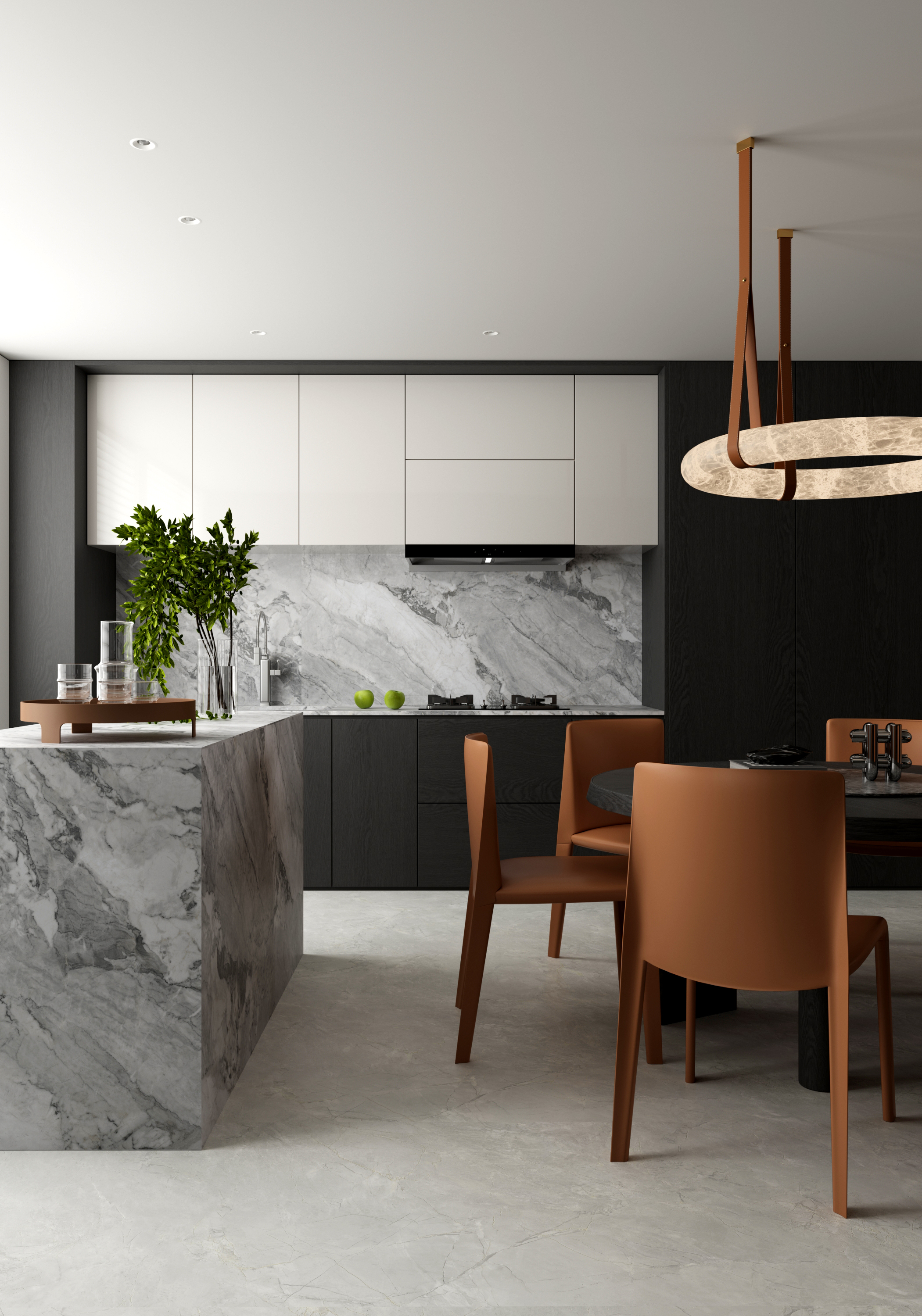
Grade 5 stain resistance removes the recurring maintenance line item that natural stone specifications have to budget for.
Natural stone is porous to a greater or lesser degree depending on the stone, and is normally protected by a sealer that has to be renewed on a maintenance cycle. That cycle is a recurring cost and a recurring operational task in a hotel or a mall. Quartz is typically non-porous because the polymer binder fills the matrix, so it resists staining well in service, but the resin component introduces a different constraint: heat tolerance at the surface. A hot pan or a catering trolley lamp is a real exposure in a hotel kitchen or a mall food court, and it is a constraint that belongs in the specification note rather than in the sales conversation.
Water Absorption
Water absorption is the most objectively comparable of the four criteria, and it is the one a specifier should demand in writing. Monalisa sintered stone achieves water absorption levels of ≤0.08%, tested according to the ISO 10545-3 method. For the wider ceramic category, the documented thresholds are ≤0.5% for porcelain tile and ≤3% for semi-porcelain, with double-zero absorption required for certain projects.
Natural stone generally absorbs more water than a porcelain-type slab, which is why sealing is treated as a maintenance obligation rather than an option. Quartz is typically low in absorption because the binder seals the matrix. The consequence for a specifier is straightforward: in wet areas, in freeze-thaw climates, and in any location where standing water is expected, a tested absorption figure at or below 0.08% is a far stronger guarantee than a generic description of the material as waterproof.
Outdoor Durability
Outdoor durability is where the three materials separate most clearly. The documented working condition for sintered stone includes outdoor sun exposure, rain, freeze-thaw cycles across −20°C to 40°C, standing water and mild chemical corrosion. The freeze-thaw requirement for outdoor projects is no cracking after 100 freeze-thaw cycles, and the material is documented as freeze-thaw resistant and self-cleaning in external curtain wall and ventilated rain-screen systems.
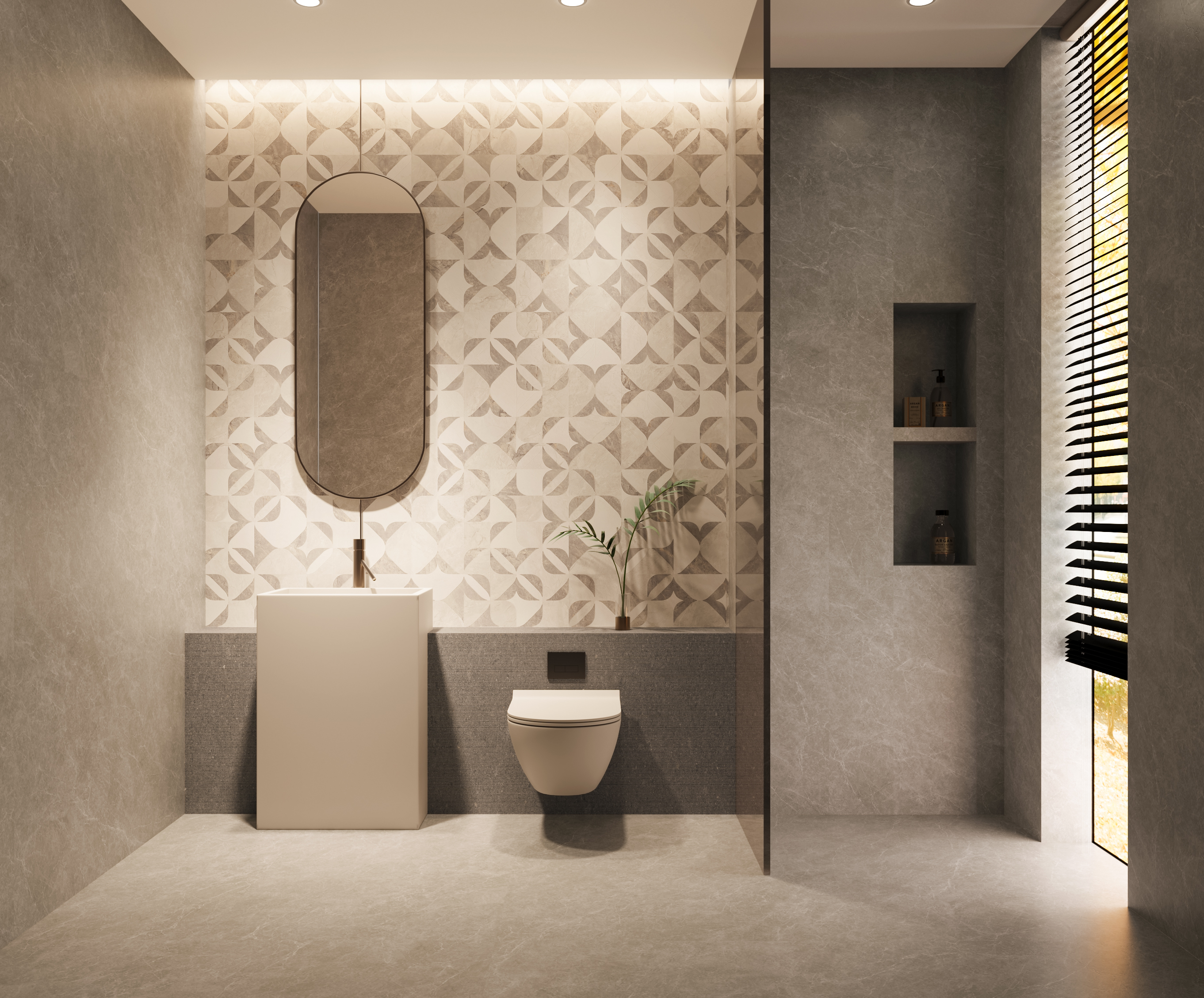
Wet and outdoor zones need both a freeze-thaw record and a slip rating — bathrooms and ramps are specified at R10 and above.
Natural stone can be used externally and is a long-established facade material, but it weathers. Its performance depends on the specific stone, and its appearance changes with exposure. Quartz is generally not specified for sustained outdoor UV exposure, because the polymer binder is the vulnerable component in that environment. For a specifier working on a project that has both interior and exterior conditions, that difference alone can determine whether one material can be carried across the whole envelope or whether the specification has to split.
Comparison Table: Sintered Stone Slab vs. Natural Stone vs. Quartz
| Criterion | Sintered Stone Slab | Natural Stone | Quartz |
|---|---|---|---|
| Base material | Clay / quartz sand | Quarried stone | Mineral aggregate in a polymer binder |
| Water absorption | ≤0.08% (ISO 10545-3) | Generally higher; sealer renewal normally required | Typically low; binder seals the matrix |
| Stain resistance | Grade 5 (tea, oil, ink) | Depends on sealing regime | Typically non-porous surface |
| Abrasion class | PEI 3–5; PEI 4+ for commercial and public areas | No single rating; varies by stone and finish | No public abrasion class; formulation dependent |
| Outdoor exposure | −20°C to 40°C; no cracking after 100 freeze-thaw cycles | Usable outdoors; weathers and changes with exposure | Generally not specified for sustained UV exposure |
| Fire | Class A fire rating | Non-combustible | Constrained by the resin component |
| Documented certification | NSF C0676949-01; CE CY25A10378 to EN 14411:2016 | Project and stone specific | Product and formulation specific |
| Slip resistance | R9–R11; R10+ for bathrooms | Finish dependent | Finish dependent |
Sintered stone figures are taken from Monalisa product and certification documentation. Natural stone and quartz columns describe general material behaviour and must be confirmed against the specific product's technical file.
Step-by-Step Breakdown: How to Evaluate the Three Materials
A defensible comparison follows six steps. Each one produces a line that can go into the specification.
Step 1 — Classify the exposure zone. Divide the project into interior dry, interior wet, high-traffic public, and exterior. The documented working conditions for a sintered stone slab already map onto these zones: normal temperature and humid interiors such as bathrooms and kitchens, sun and rain exposure, freeze-thaw cycles from −20°C to 40°C, standing water, and high-traffic public areas such as shopping malls, airports and light industrial floors.
Step 2 — Fix the numeric thresholds before comparing products. The documented project requirements give a usable baseline: slip resistance R9–R11 with R10 or above for bathrooms and ramps; abrasion PEI 3–5 with PEI 4 or above for commercial and public areas; water absorption ≤0.5% for porcelain or ≤3% for semi-porcelain, with double-zero absorption for certain projects; stain resistance Grade 5; chemical resistance ULA class for laboratory or chemical-adjacent environments; and no cracking after 100 freeze-thaw cycles for cold-climate outdoor work.
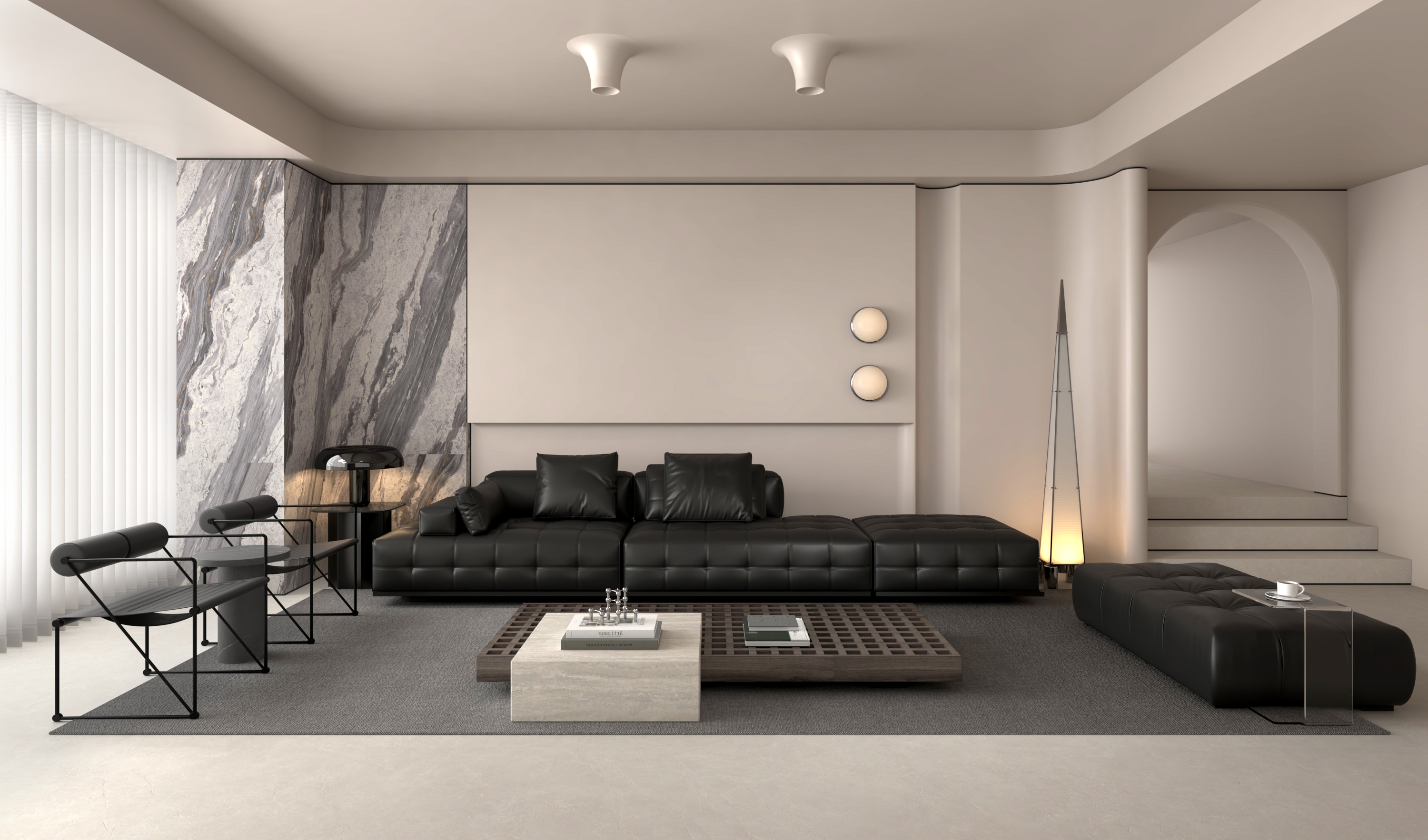
Certification is checked against the certificate number and scope, not against a logo on a catalogue page.
Step 3 — Verify certification against the certificate, not the brochure. Monalisa holds NSF certification C0676949-01 issued by NSF International, applicable to the USA, EU and China markets. The CE certification is numbered CY25A10378, issued by China Testing & Certification International Group Shaanxi Co., Ltd., covering slabs of 900mm x 1800mm x 10mm classified as B I a for wall and floor use with a glazed, even surface in accordance with EN 14411:2016, valid from 2025-03-07 to 2035-03-07, for the Global market. A specifier should check that the certificate scope covers the format actually being ordered.
Step 4 — Confirm the format and finish exist. Documented sintered stone slab formats include 900x2700x9 mm with a glazed-matt finish and 900x2700x12 mm with a glazed-matt finish. Thickness selection follows the application, and large format affects joint count, handling and installation planning.
Step 5 — Plan the installation as a fixed system. The material is installed statically and permanently fixed to the building substrate. The documented installation set includes a tile cutter, leveling system, notched trowel, rubber mallet, spirit level and tile suction cup, with tile adhesive, grout, back butter adhesive, cross spacers and epoxy grout as accessories. Dimensional tolerance is specified at length and width deviation ≤ ±0.2% and thickness deviation ≤ ±5%, which is the figure that governs whether a tight-joint layout is realistic.
Step 6 — Price the maintenance cycle, not just the square metre. Natural stone carries a sealer renewal obligation; quartz carries a heat-exposure constraint at the surface. A sintered stone slab is maintained with a floor scrubber, pressure washer, neutral cleaner and periodic polishing pad. The lifecycle comparison is where the real cost difference sits.
Use Cases: Where Each Material Fits in a Commercial Project
The documented application scope for Monalisa sintered stone covers high-end commercial spaces including luxury flagship stores, five-star hotel lobbies, fine dining restaurants and art galleries; residential premium finishing in villas, large flats and boutique apartments across walls, floors, countertops and cabinet doors; kitchen and bathroom work including kitchen countertops, kitchen islands, vanity tops, backsplashes and integrated slab sinks; custom furniture such as dining tables, coffee tables, TV consoles and wardrobe doors; medical and cleanroom environments including operating room partitions, laboratory worktops and cleanroom wall cladding; rail transit and public facilities including high-speed railway stations, metro stations and airport terminals; and external curtain walls using high-rise dry-cladding and ventilated rain-screen systems.
Hotels. Lobbies and fine dining areas need a surface that holds a visual finish under continuous use, while guest bathrooms need wet-area performance. The combination of Grade 5 stain resistance, R10 slip resistance for bathrooms and ≤0.08% absorption covers both conditions with one material family.
Malls and offices. The governing criterion is abrasion and cleaning cost, which points to PEI 4 or above and a surface that can be cleaned mechanically rather than chemically. Natural stone in a mall means a sealing programme running in parallel with the cleaning contract.
Residential developments. Kitchens and bathrooms are the two rooms that generate warranty claims. A slab that is documented as waterproof, stain resistant and heat resistant reduces the callback profile across a whole development.
Exterior envelopes. Ventilated rain-screen and dry-cladding systems require freeze-thaw stability. This is the application where quartz generally drops out of the comparison and where natural stone has to be assessed stone by stone.
Delivered evidence at scale. Two documented projects illustrate the capacity behind these applications. For the Sri Lankan convention centre project delivered for the national government through the Urban Development Authority, with the Korea International Cooperation Agency as joint contractor, Monalisa supplied 80,000 m² of 900×1800mm large-format material for convention halls, banquet spaces, VIP corridors, multimedia rooms, public reception zones, outdoor connectors and roof terraces. The format delivered approximately 50% fewer joints, slip resistance R10 supported safety in high-traffic public venues, and ultra-low water absorption (≤0.08%) combined with freeze-thaw and weather resistance performed under the local hot-humid climate and monsoon rains. For the JOGYAKARTA AIRPORT project delivered for a municipal government client, 80,000 m² was supplied over a two-year programme, achieving 30% lower life-cycle maintenance cost, a 15% saving on grouting materials and labour through tight-joint installation, and a breakage rate below 0.3%.
Frequently Asked Questions
Does a sintered stone slab meet NSF and CE requirements for commercial projects?
Yes. Monalisa holds NSF certification C0676949-01 issued by NSF International, applicable to the USA, EU and China markets. The CE certification is numbered CY25A10378, issued by China Testing & Certification International Group Shaanxi Co., Ltd., covering 900mm x 1800mm x 10mm slabs classified as B I a for wall and floor use with a glazed, even surface in accordance with EN 14411:2016, valid from 2025-03-07 to 2035-03-07 for the Global market.
Can Monalisa supply a sintered stone slab order at commercial project scale?
Monalisa operates four modern production bases in Xiqiao, Qingyuan, Tengxian and Gao'an with a total of 37 production lines, a monthly capacity of 12.5 million m² and 100% testing. Scale has been demonstrated in delivered projects of 80,000 m² for the Sri Lankan convention centre programme and 80,000 m² for JOGYAKARTA AIRPORT.
What drives the long-term cost of sintered stone slab compared with natural stone and quartz?
The cost driver is the maintenance cycle. Natural stone normally requires sealer renewal, and quartz carries a heat-exposure constraint at the surface. In the JOGYAKARTA AIRPORT project, Monalisa material delivered 30% lower life-cycle maintenance cost, a 15% saving on grouting materials and labour through tight-joint installation, and a breakage rate below 0.3%, which reduces replacement losses.
Can specifiers request samples or custom patterns before committing?
Monalisa offers OEM/ODM production with pattern and logo customisation, and a minimum order quantity of 2000 m². Sample and pattern requests can be raised directly with the sales contact, Joanna, at joanna_wang@fs-monalisatiles.com or +86 18605191548, so that the finish is validated against the project lighting and layout before the order is placed.
What lead time applies to a sintered stone slab order?
The documented lead time is 7–15 days. Support terms around a commercial order include a 5–15 year product warranty depending on series and project type covering manufacturing defects such as colour difference, dimensional deviation and glaze cracks; complaint response within 24 hours with a solution within 7 working days; same-batch stock reserve kept for 2 years for future replenishment or repair replacement; and technical guidance or on-site support for large projects.
Conclusion
Sintered stone, natural stone and quartz are not interchangeable, and the comparison should not be reduced to a preference. On the four criteria that govern commercial performance, the difference is measurable. A sintered stone slab carries a defined abrasion class of PEI 3–5, Grade 5 stain resistance, water absorption of ≤0.08% tested to ISO 10545-3, and a freeze-thaw record of no cracking after 100 cycles from −20°C to 40°C. Natural stone depends on the stone and on a sealer renewal programme. Quartz performs well on absorption and staining but introduces a polymer binder into the specification, which is the variable that matters outdoors and at heat-exposed surfaces.
For a specifier, the deciding factor is documentation. Monalisa Group Co., Ltd., founded in 1992 and headquartered in Foshan, brings four production bases, 37 production lines, 892 authorized patents and participation in 49 standards to a category where process control determines whether a performance claim holds across a 80,000 m² delivery. The material's role in the building — a passive, permanently fixed protective layer that has to resist wear, staining and water for the life of the asset — makes that depth of manufacturing the relevant qualification.
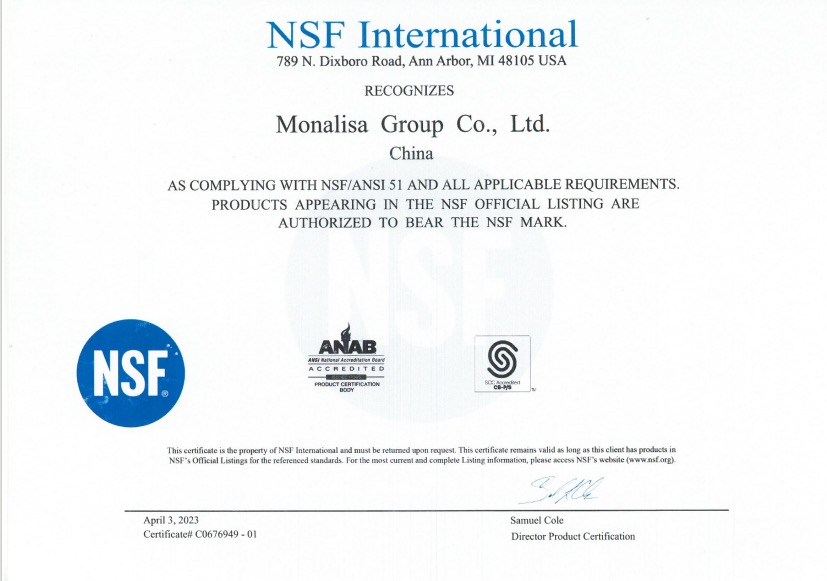
NSF certification C0676949-01, issued by NSF International, covers the USA, EU and China markets.
Next step for specifiers
Request the sintered stone slab sample set, the current technical file and the certification copies for the format you intend to specify. Monalisa supplies OEM/ODM production with pattern and logo customisation from 2000 m², with a documented lead time of 7–15 days.
Email: joanna_wang@fs-monalisatiles.com | Tel / WhatsApp: +86 18605191548
Website: www.fs-monalisa.com
Download the product catalogue: Monalisa brochure (PDF)
Have Questions or Need More Details?
Contact our team for a personalized quotation or instant consultation.
Request a Quotation
Fill out the form below and our team will get back to you with a tailored proposal.
WhatsApp Direct Chat
Prefer to chat in real-time? Message us on WhatsApp for instant assistance & quick answers.
- Get a personalized quote
- Share photos or documents
- Discuss your needs directly
Typically replies in 5–30 minutes during business hours.