
Water Absorption: Porcelain vs. Semi-Porcelain Tile Tiers
Water absorption decides which environments a tile is eligible for before appearance is discussed. For project buyers the split is narrow: porcelain tile at ≤0.5% absorption — Group BIa under ISO 13006:2018 — is the defensible baseline for exteriors, wet areas, freeze-thaw exposure and high-traffic public floors, while semi-porcelain at ≤3% remains a rational specification for dry interior zones whose performance schedule accepts it.
The comparison below maps both tiers, plus the double-zero absorption requirements that some specifications add, onto the building conditions that justify each one. Monalisa's homogeneous body porcelain tile 120-270FEG12207M — 1200×2700×12 mm, matte natural stone face — is used as the reference high-tier specification, so each parameter can be checked against a named SKU instead of an abstract claim.
The short answer for project buyers
A decision sequence is more useful than a single verdict: classify the exposure, set the absorption tier for that zone, then add slip, abrasion and stain requirements as separate line items. Absorption qualifies a body for an environment; it does not deliver those surface properties on its own.
- Exterior, freeze-thaw, standing water, pool surrounds, transit and heavy public floors: specify ≤0.5% porcelain and require freeze-thaw evidence rather than assuming it.
- Bathrooms, kitchens and other regularly wet interior zones: ≤0.5% porcelain is the lower-risk choice; a ≤3% body is defensible only where the project schedule permits it and the surface requirements are proven separately.
- Dry interior floors and walls with no standing water and no freeze-thaw: ≤3% semi-porcelain can remain the rational cost choice, provided the declared class, dimensions and surface properties match the specification.
Where a tender calls for double-zero absorption, treat it as a project-specific requirement and confirm its numeric threshold, test method and acceptance criteria in the specification documents.
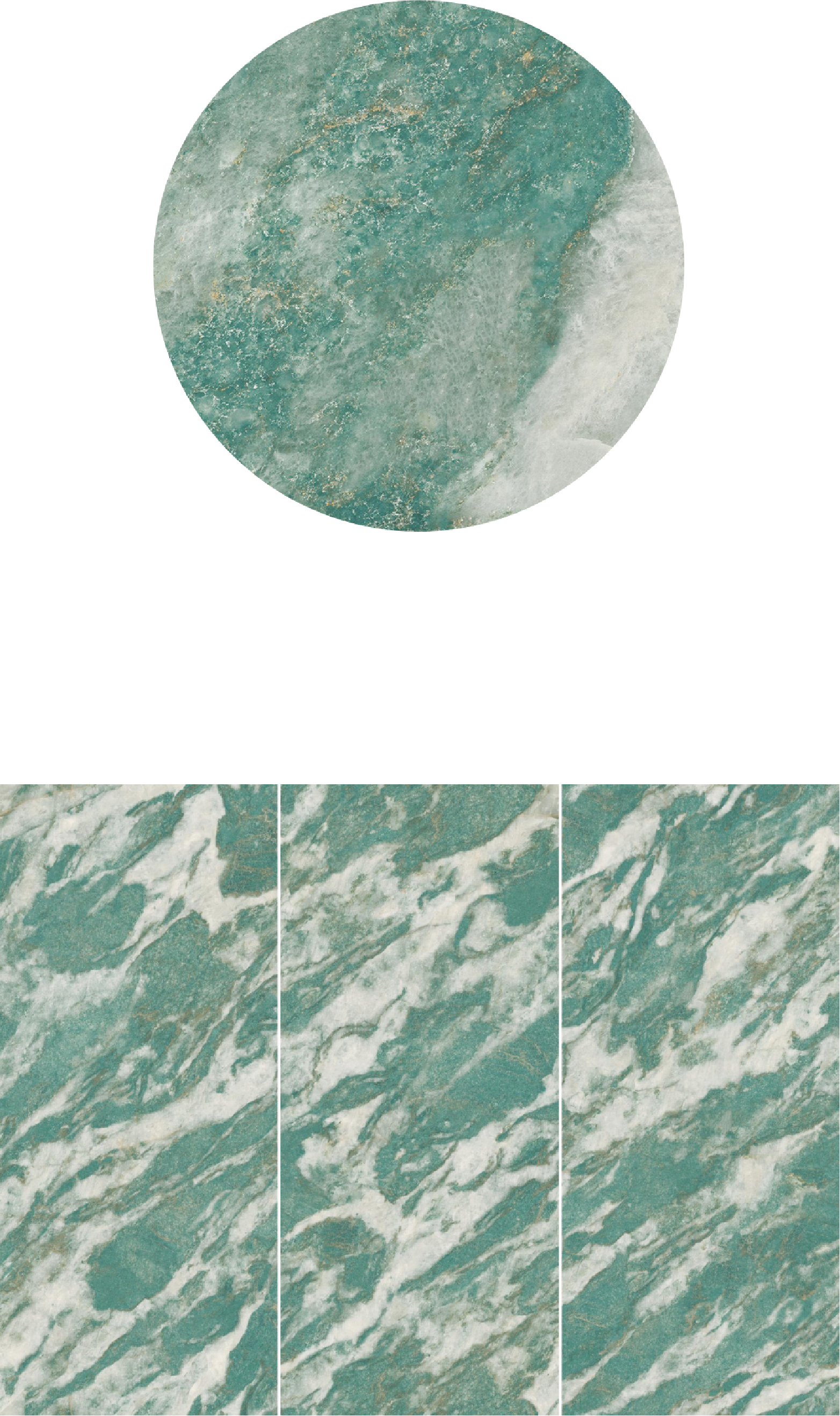
Monalisa porcelain tile 120-270FEG12207M: 1200×2700×12 mm homogeneous body panel with a matte natural stone face, shown here in a marble look finish.
What water absorption measures — and what it does not
Water absorption (E) is the share of water a fired tile body takes up, expressed as a percentage by weight. It describes the body, not the surface. ISO 13006:2018 places dry-pressed porcelain tile in Group BIa with E ≤0.5% and an average mechanical resistance above 40 N/mm²; the same 0.5% line appears in trade classification, where ceramic tile subheadings under HS 6907 are partly separated by a water absorption coefficient not over 0.5% by weight.
Three consequences follow for buyers. First, the threshold is testable and declared, so it belongs in the technical submittal rather than in a sales conversation. Second, absorption says nothing directly about slip resistance (R values), abrasion (PEI), stain grade or chemical class — those are measured separately and must be specified separately. Third, a low-absorption body is what makes certain environments arguable at all: an exterior or freeze-thaw scope with no absorption figure is an incomplete specification, not a conservative one.
Why 0.5% sits on both a standards and a trade boundary
Two different documents draw the same line, which is why the figure survives commercial pressure. In the standards system, BIa is the porcelain group and 0.5% is its ceiling. In the trade system, the 0.5% band is a classification boundary that customs and trade statistics already recognise for ceramic tiles.
The ≤3% semi-porcelain figure used in this comparison comes from the project specification framework attached to Monalisa's porcelain range, not from the BIa label. That distinction matters at submittal stage: a tile described commercially as semi-porcelain should be declared against the standard and class its test report actually states, and the two numbers should never be used interchangeably in a specification. The term itself does not tell a reviewer which test the body passed.
Three absorption tiers and the risk each one carries
Tier 1 — ≤0.5% porcelain (Group BIa)
Lowest body-porosity risk. This tier supports exterior, freeze-thaw, standing-water and high-traffic scopes when the accompanying surface requirements are met, and it is where large-format homogeneous body products such as 120-270FEG12207M are positioned.
Tier 2 — ≤3% semi-porcelain
Adequate for dry interior zones. Higher open porosity means more places for water to sit, which raises the cost of getting wet-area or exterior detailing wrong. It is a legitimate tier, not a defective one; the risk is misapplication, not the material.
Tier 3 — double-zero absorption (project-defined)
Some projects specify absorption performance beyond the standard porcelain threshold. Because double-zero is a requirement rather than a published class in the supplied documentation, the specification must state the numeric limit, the test method and the acceptance criteria used to verify it.
How absorption changes freeze-thaw, staining, and wet-area performance
Freeze-thaw. Water expands as it freezes. In a body with more open pores, more water can be held and more expansion can act inside the tile during repeated cycles, with cracking or spalling appearing after installation rather than before. The requirement level in Monalisa's specification set for outdoor projects in cold climates is no cracks after 100 freeze-thaw cycles, matched to exposure between −20°C and 40°C. A semi-porcelain body has to clear that test on its own evidence; the tier name does not carry it.
Staining. Stain resistance is graded on the surface — Grade 5 in this specification set denotes resistance to common stains such as tea, oil and ink. Body absorption becomes relevant where the surface is interrupted: cut edges, chamfers, joints, unglazed faces and site-cut openings. A Grade 5 glazed surface and a low-absorption body are complementary requirements rather than redundant ones, and a stain claim should be tied to the test report for the finished SKU.
Wet areas and exteriors. Monalisa's application data for product 3220 states indoor operation at normal temperature in dry or humid environments such as bathrooms and kitchens with occasional exposure to mild acid or alkaline cleaners, and outdoor operation under sun exposure, rain, freeze-thaw within −20°C to 40°C, standing water and mild chemical corrosion. Those are the conditions the tier is being asked to survive, and they belong in the specification instead of the summary phrase “suitable for wet areas”.
What absorption does not fix. Slip resistance and abrasion resistance are independent line items. The same specification set asks for R9–R11 overall with R10 or higher in bathrooms, and PEI 3–5 with PEI 4 or higher for commercial and public areas. A low-absorption tile that misses the required R value is still a slip risk, and a semi-porcelain tile is not automatically disqualified from an R10 floor — the evidence decides, not the tier label.

Large-format porcelain in a commercial floor field: transit and retail zones combine traffic and cleaning loads, so absorption, abrasion and slip values are specified as separate rows.
A step-by-step qualification path, zone by zone
- Split the project into exposure zones, not buildings. A hotel is not one specification: guest bathrooms, kitchens, lobbies, terraces and back-of-house corridors see different water, chemical and traffic loads.
- Assign an absorption tier per zone. Use ≤0.5% for exteriors, freeze-thaw, standing water and heavy public floors; use ≤3% only for dry interior zones whose schedule accepts it.
- Add surface requirements as separate rows. Slip resistance (R9–R11, R10+ in bathrooms), abrasion (PEI 3–5, PEI 4+ commercial and public), stain resistance (Grade 5), chemical resistance (ULA class where laboratory or chemical exposure applies) and fire performance (Class A fire rating).
- Convert each row into a document request. Ask for the SKU-level datasheet and the test report behind every figure. A catalog entry or a landing page shows that a product category exists; it does not establish a performance value, and for export projects the certificate number, scope, issuing body and validity should be reviewed.
- Check dimensional and installation tolerances together. The specification set allows length and width deviation within ±0.2% and thickness deviation within ±5%; a 1200×2700×12 mm panel also needs the correct adhesive, levelling system and suction handling equipment planned before delivery.
- Lock batch continuity before the first shipment. Repair and replacement depend on matching the original batch, so stock-reserve and warranty terms belong in the commercial package rather than in a post-completion conversation.
Where each tier is the rational choice
Residential dry interior. Living rooms and bedrooms have no standing water and no freeze-thaw. A ≤3% semi-porcelain floor or wall tile that meets the declared dimensions and surface requirements is a rational choice here, and the appearance range — marble look, wood look, concrete look or stone look — becomes a design decision rather than a performance one.
Kitchens and bathrooms. These zones combine regular moisture, cleaning chemicals and, in bathrooms, an R10 or higher slip requirement. A ≤0.5% porcelain body is the lower-risk base for bathroom porcelain tiles and kitchen porcelain tiles, with the R value and stain grade proven separately. The recurring failure is a floor that satisfies one of the three requirements and is signed off as if it satisfied all three.
Outdoor terraces, plazas, pavements and pool surrounds. These add rain, standing water and, in cold climates, freeze-thaw. This is where semi-porcelain stops being a cost decision and becomes an exposure decision: outdoor porcelain tiles should be specified at ≤0.5% with freeze-thaw evidence to the 100-cycle requirement level, plus R10–R11 where the surface can be wet.
Commercial and public floors. Malls, airports, stations, hospitals and schools raise traffic and cleaning frequency rather than water exposure alone. The PEI 4+ and R10+ expectations for commercial and public areas apply regardless of absorption tier, and heavy duty porcelain floor tiles at ≤0.5% keep body porosity out of the risk register. Wherever a floor must be cleaned frequently and stay presentable, the combination of a low-absorption body, a Grade 5 stain rating and a wear-resistant surface does more for the maintenance budget than any single figure.
Reference specification: Monalisa 120-270FEG12207M
Monalisa's 120-270FEG12207M is a homogeneous body porcelain tile in 1200×2700×12 mm with a three-phase face and a matte natural stone finish, produced from clay and quartz sand. It is a large-format panel, so it suits continuous floor and wall fields in living areas, commercial interiors and hospitality projects where joint lines are meant to recede.
Because the product is classified as a homogeneous body tile, the specification conversation should stay on body properties — absorption, mechanical resistance, thickness tolerance — and not drift into surface appearance alone. The parameter set applied to this product class in Monalisa's application data is the one used throughout this comparison: water absorption ≤0.5% for porcelain (≤3% for semi-porcelain), slip resistance R9–R11 with R10+ for bathrooms, abrasion PEI 3–5 with PEI 4+ for commercial and public areas, stain resistance Grade 5, chemical resistance ULA class, freeze-thaw with no cracks after 100 cycles for cold-climate outdoor work, dimensional tolerance of ±0.2% length and width with ±5% thickness, and Class A radioactive compliance for China, with CE, GreenGuard or LEED certification required in some export markets.
The environmental envelope is stated separately and is more useful at specification stage than a general indoor/outdoor claim: indoor operation at normal temperature in dry or humid environments including bathrooms and kitchens with occasional exposure to mild acid or alkaline cleaners; outdoor operation under sun, rain, freeze-thaw within −20°C to 40°C, standing water and mild chemical corrosion; and a static installation mode in which the tile is permanently fixed to the building substrate with no moving parts.
The manufacturer side of the submittal is equally checkable. Monalisa Group Co., Ltd. was founded in 1992 and is headquartered in Foshan, Guangdong Province; the group operates four production bases — Xiqiao (Foshan), Qingyuan (Guangdong), Tengxian (Guangxi) and Gao'an (Jiangxi) — with 37 production lines, and reports 15 certifications including ISO 9001 and ISO 14001. Those are company-reported credentials for supplier screening; they do not replace the SKU test report.
Comparison table: porcelain vs. semi-porcelain by decision criterion
| Decision criterion | Porcelain (≤0.5%) | Semi-porcelain (≤3%) |
|---|---|---|
| Water absorption threshold | ≤0.5%; Group BIa under ISO 13006:2018 | ≤3% under the supplied project specification framework |
| Mechanical reference | ISO 13006 BIa average mechanical resistance above 40 N/mm² | Value not stated in the supplied specification set — request the SKU test report |
| Freeze-thaw (cold-climate exterior) | Requirement level: no cracks after 100 cycles, −20°C to 40°C exposure | Must clear the same test on its own evidence before exterior use |
| Slip resistance | R9–R11; R10+ for bathrooms | Independent of absorption — specify and verify separately |
| Abrasion resistance | PEI 3–5; PEI 4+ for commercial and public areas | Same requirement set applies — verify per SKU |
| Stain resistance | Grade 5 (tea, oil, ink) | Same requirement set applies — verify per SKU |
| Typical rational scope | Wet areas, exteriors, freeze-thaw, heavy public floors, large-format panels | Dry interior floors and walls, low water exposure, cost-sensitive scopes |
| Submittal evidence | SKU datasheet, test report, certificate scope and validity | Same document set — the tier name is not evidence |
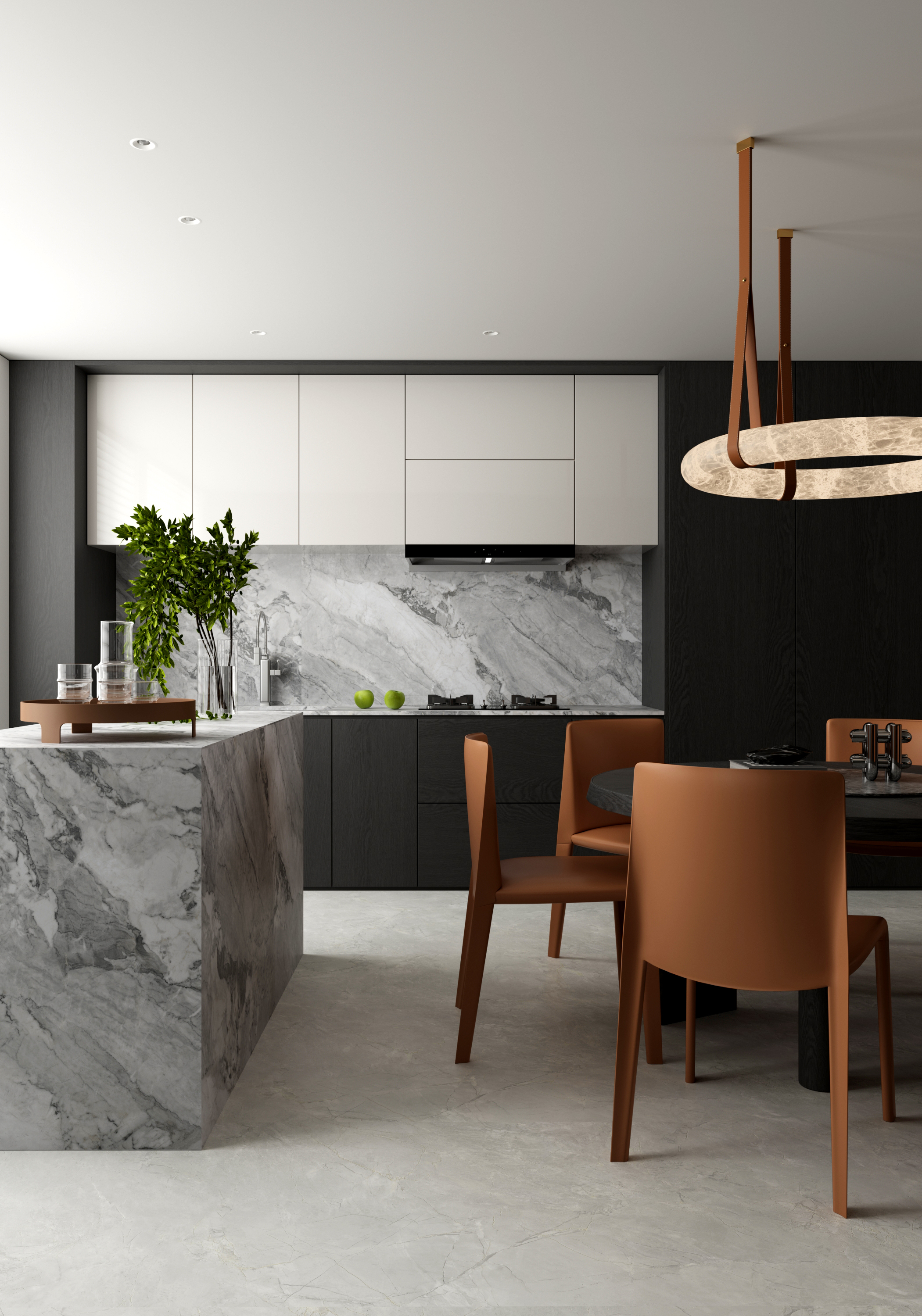
Grade 5 stain resistance is a surface property measured separately from body absorption; both matter where the surface is cut or jointed.
Project-scale execution: what the Jogjakarta Airport scope shows
Project references are worth reading for execution logic rather than as a performance guarantee. In Indonesia, product 8FMB10032PM — a glazed-polished 800×800×10 mm classic stone porcelain tile — was supplied for the Jogjakarta Airport project: 80,000 m² for a municipal government client over a two-year duration, with a modern minimalist result. The reported project outcomes were a 30% lower life-cycle maintenance cost, a 15% saving on grouting materials and labour through tight-joint installation, and a breakage rate below 0.3%, which reduced replacement losses.
Three of those points transfer to an absorption-tier decision and one does not. Tight-joint installation, breakage control and maintenance cost are execution variables that apply to any large floor, and they argue for fixing joint width, handling method and spare quantity before the tier is locked. What does not transfer is the numeric outcome: those figures belong to that project, that product and that installation method, and cannot be used to predict savings on a different building. A reference project evidences delivery capability, not a performance certificate for another SKU.
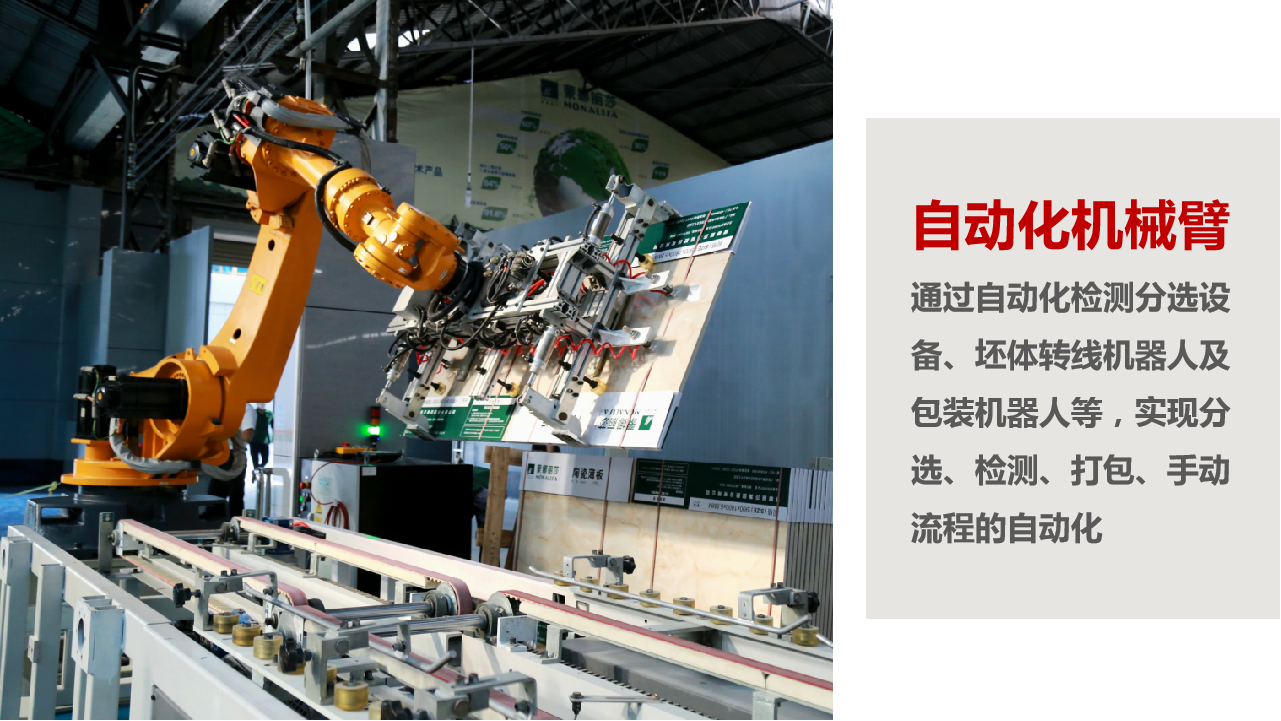
Automated handling inside Monalisa's production footprint — relevant to the factory and quality-control layer of a supplier review, not a substitute for product test reports.
Bathroom and wet-zone detail: where the tier decision is tested first
Bathrooms concentrate every requirement at once: regular water, mild acid or alkaline cleaners, bare feet and a slip threshold of R10 or higher. Specifying a ≤0.5% body removes body porosity from the list of unknowns, but it does not answer the slip question. The practical sequence is to fix the R value first, then the absorption tier, then the stain grade, and to check the floor and wall separately — a wall field and a shower floor rarely share the same requirement set.
For kitchens, the exposure is less about standing water and more about frequent cleaning and spillage. A stain resistant porcelain surface rated Grade 5 covers the common staining agents named in the specification set, while the ≤0.5% body protects the joints and cut edges where the surface layer is interrupted by sockets, upstands and drainage penetrations.
Outdoor porcelain tiles carry the reverse risk profile: standing water, sun, rain and freeze-thaw within −20°C to 40°C, all applied to a static, permanently fixed installation that cannot be swapped cheaply. That combination is why frost resistant specifications should quote the 100-cycle freeze-thaw requirement explicitly rather than relying on the phrase frost resistant, and why the slip rating belongs alongside it.
Limitations and the errors that cause callbacks
- Reading tier as a quality ranking. ≤3% is not a defective porcelain; it is a different exposure envelope, and it can be the correct choice for a dry interior.
- Using one test to cover another. Grade 5 stain resistance on the face does not describe cut edges; R11 does not describe absorption; PEI 5 does not describe freeze-thaw.
- Assuming a certificate covers the SKU. Certification scope, number and validity should be checked for the product actually shipped, especially where CE, GreenGuard or LEED documentation is a tender condition.
- Ignoring installation in the tier decision. Large-format panels need levelling systems, appropriate adhesive and suction handling; poor installation produces callbacks that no absorption figure prevents.
- Substituting tiers mid-project. A switch from ≤0.5% to ≤3% in an exterior zone is a scope change with a freeze-thaw consequence, and it should be documented as one.
Frequently asked questions
Does semi-porcelain tile comply with the same standard as porcelain?
Not at the same threshold. ISO 13006:2018 places dry-pressed porcelain tile in Group BIa with water absorption ≤0.5% and average mechanical resistance above 40 N/mm², while the ≤3% semi-porcelain figure used here comes from the project specification framework rather than the BIa class. Compliance therefore depends on the class the SKU's test report declares and on what the tender accepts. Neither term is self-certifying: for export projects, the CE, Class A or other declaration attached to the specific product still has to be reviewed.
Can a semi-porcelain tile still meet R10 slip resistance and PEI 4 abrasion requirements?
Slip resistance and abrasion resistance are measured separately from water absorption, so the absorption tier neither guarantees nor rules them out. The specification set used in this comparison asks for R9–R11 with R10 or higher in bathrooms and PEI 3–5 with PEI 4 or higher for commercial and public areas. The correct check is the test report for the specific SKU against those values, not the tier label on the product name.
Where does semi-porcelain remain the rational cost choice?
In dry interior zones without standing water or freeze-thaw — living areas, bedrooms, corridors and similar floors and walls — where the project schedule accepts ≤3%. In wet areas, exteriors and cold-climate work, the saving has to be weighed against the cost of proving freeze-thaw and stain performance and against the risk of a mid-project tier change. No price data is published here, so the commercial comparison should be built from supplier quotations on the same scope, thickness and finish.
How should a buyer validate an absorption tier before ordering?
Request the SKU-level datasheet and the test reports behind each declared value, then check the sample against them. Monalisa's production terms state 100% testing, a 2,000 m² minimum order quantity and a 7–15 day lead time, with OEM/ODM pattern and logo customization available — enough to run a trial area before the full order. A catalog or landing page confirms that a product category exists; it does not confirm a performance value for the item being shipped.
What lead time and supply continuity should a project order plan for?
Monalisa's stated production terms are a 7–15 day lead time and 12.5 million m² monthly capacity, with same-batch stock reserved for two years for later replenishment or repair, a 5–15 year product warranty depending on series and project type, complaint response within 24 hours and a solution within seven working days. For a phased project, confirm the batch-reserve and warranty terms in the purchase contract before the first delivery; the specification catalog and company profile can be downloaded from the Monalisa brochure, and samples can be requested through Monalisa.
Conclusion: choose the tier per zone, verify per SKU
The absorption comparison resolves into a short rule. Porcelain at ≤0.5% — Group BIa under ISO 13006:2018 — carries the exterior, freeze-thaw, standing-water and heavy-traffic scopes, with freeze-thaw, slip, abrasion and stain evidence attached to the SKU. Semi-porcelain at ≤3% stays rational for dry interior zones where the schedule accepts it, and it is not a lesser material as long as it is not pushed into an exposure it was never specified for. Double-zero requirements sit outside both and must be defined in the tender.
Using Monalisa's 120-270FEG12207M as the reference shows what a high-tier submittal looks like in practice: a 1200×2700×12 mm homogeneous body panel with a matte natural stone face, an indoor envelope covering humid rooms and mild cleaners, an outdoor envelope covering freeze-thaw within −20°C to 40°C, and a parameter set built from ≤0.5% absorption, PEI 3–5, R9–R11 and Grade 5 stain resistance. The remaining step is document review, not preference.
Need to check a tier against a specific zone? Download the Monalisa product brochure for formats and specification data, or request a 120-270FEG12207M sample and its test documentation through fs-monalisa.com.
Have Questions or Need More Details?
Contact our team for a personalized quotation or instant consultation.
Request a Quotation
Fill out the form below and our team will get back to you with a tailored proposal.
WhatsApp Direct Chat
Prefer to chat in real-time? Message us on WhatsApp for instant assistance & quick answers.
- Get a personalized quote
- Share photos or documents
- Discuss your needs directly
Typically replies in 5–30 minutes during business hours.