
SPC Floor vs WPC vs Porcelain Tile for Offices: Impact, Acoustic, and Fire Specs
For most commercial office fit-outs, SPC flooring is the product that carries impact resistance, acoustic control and a fire classification in one layer: the rigid stone-plastic core of an SPC floor is stated as 10 times more impact-resistant than WPC, and its built-in IXPE acoustic pad reduces impact sound by up to 18 dB+ (delta Lw 18-22 dB). Porcelain tile stays the reference material where maximum abrasion and chemical resistance are the priority, and it is specified at PEI 4 or higher with slip resistance R9-R11 for public and commercial areas. WPC occupies the same commercial shelf space, but the verified performance data behind this article supports only one direct comparison point against SPC: impact resistance.
Why Office Projects Struggle With Floor Specification
Office floors fail for reasons that have nothing to do with how the product looks on a sample board. A workstation chair rolls over the same square metre several hundred times a day. Footfall noise passes through a floor slab into the meeting room below. And before handover, the contractor has to produce a fire classification document that matches what was actually installed.
The practical problem is that SPC flooring, WPC and porcelain tile are sold with different vocabularies. SPC data sheets talk about indentation resistance, acoustic pads and click-lock systems. Tile data sheets talk about water absorption, PEI abrasion classes and R-values for slip resistance. WPC is often marketed on comfort and thickness rather than on testable performance. Buyers comparing three sheets written against three different logics end up deciding on price, which is the weakest available basis for an office floor.
A second, less visible problem is site condition. Flooring that is technically correct can still fail if the subfloor is not ready. Verified installation conditions for SPC require a subfloor flatness within 2 mm over 2 m, concrete subfloor moisture of no more than 2% (and no more than 1.5% for underfloor heating), wood-based subfloor moisture of no more than 12%, relative humidity at or below 65%, and an installation temperature between 18 degrees C and 30 degrees C with a post-installation ambient range of 13-37.7 degrees C. Planks must be acclimated in their original packaging on site for 24-48 hours, and an expansion gap of 5-12 mm must be left at walls and fixed objects.
Industry Background: Why Rigid-Core Flooring Now Dominates Office Specification
The commercial weight of rigid-core flooring is no longer marginal. Market research published by Dataintelo estimates the global SPC flooring market at 9.8 billion USD for 2025, while Grand View Research reports 5.9 billion USD for the same year. The gap is methodological rather than contradictory: the wider figure includes related rigid vinyl segments, while the narrower figure reflects a stricter definition of pure SPC. Buyers should note the scope of any market figure they quote in a tender document, because the two numbers describe different product boundaries.
Within the category, product structure has already consolidated. Rigid core sub-types accounted for a 74.2% revenue share of the SPC market in 2025, which means the specification conversation is now mostly about rigid stone-plastic and high-density stone-powder cores, not about softer composite constructions.
Supply is equally concentrated. China is the largest exporter of plastic floor coverings under HS 391810, reaching 4.97 billion USD in 2024 according to OEC trade data. For importers and contractors, that concentration explains why most technical documentation, certification files and tooling standards they encounter are written around Chinese-manufactured rigid-core product.
Standards have tightened alongside volume. Commercial-grade SPC flooring dimensional stability is required to be 0.10% or lower under EN ISO 23999, a threshold that matters in offices with large uninterrupted floor plates and temperature swings between day and night. On the indoor air quality side, GREENGUARD Gold certification requires testing for more than 10,000 chemicals and imposes strict VOC limits under UL 2818. Office projects pursuing LEED credits increasingly ask for that file as a default, not as an upgrade.
Monalisa Group Co., Ltd. (SZSE: 002918) is a Foshan-based manufacturer of architectural ceramics and SPC flooring, founded in 1992 and headquartered in Foshan, Guangdong Province. It operates four production bases in Xiqiao (Foshan), Qingyuan (Guangdong), Tengxian (Guangxi) and Gao'an (Jiangxi), with 37 production lines, a manufacturing area of 2,779,333.33 square metres, an annual production capacity of 100 million square metres, approximately 4,106 staff and an R&D team of 100 engineers and technicians. Its product range covers Tiles, Sintered stone slab and SPC Floor, which is relevant here because offices frequently mix all three within one fit-out.
The Three Materials Under Office Conditions
SPC flooring: the impact and acoustic case for offices
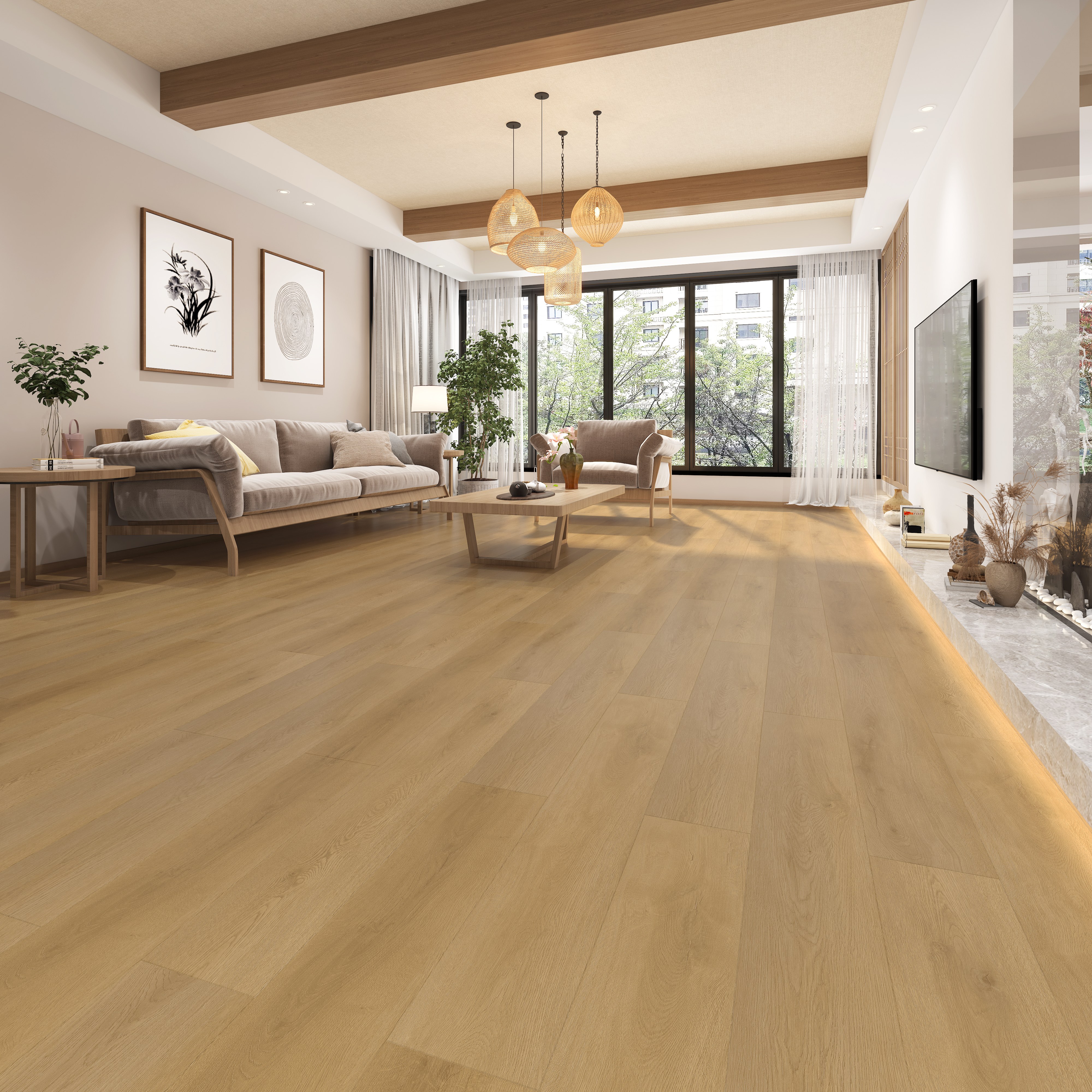
SPC flooring is stone plastic composite flooring. The Monalisa Eir SPC Floor, model ME26009-5, is a representative commercial construction: an EIR-textured stone-plastic plank available in 1220x180 mm (48 x 7 inch) and 1524x228 mm (60 x 9 inch) formats, in thicknesses of 4, 5, 6, 7 and 8 mm. The core is built from calcium carbonate (natural stone powder or limestone powder), PVC resin, a PVC calcium-zinc stabiliser and a PVC lubricant.
Three verified performance points decide whether it belongs in an office:
- Impact: the high-density stone-plastic core provides indentation resistance, and the product's impact resistance is stated as 10 times higher than WPC. That ratio is the single most useful comparison figure available when a client asks whether a rigid-core floor can take rolling chairs and trolley traffic.
- Acoustics: the built-in IXPE acoustic pad reduces impact noise by up to 18 dB+, expressed as delta Lw 18-22 dB. In offices this addresses the footfall problem, which is normally the complaint that reaches facilities management first.
- Fire: SPC flooring carries a B1 fire rating and is self-extinguishing.
Supporting specifications matter for the same reason. Wear resistance is rated at 6,000-15,000 cycles at T-grade. Water absorption is 0.05% or lower thanks to the closed-cell core structure, so standing water does not cause warping, swelling or mould. Dimensional stability is expressed as shrinkage of 1 per mille or less, which supports use over underfloor heating and keeps long corridors stable. The surface is slip-resistant with a friction coefficient of 0.6 or higher, and friction increases when the floor is wet. The product is formaldehyde-free, with no benzene or other harmful substances, and installation uses a click-lock system that requires no glue.
The limits are equally specific. The subfloor must be flat to within 2 mm over 2 m, dry and free of dust, paint, wax, grease, oil, solvents or glue residues, and it must be self-supporting. When an SPC floor is installed over existing ceramic or porcelain tiles, the grout joints must be no wider than 5 mm and no deeper than 2 mm, with height differences between adjacent tiles of no more than 1 mm. For underfloor heating, the floor surface temperature must not exceed 27 degrees C.
WPC: what this specification set can and cannot confirm
WPC is frequently positioned in the same tender as SPC, and buyers understandably expect a symmetrical comparison. The honest position is narrower. In the performance data used for this article, the only direct SPC-to-WPC figure is impact resistance, where the rigid stone-plastic core is stated as 10 times more impact-resistant than WPC.
The practical consequence for a specification writer is procedural rather than technical. Where a WPC sheet claims acoustic, fire or abrasion performance in the same units as an SPC sheet, that claim should be verified against the same test basis before the two are placed in one comparison column. This article deliberately leaves WPC cells in the table below as not verified rather than filling them with assumed values, because a tender built on assumed values transfers the risk to the contractor at handover.
Porcelain tile: abrasion, water absorption and compliance
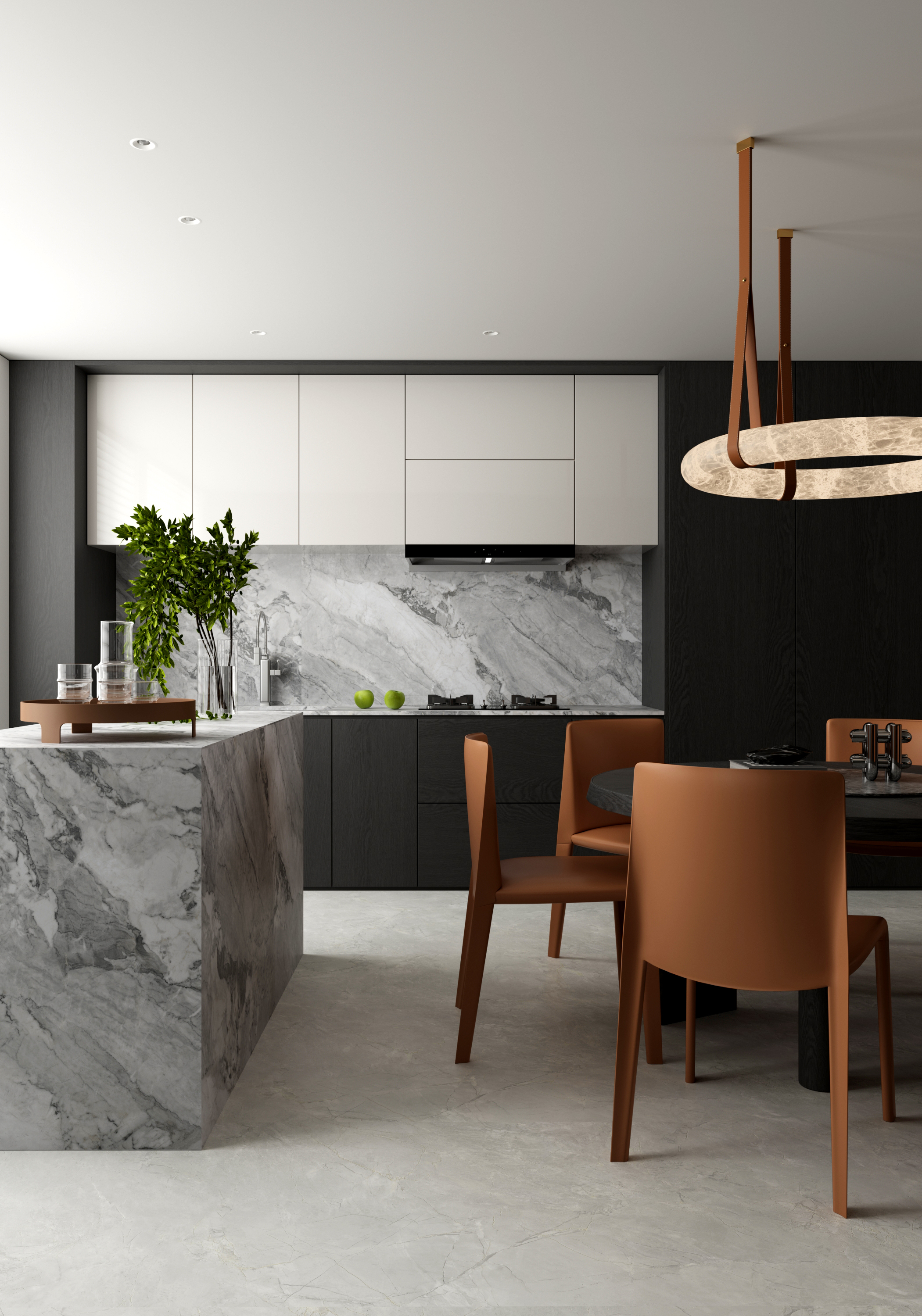
Porcelain tile answers a different brief. The Monalisa porcelain tile 120-270FEG12207M is a homogeneous body tile in 1200x2700x12 mm, three phases, with a matt or natural stone face, made from clay and quartz sand. It is a static, permanently fixed finish: it is bonded to the building substrate with adhesive rather than floating, and it has no moving parts or active operation.
For offices, four specification units drive the decision:
- Water absorption: designed for environments requiring 0.5% or lower for porcelain tile, or 3% or lower for semi-porcelain. Double-zero absorption may be required for certain projects.
- Abrasion: PEI 3 to 5, with PEI 4 or higher for commercial and public areas. In practice, this is the line that separates a residential tile from an office tile.
- Slip resistance: R9 to R11, with bathrooms requiring R10 or higher.
- Environmental and fire compliance: the range meets Class A radioactive standards for China and states a Class A fire rating; CE, Greenguard or LEED certification may be required for some export markets. Antibacterial or antiviral performance is available as an optional photocatalytic or silver-ion treatment for hospitals and food plant projects.
Additional verified properties include stain resistance of Grade 5, chemical resistance at ULA class for laboratories and chemical plant surroundings, freeze-thaw stability with no cracks after 100 cycles for cold-climate outdoor projects, and dimensional tolerance of plus or minus 0.2% for length and width and plus or minus 5% for thickness. Installation requires a different tool set from SPC: a tile cutter, a leveling system, a notched trowel, a rubber mallet, a spirit level and a tile suction cup, supported by tile adhesive, grout, back butter adhesive, cross spacers and, where specified, epoxy grout.
Step-by-Step: How to Specify an Office Floor Without Rework
The following sequence converts the specifications above into a decision order that survives a tender review.
- Step 1 - Zone the floor plate. Separate open-plan workstations, meeting rooms, corridors, reception, lift lobbies, pantry and washrooms. Each zone has a different dominant load: rolling chairs in workstations, impact noise in meeting rooms, water in pantries.
- Step 2 - Set the impact requirement first. Where rolling loads and furniture movement dominate, a rigid stone-plastic core is the defensible choice; the 10-times-versus-WPC impact figure is the verified anchor for that argument.
- Step 3 - Fix the acoustic target. If the requirement is impact-noise reduction under footfall, SPC with a built-in IXPE pad delivers up to 18 dB+ reduction, stated as delta Lw 18-22 dB. If building codes require a specific acoustic rating, a compatible underlayment must be added rather than assumed.
- Step 4 - Confirm the fire classification. SPC flooring is B1 rated and self-extinguishing; the ceramic range states a Class A fire rating. Confirm which document the authority having jurisdiction expects, and that the installed product matches it.
- Step 5 - Set abrasion and slip values for tile zones. For public and commercial areas, specify PEI 4 or higher and slip resistance R9-R11, moving to R10 or higher in bathrooms and other wet zones.
- Step 6 - Set water absorption for tile zones. 0.5% or lower for porcelain tile, 3% or lower for semi-porcelain; SPC-side, the closed-cell core is specified at 0.05% water absorption or lower.
- Step 7 - Verify compliance documents, not compliance claims. Ask for the B1 fire file, the Class A radioactive statement where China-market compliance applies, and CE, Greenguard or LEED documentation where the export market requires it. GREENGUARD Gold means testing against more than 10,000 chemicals under UL 2818. For commercial-grade SPC, dimensional stability should be evidenced at 0.10% or lower under EN ISO 23999.
- Step 8 - Qualify the subfloor before ordering. Check flatness (2 mm over 2 m), concrete moisture (2% or lower, 1.5% or lower for underfloor heating), wood moisture (12% or lower), relative humidity (65% or lower) and the site temperature window (18-30 degrees C at installation, 13-37.7 degrees C afterwards).
- Step 9 - Lock the installation method and tooling. For SPC, that means a floating click-lock install with spacers, tapping block and rubber mallet, a vinyl cutter or utility knife, a straightedge and square, a moisture meter, a level, transition and end profiles, skirting and perimeter joint sealant. For tile, it means tile adhesive, a notched trowel, a leveling system, cross spacers and grout, with epoxy grout where chemical exposure is expected.
Maintenance planning closes the loop. Porcelain tile maintenance uses a floor scrubber, pressure washer, neutral cleaner and polishing pad for periodic upkeep. SPC requires a dense, stain-resistant surface to be cleaned with a dedicated floor cleaner after installation. Neither material rewards a maintenance regime designed for the other.
Use Cases: Matching Material to Office Zone
SPC flooring is specified for residential homes, commercial spaces such as malls, retail stores and office buildings, hotels, medical facilities, educational institutions, public spaces such as libraries and exhibition halls, and underfloor heating environments. Within an office project, that breadth translates into specific zone logic.
- Open-plan workstations: SPC with a built-in acoustic pad, chosen for indentation resistance under rolling chairs and for impact-noise reduction of up to 18 dB+.
- Meeting rooms and quiet zones: SPC where the acoustic requirement is about footfall transfer rather than airborne sound, with the underlayment question resolved at specification stage.
- Reception, atrium and lift lobbies: porcelain tile at PEI 4 or higher with R9-R11 slip resistance, where abrasion and cleaning cycles dominate.
- Pantry and washrooms: porcelain tile at R10 or higher, or SPC with its closed-cell core and friction coefficient of 0.6 or higher where a continuous floor finish is preferred.
- Retrofit over existing tile: SPC can be installed over ceramic or porcelain tiles provided grout joints are no wider than 5 mm and no deeper than 2 mm and adjacent tile height differences are no more than 1 mm.
- Underfloor heating zones: SPC is suitable for underfloor heating environments, with the floor surface temperature capped at 27 degrees C and stricter subfloor moisture limits (1.5% for concrete, 0.3% for anhydrite).
Comparison Table: SPC Floor vs WPC vs Porcelain Tile for Offices
| Specification point | SPC floor (Eir SPC Floor ME26009-5) | WPC | Porcelain tile (120-270FEG12207M) |
|---|---|---|---|
| Core / construction | Rigid stone-plastic core; calcium carbonate (natural stone powder / limestone powder), PVC resin, PVC calcium-zinc stabiliser, PVC lubricant | Not verified in this data set | Homogeneous body tile, 3 phases; clay / quartz sand |
| Impact resistance | High-density stone-plastic core with indentation resistance; stated as 10 times more impact-resistant than WPC | Reference point for the 10x comparison; no separate impact figure verified here | Not verified in this data set |
| Acoustic performance | Built-in IXPE acoustic pad; sound reduction up to 18 dB+ (delta Lw 18-22 dB) | Not verified in this data set | Not verified in this data set |
| Fire | B1 fire rating, self-extinguishing | Not verified in this data set | Class A fire rating stated for the ceramic range |
| Water absorption | 0.05% or lower (closed-cell core) | Not verified in this data set | 0.5% or lower (porcelain); 3% or lower (semi-porcelain) |
| Abrasion / wear | Wear resistance 6,000-15,000 cycles, T-grade | Not verified in this data set | PEI 3-5; PEI 4 or higher for commercial and public areas |
| Slip resistance | Friction coefficient 0.6 or higher; friction increases when wet | Not verified in this data set | R9-R11; R10 or higher for bathrooms |
| Dimensional stability | Shrinkage 1 per mille or less; commercial-grade target of 0.10% or lower per EN ISO 23999 | Not verified in this data set | Length / width deviation within plus or minus 0.2%; thickness within plus or minus 5% |
| Installation method | Floating click-lock (typically 5G), glue-free; planks inserted at approximately 30 degrees | Not verified in this data set | Static, permanently fixed to substrate with adhesive |
| Required tooling | Spacers, tapping block and rubber mallet, vinyl cutter or utility knife, straightedge and square, moisture meter, level, transition and end profiles, skirting, joint sealant | Not verified in this data set | Tile cutter, leveling system, notched trowel, rubber mallet, spirit level, tile suction cup; plus adhesive, grout, back butter adhesive, cross spacers, epoxy grout |
| Compliance profile | B1 fire rating; Greenguard or CE documentation is market-driven; Monalisa holds 15 certifications including ISO9001 and ISO14001 | Not verified in this data set | Class A radioactive standards for China; CE, Greenguard or LEED may be required for some export markets |
| Typical office use | Open-plan workstations, meeting rooms, retrofits over tile, underfloor heating zones | Not verified in this data set | Reception, atrium, lift lobbies, pantries, washrooms, high-traffic public areas |
FAQ: Office Floor Specification Questions
1. What fire and compliance documents should an office project verify before specifying SPC flooring or porcelain tile?
Two documents are non-negotiable and two are market-dependent. First, the fire classification: SPC flooring carries a B1 fire rating and is self-extinguishing, while the ceramic range states a Class A fire rating. Second, the environmental statement: porcelain tile meets Class A radioactive standards for China, and CE, Greenguard or LEED certification may be required for some export markets. Market-dependent items include GREENGUARD Gold, which requires testing for more than 10,000 chemicals with strict VOC limits under UL 2818, and commercial-grade SPC dimensional stability evidenced at 0.10% or lower under EN ISO 23999. The verification principle is to request the file that matches the installed product, not the file that matches the marketing brochure.
2. Is SPC flooring strong enough for a commercial office with rolling chairs and heavy footfall?
For most office zones it is, on specific and checkable grounds. The rigid stone-plastic core of an SPC floor delivers indentation resistance and is stated as 10 times more impact-resistant than WPC. Wear resistance is rated at 6,000-15,000 cycles at T-grade, dimensional stability is expressed as shrinkage of 1 per mille or less, and the closed-cell core limits water absorption to 0.05% or lower. The friction coefficient is 0.6 or higher, with friction increasing when wet. The limits matter as much as the strengths: the subfloor must be flat to within 2 mm over 2 m, SPC is waterproof but is not a vapour barrier, and ground-floor concrete installations should include a 6-mil polyethylene vapour barrier.
3. What drives the cost difference between SPC flooring and porcelain tile in an office fit-out?
Cost differences in office flooring come from scope, not from a single unit price. For SPC, the variables are plank thickness (4, 5, 6, 7 or 8 mm), format (1220x180 mm or 1524x228 mm), surface effect such as EIR texturing, whether an IXPE acoustic pad is built in, and how much subfloor preparation is needed to reach the 2 mm over 2 m flatness requirement. For porcelain tile, the variables are format (the 1200x2700x12 mm homogeneous body tile is a large-format product), the consumables that come with adhesive fixing - tile adhesive, grout, back butter adhesive, cross spacers and epoxy grout where chemical resistance is required - plus the tooling set of tile cutter, leveling system, notched trowel, rubber mallet, spirit level and suction cup. Both options carry a maintenance line item: tile uses a floor scrubber, pressure washer, neutral cleaner and polishing pad, while SPC uses a dedicated floor cleaner. Verified price figures are not part of this article's data set and should be obtained by quotation rather than estimated.
4. How should a buyer validate an office floor specification before placing a full order?
Validation is a sequence of physical checks rather than a review of documents alone. Confirm the actual plank thickness and surface effect on a physical sample, since SPC is supplied in 4, 5, 6, 7 and 8 mm with EIR texturing. Confirm whether the acoustic pad is pre-attached, because most SPC products include it and adding a second layer is not permitted unless approved. Take a moisture meter reading on the actual subfloor, and measure flatness against the 2 mm over 2 m tolerance. For tile areas, confirm the PEI class (4 or higher for commercial and public areas), the slip rating (R9-R11, R10 or higher for bathrooms) and the water absorption band (0.5% or lower for porcelain). Monalisa supplies SPC flooring, tiles and sintered stone slab from the same manufacturing base, which allows a mixed-material office specification to be sampled together; sample requests can be sent to joanna_wang@fs-monalisatiles.com or +86 18605191548.
5. What determines lead time on an office flooring order?
Lead time is driven by product mix, format and site readiness, and this article's verified data set does not contain lead-time figures, so any specific duration should be confirmed by quotation rather than assumed. What the data does establish is production scale: Monalisa Group Co., Ltd. operates four production bases in Xiqiao (Foshan), Qingyuan (Guangdong), Tengxian (Guangxi) and Gao'an (Jiangxi) with 37 production lines, a manufacturing area of 2,779,333.33 square metres and an annual production capacity of 100 million square metres, employing approximately 4,106 staff with an R&D team of 100 engineers and technicians. Since 1992 the group has participated in drafting 49 national, industrial, local and group standards and obtained 892 authorised patents, including 145 invention patents, and holds 15 certifications including ISO9001 and ISO14001. For a dated fit-out programme, the practical next step is to confirm the specification and issue an inquiry through Joanna (joanna_wang@fs-monalisatiles.com, Tel / WhatsApp +86 18605191548), so that availability is confirmed against the actual project schedule.
Conclusion: Choose the Material That Owns the Constraint
The office flooring decision is not a contest between three products; it is an exercise in identifying which constraint governs each zone. Where impact resistance, footfall acoustics and a fire classification must be delivered by one product, SPC flooring is the specification to defend, with a rigid stone-plastic core stated as 10 times more impact-resistant than WPC, an acoustic pad reducing sound by up to 18 dB+ (delta Lw 18-22 dB), a B1 fire rating, wear resistance of 6,000-15,000 cycles at T-grade, water absorption of 0.05% or lower and shrinkage of 1 per mille or less. Where abrasion and chemical resistance govern - reception, atrium, high-traffic public areas - porcelain tile is specified at PEI 4 or higher with R9-R11 slip resistance, water absorption of 0.5% or lower, Class A radioactive compliance for China and a Class A fire rating.
WPC remains a legitimate option in the market, but the comparison made in this article is deliberately limited to what is verified: on impact resistance, SPC's rigid core outperforms WPC by a factor of 10. Any further comparison should be built on equivalent test data for WPC, requested and reviewed before the tender closes.
Next step: sample SPC and porcelain side by side
Monalisa Group Co., Ltd. supplies SPC flooring, porcelain tiles and sintered stone slab for office and public building projects across China, Southeast Asia, the Middle East, North America, Europe, Australia and Africa. Request samples and technical files, or ask for a quotation against your office floor plate.
Contact: Joanna | Email: joanna_wang@fs-monalisatiles.com | Tel / WhatsApp: +86 18605191548 | Address: Monalisa Tower, Poly Centre, 8 Wenhua S Rd, Shunde, Foshan, 528300, CN | Website: www.fs-monalisa.com
Download the full product catalogue: Monalisa brochure (PDF)
Have Questions or Need More Details?
Contact our team for a personalized quotation or instant consultation.
Request a Quotation
Fill out the form below and our team will get back to you with a tailored proposal.
WhatsApp Direct Chat
Prefer to chat in real-time? Message us on WhatsApp for instant assistance & quick answers.
- Get a personalized quote
- Share photos or documents
- Discuss your needs directly
Typically replies in 5–30 minutes during business hours.