
Porcelain Tile Application Guide: Specifying Public Facilities and Transit Projects
Public facilities and transit buildings are unforgiving clients. An airport terminal floor is walked by tens of thousands of people a day, a hospital corridor is cleaned with aggressive agents several times a day, and a metro station hall can only be repaired inside a handful of night windows. The specification that survives that environment is not a colour or a size — it is a zone-by-zone performance match, and every criterion behind it needs a document.
This guide is written for the people who sign the technical submittal: project specifiers, procurement managers, and owner-side engineers working on hospitals, schools, museums, metro stations, and airport terminals. The reference product is Product 3516, catalogued by Monalisa as Porcelain Tile 8FMB10032PM — an 800 × 800 × 10 mm glazed-polished porcelain tile from the Classic Stone series, with an eight-phase surface design and a clay/quartz sand body. Its documented application scope covers public buildings such as hospitals, schools, kindergartens, libraries, museums, and sports halls, along with municipal engineering applications including pavements, plazas, park trails, public restrooms, and metro station halls.
Monalisa Group Co., Ltd. ("Monalisa") is an architectural ceramics manufacturer founded in 1992 and headquartered in Foshan, Guangdong Province. It operates four production bases and 37 production lines across ceramic tiles, ceramic slabs, and related products, and employs 4,106 people. For public-sector buyers, the most useful part of that record is the project list: eight venues of the Beijing Olympic Games, ten venues of the Guangzhou Asian Games, the Hong Kong–Zhuhai–Macao Bridge, the China Pavilion at Expo 2020 Dubai as designated ceramic tile supplier, and the 19th Asian Games Hangzhou 2022 as exclusive supplier of official architectural ceramics.
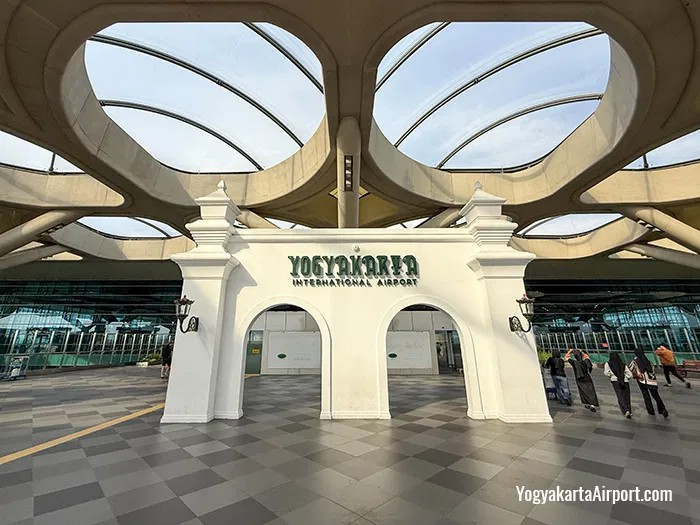
Airport terminal flooring in Indonesia — an 80,000 m² Monalisa porcelain tile programme delivered for a municipal government client over two years.
Why Public Facility Tile Specifications Fail
Most public-project tile problems are not material problems. They are mapping problems, and they repeat in the same three places.
- A criterion is assigned to the building instead of the zone. One tile is written into the specification for entrance halls, corridors, wet rooms, plant areas, and external plazas. The result is predictable: a surface that is easy to clean in the concourse becomes a slip risk at the restroom door, or a slip-safe surface becomes a maintenance burden in a gallery where every scuff shows.
- A requirement is stated without a document. "Anti-slip" and "fire resistant" are adjectives until a test report names the standard and the exact product that was tested. Certificates that list a work size different from the SKU being ordered do not transfer automatically.
- Acceptance criteria are written after installation. Batch colour consistency, dimensional deviation, breakage allowance, joint width, and flatness must be agreed before production, otherwise the argument happens on site with the tiles already laid.
The working method is to build the specification as a matrix: zones on one axis, performance criterion plus evidence document on the other. Once that matrix exists, the remaining question is purely commercial — whether the chosen product can be delivered in the quantities and timeframes the programme allows.
What Public Buyers Should Understand About Today's Porcelain Tile Market
Two verified market signals frame the sourcing decision. World tile production fell to 14.95 billion m² in 2024, a 6.2% decrease compared with 2023, according to MECS / Acimac Research Centre figures. At the same time, the global porcelain tile market is projected to grow from USD 9.73 billion in 2024 to USD 18.33 billion by 2035, a projection published by Spherical Insights that is best treated as directional rather than as a budget line.
Read together, the two numbers describe consolidation rather than a collapse in demand: general production is being rationalised while specification-grade porcelain continues to expand. For a public facility with a 30- to 50-year service life, that has two practical consequences. First, the supplier's ability to re-supply a matching batch in year eight matters as much as the first container price. Second, the specification document is the only durable record of what was approved — which is why written acceptance criteria, not verbal assurances, protect the project.
The technical baseline is settled internationally. Under ISO 13006:2018, dry-pressed porcelain tiles are classified in Group BIa, with water absorption (E) of 0.5% or less and a mechanical resistance average value exceeding 40 N/mm². International trade classification follows a similar logic: HS 6907 subheadings separate ceramic paving and wall tiles partly by water-absorption bands, including a category for tiles with a water absorption coefficient by weight of not more than 0.5%. The practical takeaway for specifiers is that performance is defined by a number, and procurement should ask for that number at SKU level rather than at catalogue level.
The Specification Solution: Mapping Product 3516 to Public and Transit Zones
Product 3516 — the documented parameters
| Attribute | Documented value |
|---|---|
| Product / model | Porcelain Tile 8FMB10032PM (Product 3516) |
| Series and type | Classic Stone, porcelain tile |
| Size | 800 × 800 × 10 mm |
| Surface finish | Glazed-Polished |
| Design phases | 8 |
| Body material | Clay / quartz sand |
| Documented certification linkage | Listed within NSF certificate C0676949-01 (NSF/ANSI 51) |
Everything else a public project will ask about — slip class, abrasion class, stain class, freeze-thaw result, and fire classification — should be read from the SKU datasheet and test report issued with the submittal. Where a certificate scope names a different work size, request the report that matches the size actually ordered.
Where zone performance actually applies
Product 3516 is documented for public buildings such as hospitals, schools, kindergartens, libraries, museums, and sports halls; for municipal engineering applications including pavements, plazas, park trails, public restrooms, and metro station halls; for commercial spaces such as shopping malls, supermarkets, office buildings, restaurants, cafés, and gyms; and for hospitality environments including guest rooms, corridors, pool surrounds, shower areas, and outdoor terraces. Industrial and logistics applications are also within scope, covering clean workshops, warehouse flooring, and anti-static workshops where specialty functional tiles are required, while agricultural and livestock flooring is listed for surfaces that must be slip-resistant, chemical-resistant, and easy to wash.
A 10 mm glazed-polished porcelain tile is a strong default for dry, high-traffic interior circulation: terminal concourses, gallery floors, school halls, hospital corridors, and station halls. Wet rooms, ramps, and ramped approaches are the zones that need a separate look at slip performance, and often a matt-finish format rather than the polished surface.
The six performance criteria that decide approval
- Slip resistance. Specify it per zone and per test method. Ramp testing and pendulum testing are the two families of methods most commonly referenced by specifiers, and the required result should be written against the traffic and wetness condition of the zone, not against the building as a whole.
- Abrasion resistance. Terminal halls, ticket areas, and school corridors carry the highest footfall and the most abrasive grit. Ask for the abrasion classification on the SKU datasheet rather than assuming that "porcelain" answers the question.
- Water absorption. ISO 13006:2018 places dry-pressed porcelain in Group BIa at 0.5% or less. Low absorption is the precondition for stain behaviour, frost behaviour, and long-term dimensional stability, and it is the number to quote in the submittal.
- Stain and chemical resistance. Hospitals, food service areas, restrooms, and cleaning-cupboard zones need a surface that tolerates routine cleaning agents. Glazed surfaces clean readily; the manufacturer's maintenance guidance should still be attached to the submittal so that cleaning contractors work to the same rules.
- Freeze-thaw stability. External plazas, pavements, park trails, and unheated structures need frost performance. Low water absorption is the precondition; the freeze-thaw test report is the evidence.
- Fire performance. Where a project requires Class A non-combustibility, the requirement should be written as a named standard plus a required class, and satisfied by a test report that identifies the ordered SKU. Fired ceramic with an inorganic clay/quartz sand body is the expected product family, but classification is a documented property, not an assumption.
Step-by-Step: Specifying 3516 for a Public Facility or Transit Project
Step 1 — Map zones and traffic on the drawing set
Mark every floor and wall surface by function and traffic level: entrance and ticketing, concourse and platform, corridor and ward, classroom and hall, gallery and atrium, wet room and restroom, plant and back-of-house, external plaza and pavement. A metro station hall and a metro platform edge are not the same zone, even though they are fifteen metres apart.
Step 2 — Convert each zone into criteria and evidence
Use the zone-to-criteria matrix in the comparison section below to assign the dominant risk, the criterion, and the document that will close the criterion. The matrix is deliberately written so that each row ends in a piece of paper, not an opinion.
Step 3 — Verify compliance documents before technical approval
- NSF certificate C0676949-01, issued by NSF International and valid from 3 April 2023 for markets including the USA, EU, and China, states compliance with NSF/ANSI 51 and authorises products appearing in the NSF Official List to bear the NSF mark. Porcelain Tile 8FMB10032PM falls within the listed product scope.
- CE / EN 14411 test certification CY25A10379-TVOC, issued on 7 March 2025 and valid to 7 March 2035 by China Testing & Certification International Group Shaanxi Co., Ltd., covers a 1200 × 1200 × 10 mm BIa glazed tile for wall and floor under EN 14411:2016. Because the certificate scope states a work size, confirm that the SKU ordered for the project sits inside it.
- ISO 9001 and ISO 14001 are among the 15 certifications held by the group, alongside recognition as a national "Resource-saving and Environment-friendly" pilot enterprise and one of the first batch of "Green Factories" designated by the Ministry of Industry and Information Technology.
- Fire classification must be evidenced by a report that names the ordered SKU and the standard applied.
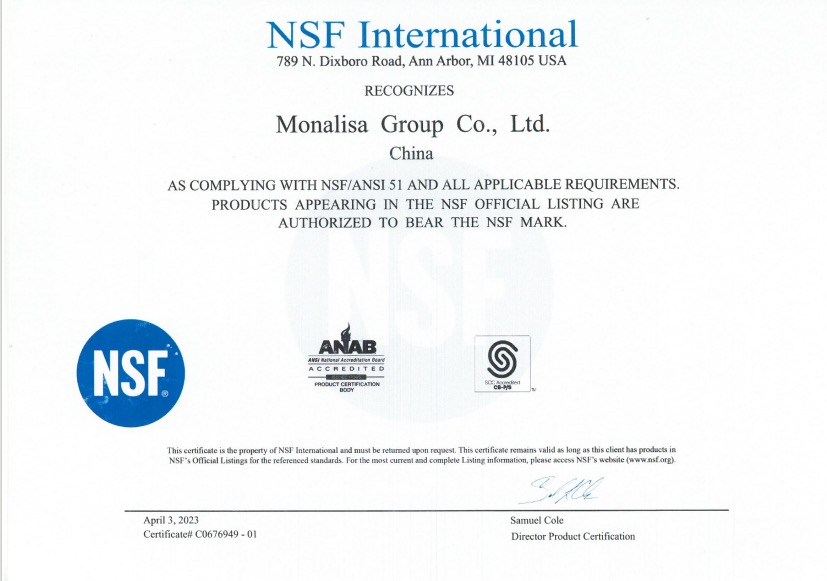
NSF certificate C0676949-01 issued by NSF International — the listed product scope includes Porcelain Tile 8FMB10032PM.
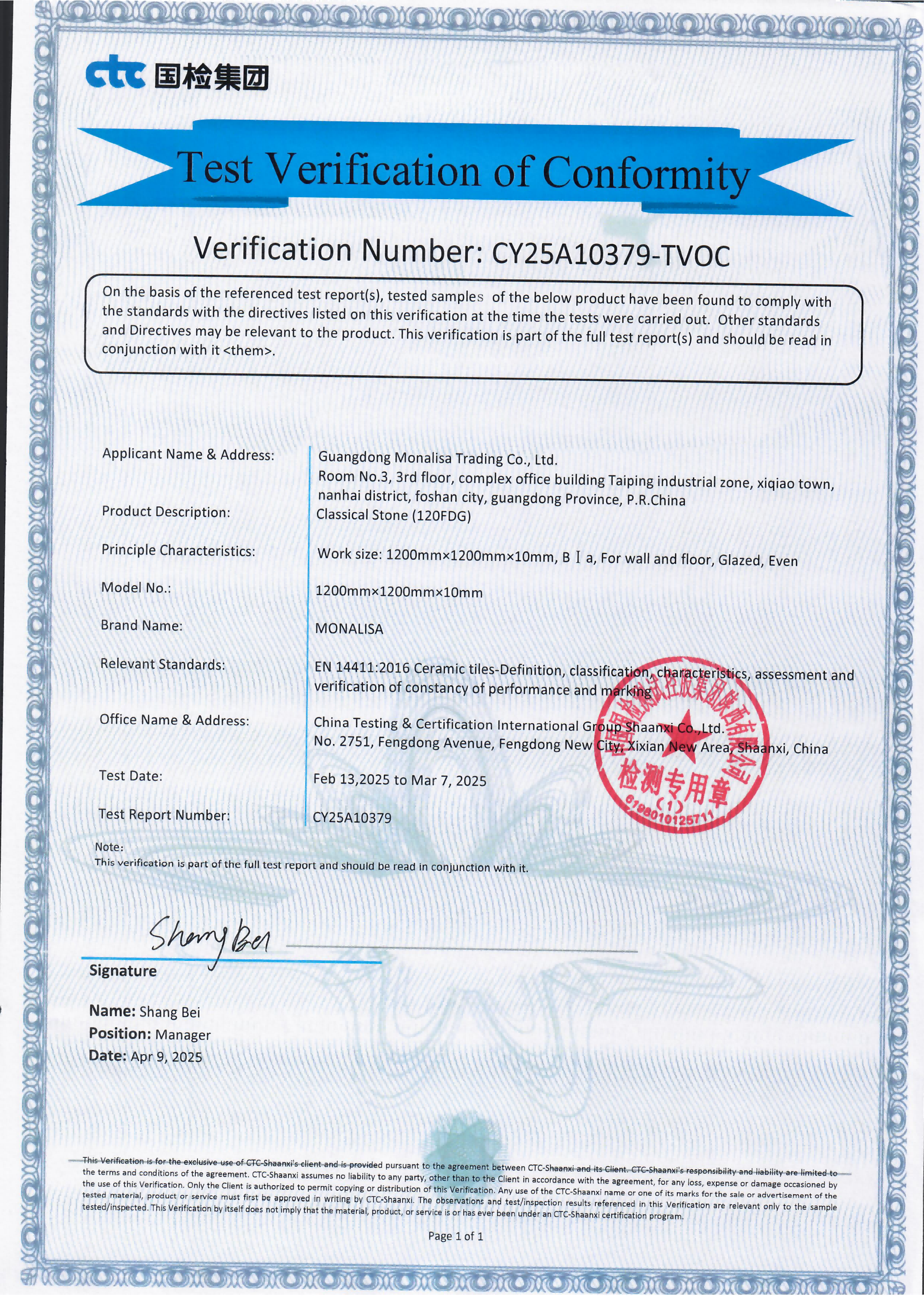
Test certification CY25A10379-TVOC, issued under EN 14411:2016 by China Testing & Certification International Group Shaanxi Co., Ltd., covering a 1200 × 1200 × 10 mm BIa glazed tile.
Step 4 — Lock commercial and supply terms before tender
- Minimum order quantity: 2,000 m².
- Production lead time: 7–15 days.
- Monthly capacity: 12.5 million m².
- Customisation: OEM/ODM with pattern and logo customisation.
- Quality control: 100% test.
- Warranty: 5–15 years depending on series and project type, covering manufacturing defects such as colour difference, dimensional deviation, and glaze cracks.
- Continuity: same-batch tiles held in stock for 2 years for later replenishment or repair replacement.
- Service: complaint response within 24 hours and a solution within 7 working days; free technical guidance on layout design, installation techniques, and substrate preparation; on-site technical representation for large projects; training for distributors and installation teams; product test reports, certificate of conformity, instruction manual, and maintenance guide available in Chinese and English.
Step 5 — Write acceptance criteria into the contract
Fix batch colour consistency, dimensional deviation, breakage allowance, joint width, and flatness as contractual acceptance items. A comparable public reference point is the Jogjakarta Airport programme, where tight-joint installation produced a reported 15% saving on grouting materials and labour and a breakage rate below 0.3%. Used properly, that figure is a benchmark to negotiate against during tender, not a guarantee for every site.
Use Cases: Transit and Public Building Applications
Jogjakarta Airport, Indonesia — 80,000 m² of public transit flooring
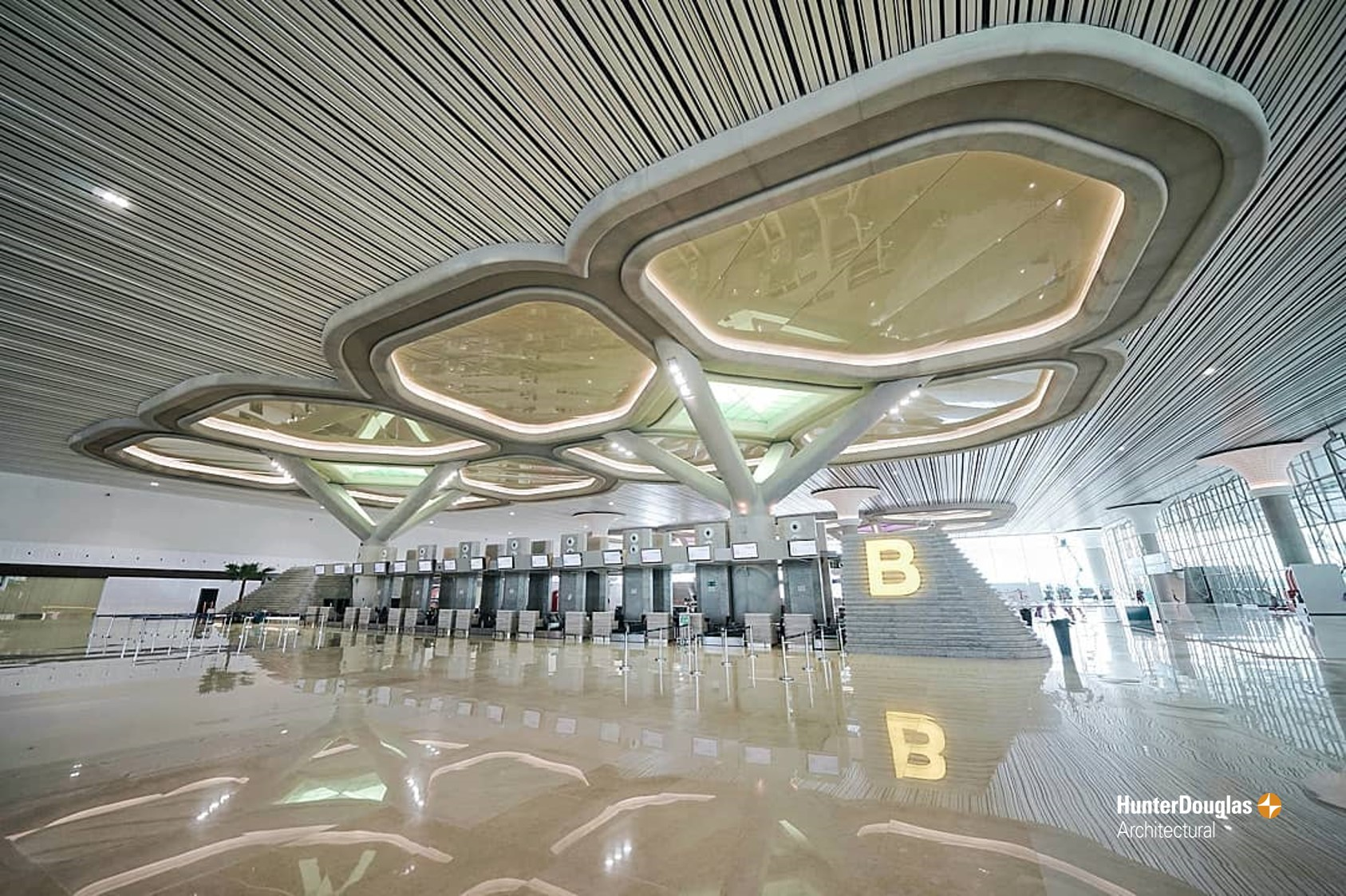
Public infrastructure flooring — tight-joint installation at the airport programme was reported to cut grouting material and labour use by 15%.
A municipal government client in Indonesia used Product 3516 across 80,000 m² of airport flooring over a two-year programme. The recorded outcomes are a modern minimalist aesthetic, a 30% lower life-cycle maintenance cost, a 15% saving on grouting materials and labour through tight-joint installation, and a breakage rate below 0.3%.
For a specifier, the case carries three usable signals. It shows that a glazed 800 × 800 mm porcelain tile can carry a full airport programme at scale. It shows that tight-joint installation converts dimensional control into an installed-cost line, which is where public budgets are usually won. And it shows that the maintenance figure — not the purchase price — is the number to interrogate when comparing first cost against a ten-year cost.
National and international public works
Monalisa's public-project record also includes eight venues of the Beijing Olympic Games, ten venues of the Guangzhou Asian Games, the Hong Kong–Zhuhai–Macao Bridge, the China Pavilion at Expo 2020 Dubai as designated ceramic tile supplier, and the 19th Asian Games Hangzhou 2022 as exclusive supplier of official architectural ceramics. For a buyer building a supplier longlist for stadium concourses, transport structures, or exhibition facilities, that record is a screening signal — it still has to be paired with SKU-level documents for the product actually ordered.
Other zones the same specification logic covers
The recorded application scope for Product 3516 extends to hospital and school interiors, museum and library floors, sports halls, plazas, park trails, public restrooms, commercial and hospitality interiors, and industrial clean workshops. In every case the sequence is identical: name the zone, name the criterion, attach the document.
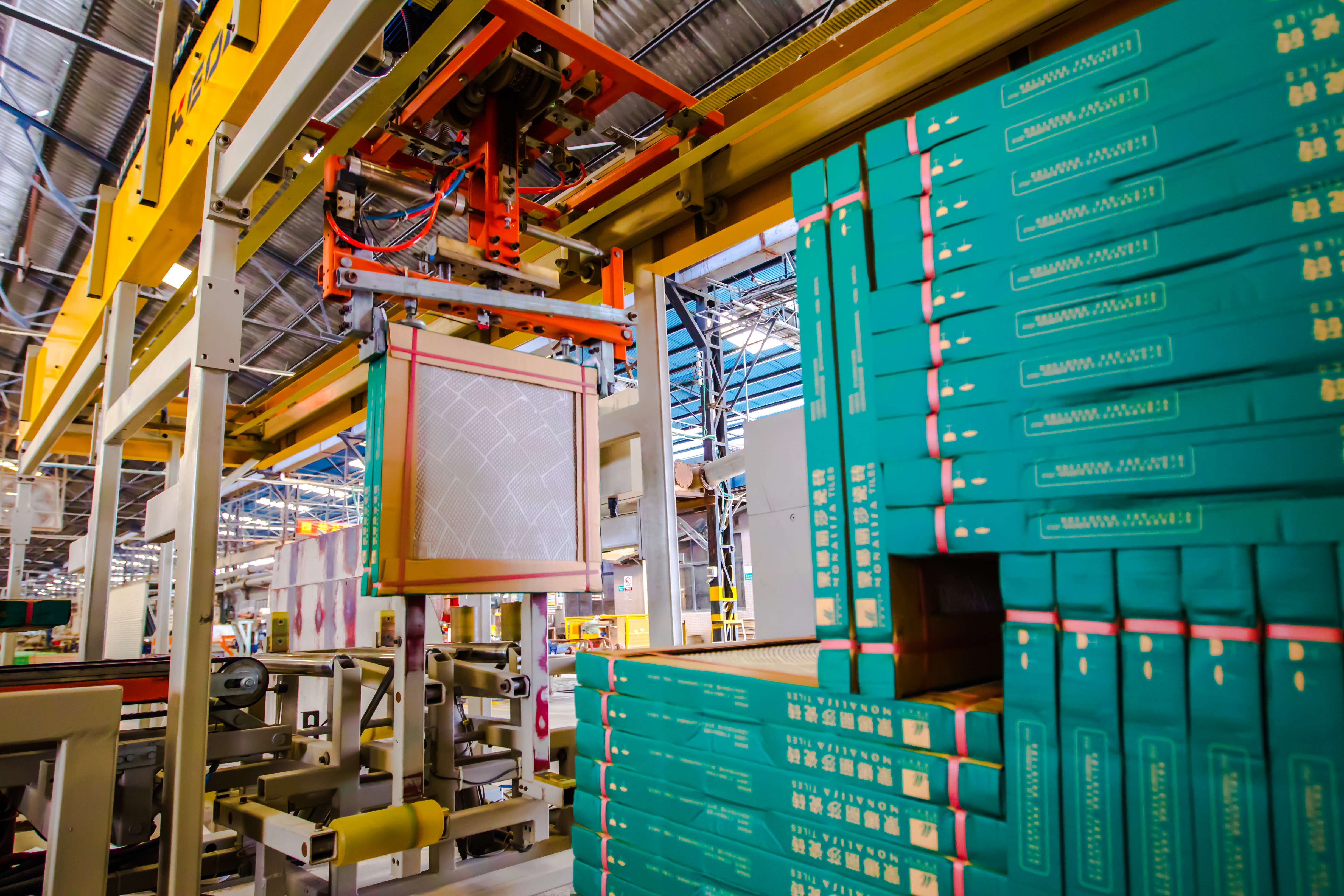
Production capacity behind a public programme: Monalisa runs 37 lines across four production bases, with 12.5 million m² of monthly capacity.
Comparison Tables for Specification Decisions
Zone-to-criteria matrix
| Project zone | Dominant risk | Criterion to specify | Evidence to request |
|---|---|---|---|
| Airport terminal concourse and ticketing hall | High footfall, abrasive grit, repeated cleaning | Abrasion classification; stain resistance; dimensional consistency for tight joints | SKU datasheet; abrasion and stain test data; batch control records |
| Metro station hall and platform (interior) | Dense footfall, spillage, night-window maintenance | Slip resistance for the specific wet or dry condition; abrasion; stain resistance | Slip test report naming the method and result for the ordered SKU |
| Hospital corridor, ward, and waiting area | Cleaning chemicals, wheeled traffic, hygiene | Chemical and stain resistance; wear resistance; ease of cleaning | Maintenance guidance; chemical resistance data |
| School corridor, hall, and canteen | Impact, spillage, high traffic | Abrasion; slip resistance in wet zones; impact behaviour | Abrasion class; slip test report |
| Museum, library, gallery floor | Appearance retention, dust, occasional heavy loads | Batch-to-batch surface consistency; stain resistance; flatness | Batch colour control records; dimensional deviation limits |
| Public restroom and wet room | Permanent wetness, cleaning agents | Slip resistance in wet condition; chemical resistance | Wet slip test report; maintenance instructions |
| External plaza, pavement, park trail | Rain, frost, thermal cycling | Freeze-thaw stability; slip resistance; water absorption of 0.5% or less (Group BIa) | Freeze-thaw test report; water absorption data |
| Plant, back-of-house, warehouse | Loads, trolleys, chemicals | Heavy-duty abrasion; chemical resistance; ease of washing | Abrasion and chemical resistance data |
Format shortlist within the documented porcelain range
| Product / model | Format and finish | Documented scope | Typical public-project fit |
|---|---|---|---|
| Porcelain Tile 8FMB10032PM (Product 3516) | 800 × 800 × 10 mm, glazed-polished, 8 design phases, clay/quartz sand body | Public buildings, municipal engineering, commercial spaces, hospitality, industrial, agricultural | Dry, high-traffic interior circulation: terminals, concourses, corridors, halls, galleries, plazas, metro station halls. Listed within NSF certificate C0676949-01. |
| Porcelain Tile 120-270FEG12207M | 1200 × 2700 × 12 mm, homogeneous body, matt / natural stone face, 3 phases | Public buildings, rail transit, hospitality, commercial spaces | Large wall and floor surfaces where joint count matters, and wet or ramped zones where a matt face is preferred. Confirm the certificate scope for the ordered work size. |
| Luxury Slab 90-270FDK09003M / 90-270FDK09008M | 900 × 2700 × 12 mm, glazed-matt, 5 phases | Rail transit and public facilities, external curtain walls, medical and cleanroom environments, high-end commercial | Metro stations, airport terminals and corridors, hospital partitions and laboratory worktops, ventilated façade systems. |
These tables rank formats inside the specified supplier's documented range; they are not a market ranking of manufacturers, because approval in a public project is decided by the SKU datasheet and the certificate scope, not by brand preference.
FAQ: Specifying Porcelain Tile for Public Facilities
1. Which certifications should a public project verify before approving Product 3516?
Three document families matter. First, NSF certificate C0676949-01, issued by NSF International and valid from 3 April 2023, covers compliance with NSF/ANSI 51 and lists Porcelain Tile 8FMB10032PM within its product scope. Second, the CE / EN 14411 test certification CY25A10379-TVOC, issued on 7 March 2025 and valid to 7 March 2035 by China Testing & Certification International Group Shaanxi Co., Ltd., states a scope of 1200 × 1200 × 10 mm BIa glazed tile for wall and floor — because that scope names a work size, confirm that the SKU being ordered falls inside it. Third, ISO 9001 and ISO 14001, which are among 15 certifications held by Monalisa Group. If the project requires Class A fire performance, the requirement should be written as a named standard plus a required class and evidenced by a test report that identifies the ordered SKU.
2. Can one 800 × 800 mm porcelain tile cover both an airport terminal and a hospital corridor?
Product 3516 is documented for public buildings including hospitals, schools, kindergartens, libraries, museums, and sports halls, as well as for municipal engineering applications such as pavements, plazas, park trails, public restrooms, and metro station halls, plus commercial and hospitality interiors. Its 800 × 800 × 10 mm format, eight-phase glazed-polished surface, and clay/quartz sand body make it a practical default for dry, high-traffic circulation zones. Two zone types need separate treatment rather than a different product family: wet rooms and ramps, where slip performance must be specified explicitly, and large uninterrupted surfaces such as terminal walls, where a bigger format reduces joint count — for example the 1200 × 2700 × 12 mm matt-finished tile 120-270FEG12207M or the 900 × 2700 × 12 mm glazed-matt slab 90-270FDK09003M / 90-270FDK09008M.
3. Where does the budget actually go over a public project's life?
First cost is only one line. Recorded outcomes from the Jogjakarta Airport programme — 80,000 m², a municipal government client, two-year duration, Product 3516 — include a 30% lower life-cycle maintenance cost, a 15% saving on grouting materials and labour through tight-joint installation, and a breakage rate below 0.3%. Those three figures point to where public budgets are decided: cleaning and repair frequency, installed joint cost, and breakage replacement losses. The commercial terms that affect the budget include a minimum order quantity of 2,000 m², a production lead time of 7–15 days, and a monthly capacity of 12.5 million m², which determines how much of a large programme can be supplied per batch.
4. What should be validated before a full production run is released?
Validate documents and appearance before volume. On documents, request the SKU datasheet, product test reports, certificate of conformity, instruction manual, and maintenance guide — this documentation is available in Chinese and English — then check that each certificate scope matches the work size ordered. On appearance, review the eight-phase surface design under the project's actual lighting conditions and confirm batch consistency against the approved control sample, since colour difference and dimensional deviation are named within the 5–15 year warranty scope. Production quality control runs at 100% test, and same-batch tiles can be reserved for two years for later repair or replenishment, which is what prevents patchwork repairs years after handover.
5. What lead time and supply continuity can a public project plan for?
Standard production lead time is 7–15 days with a minimum order quantity of 2,000 m², supported by 12.5 million m² of monthly capacity and a production footprint of four bases and 37 lines. For continuity, same-batch stock reserves are held for two years, complaints receive a response within 24 hours and a solution within 7 working days, and the product warranty runs 5–15 years depending on series and project type. Technical support covers free layout, installation, and substrate consultations, on-site representation for large projects, and training for installation teams. Project teams can download the Monalisa product brochure below, or send a zone list with approximate areas and fixed criteria to receive the matching SKU datasheets and supply terms.
Conclusion
Public facility and transit specifications are won or lost in the details: which zone, which criterion, which document, which supply commitment. Product 3516 — Porcelain Tile 8FMB10032PM — covers the dry, high-traffic interior zones that dominate these buildings: terminal concourses, hospital corridors, school halls, museum floors, plazas, and metro station halls, with documented application scope that extends into commercial, hospitality, industrial, and external municipal work. The work of the specification is to name the criterion for each zone, attach the document that proves it, and lock the commercial terms before the tender closes.
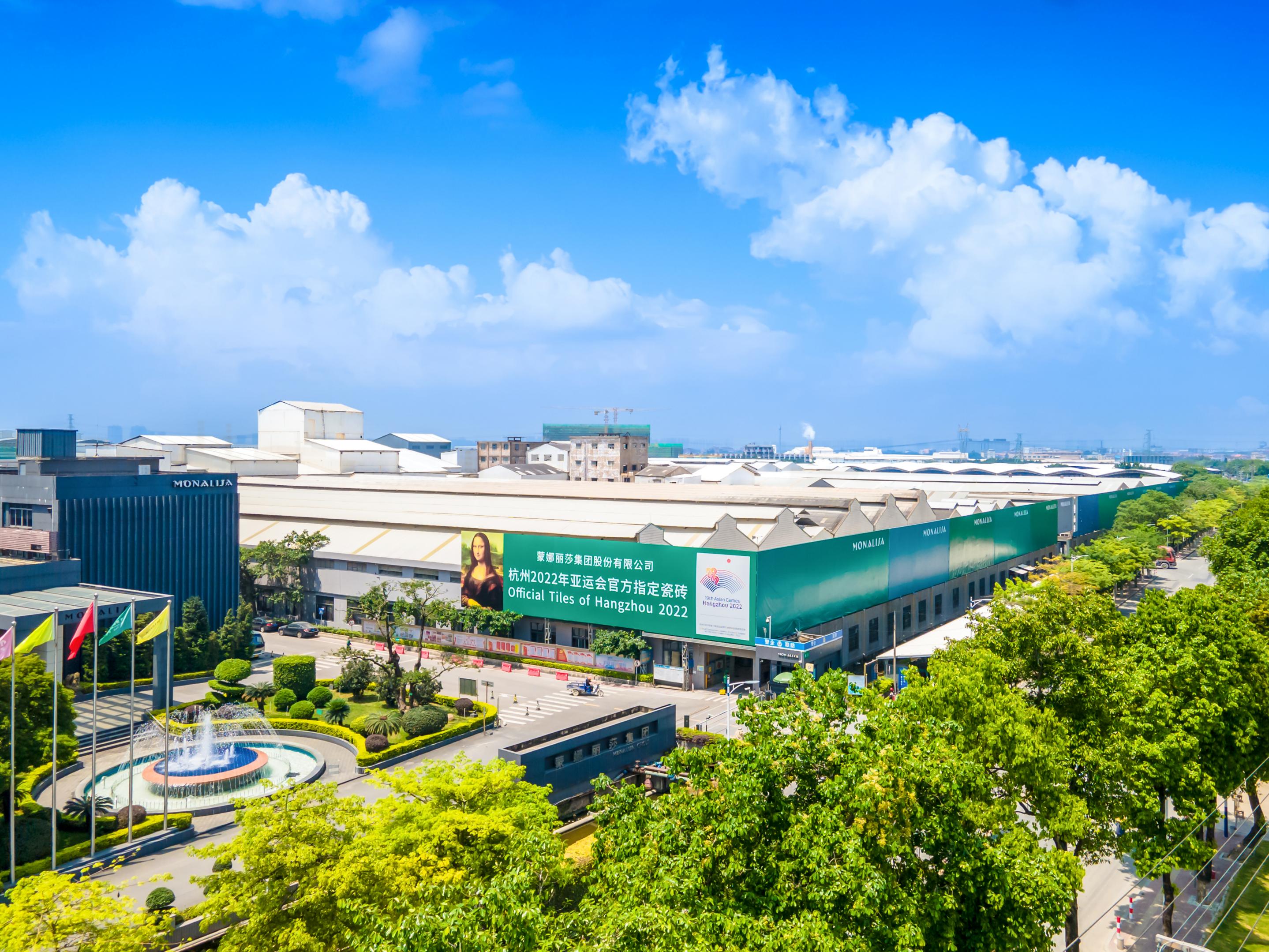
Monalisa Group Co., Ltd., headquartered in Foshan, Guangdong — founded 1992, with four production bases and 37 production lines.
Next Step: Zone List and Project Documentation
Send the project zone list, approximate areas, and the criteria already fixed, and Monalisa's project team can respond with the matching SKU datasheets, certificate copies, and supply terms for the quantities involved.
Product brochure (public download): Monalisa product brochure (PDF)
Contact: Joanna — Email: joanna_wang@fs-monalisatiles.com · Tel / WhatsApp: +86 18605191548
Website: fs-monalisa.com · Address: Monalisa Tower, Poly Centre, 8 Wenhua S Rd, Shunde, Foshan, 528300, CN
Have Questions or Need More Details?
Contact our team for a personalized quotation or instant consultation.
Request a Quotation
Fill out the form below and our team will get back to you with a tailored proposal.
WhatsApp Direct Chat
Prefer to chat in real-time? Message us on WhatsApp for instant assistance & quick answers.
- Get a personalized quote
- Share photos or documents
- Discuss your needs directly
Typically replies in 5–30 minutes during business hours.