
Sintered Stone Slab Technical Selection Guide: Matching Parameters to Application Environments

Sintered stone slab: appearance is the last decision, not the first.
Sintered stone slab selection usually fails at the parameter stage, not the design stage. Two projects can install visually identical slabs and get completely different service lives, because the variables that decide performance are water absorption, abrasion class, slip rating, freeze-thaw stability and chemical resistance — not colour, finish or format.
This guide is written for specifiers, architects and procurement teams who have already decided they want a sintered stone slab and now need to justify a specific parameter set for a specific environment. It follows one rule throughout: identify the dominant stressor in the application first, then match the parameters to it.
Quick answer. Match the parameter to the environment, not to the sample board:
• Water absorption — porcelain group at ≤0.5%; semi-porcelain up to about ≤3%; “double-zero” product (below 0.1%) where facades, laboratories or cold climates are specified.
• Abrasion — PEI 3–5, with PEI 4 or higher preferred for commercial and public areas.
• Slip resistance — R9–R11, with R10 or higher preferred for bathrooms, showers and other wet areas.
• Freeze-thaw stability — required for outdoor cold climates, typically specified as no cracking after 100 freeze-thaw cycles.
• Chemical resistance — ULA-class chemical resistance for laboratory and aggressive-cleaner environments.
Problem Definition: Why Parameter Mismatches Cause Most Sintered Stone Slab Failures
A sintered stone slab that fails in service is rarely a defective product. It is usually a correctly manufactured product specified against the wrong stressor. The five parameter families above cover the vast majority of real-world failure paths, and almost every mismatch traces back to one of a small number of specification habits.
Mismatch pattern 1: the transplanted specification
A specification written for a temperate interior wall is copied into a bathroom, a pool surround or a north-facing facade. The slab still looks correct on delivery, and the problem only appears after the first wet season or the first winter of thermal cycling.
Mismatch pattern 2: the aesthetics-first specification
Colour, veining and finish are chosen from a sample board, and the parameter set is left entirely to the supplier. This transfers a technical decision to the party with the least visibility into the end use.
Mismatch pattern 3: the single-number specification
Buyers fixate on one figure — usually thickness or format size — and assume it governs performance. Thickness supports structural and installation requirements; it does not compensate for a weak abrasion class or an unsuitable slip rating.
Mismatch pattern 4: the climate-agnostic specification
Outdoor cladding and paving are specified on the same basis as interior walls. In cold climates, freeze-thaw cycling is the dominant stressor and it must be specified explicitly.
Mismatch pattern 5: the maintenance-blind specification
Laboratory benches, commercial kitchens and industrial wash-down areas are specified for appearance, without a chemical resistance class that matches the cleaners, reagents or oils they will actually contact.
Why this matters commercially. Parameter decisions are cost decisions. In a delivered Monalisa project at Jogjakarta Airport in Indonesia, a tight-joint installation strategy saved 15% on grouting materials and labour, the breakage rate stayed below 0.3%, and the project recorded 30% lower life-cycle maintenance cost. Those outcomes came from a coordinated specification and installation plan — not from the slab surface alone.
Industry Background: Standards, Market Context and the Language of Parameters
Sintered stone has moved from a niche countertop product to a mainstream architectural material, and the vocabulary used to specify it now comes almost entirely from the ceramic tile standards framework.
Market sizing reflects that shift. The global sintered stone market was valued at approximately USD 877.75 million in 2024 and is projected to reach USD 1.41 billion by 2032, according to Intel Market Research. Wider estimates exist because different reports define the category differently — some include engineered stone and quartz surfaces — so the narrower sintered-stone figure is the more useful planning reference. China’s ceramic product exports, which include sintered stone slabs, totalled USD 19.15 billion from January to November 2025, according to the General Administration of Customs of China.
On the supply side, the premium global countertop category is associated with brands such as Dekton (Cosentino) and Neolith, which market coverage cites as leading brands in premium sintered stone countertops, with typical Mohs hardness of 7–8. That benchmark is useful mainly as a reference point for what the category can deliver; it does not replace application-specific parameter matching.
The standards that define the parameters
Most sintered stone specification conversations resolve into four documents and one assessment route:
- EN 14411:2016 — ceramic tiles: definition, classification, characteristics, assessment and verification of constancy of performance and marking. This is the classification framework behind water absorption groups and the marking used on CE documentation.
- ISO 10545 series — the test methods. Water absorption is tested to ISO 10545-3; flexural strength to ISO 10545-4; freeze-thaw resistance is assessed through the ISO 10545-12 test framework; chemical resistance classes follow ISO 10545-13.
- EAD 090142-00-0404 — the European assessment document route for CE marking of sintered stone for internal and external use, published by the European Organisation for Technical Assessment (EOTA).
- NSF/ANSI 51 — the food equipment materials standard applied to surfaces that contact food, including countertops and worktops.
Two architectural benchmark figures are worth keeping in the specification file: water absorption below 0.1% to ISO 10545-3, and flexural strength of at least 45 N/mm² to ISO 10545-4. These are the levels competent architectural sintered stone is generally expected to reach, and they are the reference points against which a supplier’s test reports should be read.
| Parameter | Test / assessment framework | Common architectural benchmark |
|---|---|---|
| Water absorption | ISO 10545-3 | Below 0.1% for architectural sintered stone |
| Flexural strength | ISO 10545-4 | ≥ 45 N/mm² |
| CE marking (EU market) | EAD 090142-00-0404 | Required for sintered stone for internal and external use |
| Food-contact surfaces | NSF/ANSI 51 | Required for countertops and worktops in food-contact use |
Reference table: the frameworks behind the five parameter families.
The Five Parameters That Decide Most Specifications
1. Water absorption — the primary durability gate
Water absorption is the first parameter to fix because it correlates with frost resistance, staining behaviour and dimensional stability. In the EN 14411 / ISO 13006 classification language, porcelain products sit at or below 0.5%, semi-porcelain (vitrified) products run up to roughly 3%, and “double-zero” products are specified below 0.1% where the exposure is severe. Interior wall cladding tolerates the widest band; external facades, laboratories and cold climates tolerate the narrowest.
2. Abrasion resistance — PEI class
Abrasion resistance is expressed through PEI (Porcelain Enamel Institute) classes. For architectural wear surfaces, PEI 3 to PEI 5 is the practical range. Floors in commercial and public areas should be specified at PEI 4 or higher; residential floors and wall surfaces are usually served by PEI 3 or above. PEI class matters most where foot traffic, trolley wheels and grit are present.
3. Slip resistance — R classification
Slip resistance is classified on the R scale (R9 to R13 under the DIN 51130 ramp method), and it is the parameter most often under-specified. For architectural work, R9 to R11 covers the majority of applications, but bathrooms, showers, pool surrounds and other wet areas should be specified at R10 or higher. Public venues with heavy footfall and occasional moisture belong in the same band.
4. Freeze-thaw stability
Freeze-thaw resistance is a requirement, not an optional extra, wherever an exterior surface is exposed to sub-zero temperatures and moisture. The specification is normally written as a test outcome rather than a material claim: no cracking, spalling or loss of integrity after 100 freeze-thaw cycles. Products with ultra-low water absorption are the natural starting point, because less absorbed water means less internal expansion pressure.
5. Chemical resistance — ULA and related classes
Chemical resistance is classified under ISO 10545-13. For unglazed products, ULA denotes a class A rating for resistance to low-concentration acids, and the class scale continues upward for harsher exposure. Laboratory benches, healthcare surfaces, industrial wash-down areas and commercial kitchens should all carry an explicit chemical resistance class rather than relying on a general stain-resistance claim.
Preferred Parameter Profiles by Application Environment
The table below converts the five parameter families into preferred profiles. “Preferred” is a specification target, not a mandatory minimum — but where a project deviates downward, the deviation should be documented against the specific stressor it accepts.
| Application environment | Water absorption | Abrasion (PEI) | Slip (R) | Freeze-thaw | Chemical resistance | Preference tier |
|---|---|---|---|---|---|---|
| Kitchen countertop / island | Double-zero preferred (<0.1%) | PEI 4+ | Not primary | Not required (interior) | Required for food-contact surfaces (NSF/ANSI 51) | High |
| Bathroom vanity & backsplash | Porcelain ≤0.5% | PEI 3–4 | R10+ for wet areas | Not required (interior) | Moderate (household cleaners) | High |
| Interior wall cladding | Porcelain ≤0.5% (semi-porcelain up to ≤3% acceptable) | PEI 3+ | Not primary | Not required | Low | Standard |
| Residential & light commercial flooring | Porcelain ≤0.5% | PEI 3–4 | R9–R10 | Not required (interior) | Low | Standard |
| High-traffic public flooring | Porcelain ≤0.5% | PEI 4+ | R10+ | Not required (interior) | Moderate | High |
| Exterior facade — temperate climate | Double-zero preferred (<0.1%) | Not primary | Not primary (vertical) | Recommended | Low | High |
| Exterior facade — cold / freeze-thaw climate | Double-zero (<0.1%) | Not primary | Not primary (vertical) | Required — no cracking after 100 cycles | Low | Critical |
| Laboratory & healthcare surfaces | Porcelain ≤0.5%, double-zero preferred | PEI 4+ | R10+ where wet | Not required (interior) | ULA class specified | Critical |
| Food-contact countertops & worktops | Porcelain ≤0.5% | PEI 4+ | Not primary | Not required (interior) | NSF/ANSI 51 certification | High |
Preferred parameter profiles by application environment.
Step-by-Step Breakdown: How to Build the Specification
The workflow below takes a project from environment definition to a documented, purchasable parameter set.
Step 1 — Classify each surface by dominant stressor
List every surface in the project and assign one dominant stressor: water, abrasion, slip, thermal cycling, or chemical attack. Surfaces with two strong stressors (a commercial kitchen floor, for example) inherit both requirements.
Step 2 — Set the water absorption gate first
Choose the absorption band before anything else, because it constrains the rest. Interior walls can accept the widest band; facades, wet areas, laboratories and food-contact surfaces should be held at the porcelain level or tighter, with double-zero specified where exposure is severe.
Step 3 — Assign the abrasion class by traffic, not by room name
Use PEI 4 or higher wherever the surface takes commercial or public foot traffic, trolleys or grit. Residential floors and wall surfaces generally sit at PEI 3 or above.
Step 4 — Assign the slip rating by wetness
Bathrooms, showers, pool surrounds and any surface that can be wet underfoot should be R10 or higher. Vertical cladding is normally governed by the fixing system rather than by slip class.
Step 5 — Add freeze-thaw where the climate demands it
For outdoor installations in cold climates, write freeze-thaw resistance as a test outcome — no cracking after 100 cycles — and pair it with a double-zero absorption requirement.
Step 6 — Add the chemical resistance class for aggressive environments
Laboratories, healthcare and industrial wash-down areas should carry an explicit ULA-class (or higher) chemical resistance requirement, tested under ISO 10545-13.
Step 7 — Verify against documents, not against descriptions
Require the supplier’s test reports, certificate of conformity and certification documents before the order is placed, and confirm that the certified product size and finish matches what is being supplied.
Step 8 — Verify that the specified format can be installed as designed
Large-format slabs reduce joint count and improve visual continuity, but they also demand installation competence. In the Sri Lanka convention centre delivery, Monalisa provided on-site technical support during installation specifically because the local contractor team had limited experience with large-format panel installation. Specification and installation capability must be checked together.
Use Cases: What Parameter Matching Looks Like in Practice
Kitchen countertops and islands
Countertops combine food contact, thermal shock from cookware and daily cleaning. The preferred profile is a porcelain-grade slab at or below 0.5% absorption, PEI 4 or higher, with NSF/ANSI 51 certification where the surface is defined as food-contact.
Bathroom vanities and wet zones
Vanity tops, shower walls and pool surrounds share one dominant stressor: standing water. Specify R10 or higher for the walked surfaces, and keep the slab at porcelain-grade absorption. A deliv ered example is the R10 rating used at the Sri Lanka convention project, where slip resistance was specified specifically for safety in high-traffic public venues.
Interior wall cladding and feature walls
Wall cladding is the most forgiving application. The parameter emphasis shifts to format, joint planning and surface consistency rather than aggressive performance classes.
High-traffic public flooring
Airport terminals, stations and convention halls combine abrasion and slip. Specify PEI 4 or higher and R10 or higher, then confirm breakage resistance through the packing, transport and installation plan. The Jogjakarta Airport project in Indonesia covered 80,000 sqm and recorded a breakage rate below 0.3%.
Exterior facades in cold climates
Facade specification is a freeze-thaw specification. Double-zero absorption plus a verified no-cracking result after 100 freeze-thaw cycles is the preferred combination.
Laboratories, healthcare and clean environments
Non-porous surfaces with a defined chemical resistance class are the requirement. Specify ULA-class chemical resistance under ISO 10545-13 for laboratory worktops, and hold absorption at porcelain level or tighter.
Comparison Table: Format and Product Fit
The table below compares the Monalisa slab and tile formats that are most often specified for these environments. It is a fit comparison, not a ranking of quality — each format is the preferred choice in a different environment.
| Product / format | Size | Body & phases | Surface finish | Preferred environments (per supplier application data) |
|---|---|---|---|---|
| Monalisa Luxury Slab — 90-270FDK09003M / 90-270FDK09008M | 900 × 2700 × 12 mm | Luxury slab, 5 phases, clay / quartz sand | Glazed-matt | High-end commercial spaces, hotel lobbies, fine dining, art galleries; residential premium finishing; kitchen countertops, islands, vanity tops and backsplashes; custom furniture; medical and cleanroom partitions, laboratory worktops, cleanroom wall cladding; rail transit and public facilities; external curtain walls and ventilated rain-screen systems (ultra-low water absorption, freeze-thaw resistant, self-cleaning) |
| Monalisa Porcelain Tile — 120-270FEG12207M | 1200 × 2700 × 12 mm | Homogeneous body tile, 3 phases, clay / quartz sand | Matt / natural stone face | Residential floors and walls; commercial spaces including malls, offices, restaurants and gyms; public buildings such as hospitals, schools, libraries and museums; municipal paving and public facilities; hospitality guest rooms, corridors and pool surrounds; agricultural and livestock flooring |
| Monalisa Porcelain Tile — 8FMB10032PM | 800 × 800 × 10 mm | Classic stone, 8 phases, clay / quartz sand | Glazed-polished | Residential floors and walls; commercial interiors; public buildings; municipal paving; clean workshops and warehouse flooring; hospitality and tourism interiors; agricultural flooring — the format used for the Jogjakarta Airport project area |
Format fit by environment. Parameter targets should still be confirmed against the project specification.
How Manufacturing Capability Supports Consistent Parameter Control
A parameter set is only as reliable as the production system behind it. Sintered stone slabs are fired products: absorption, flexural strength and surface consistency depend on body formulation, pressing and firing control, and those variables must be held stable across an entire order — not just across a sample.
Monalisa Group Co., Ltd. is a Chinese architectural ceramics manufacturer founded in 1992 and headquartered in Foshan, Guangdong Province. The group operates four modern production bases — Xiqiao (Foshan), Qingyuan (Guangdong), Tengxian (Guangxi) and Gao’an (Jiangxi) — with a total of 37 production lines, a factory area of 2,779,333.33 sqm and 4,106 employees. Product lines include ceramic tiles, ceramic slabs (thin plates, large plates and rock plates) and porcelain art paintings. Annual output is reported at 100 million square metres.
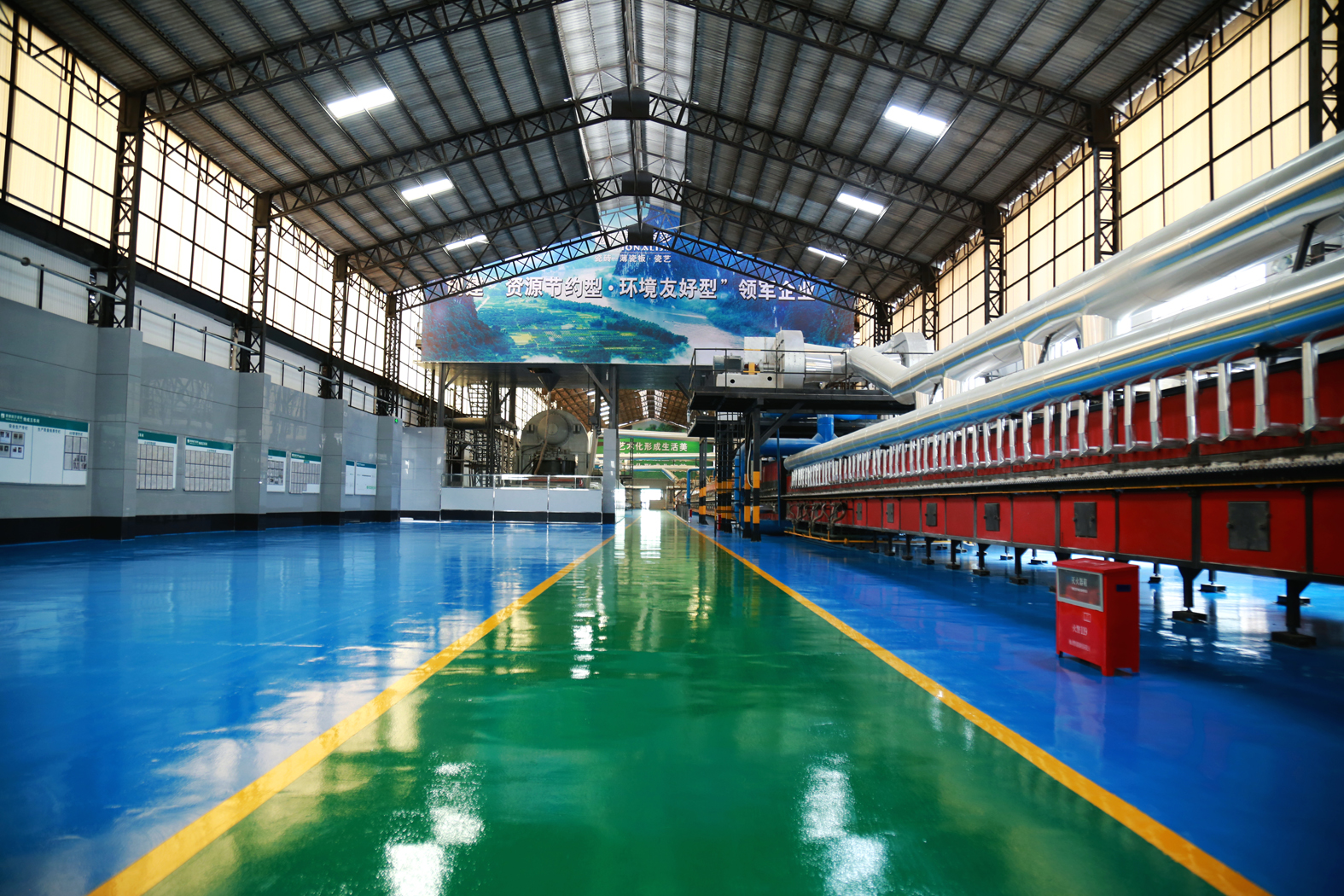
Production control at the base level is what keeps absorption, strength and surface consistency inside a narrow band across a full order.
Three capability facts are directly relevant to parameter consistency. First, the group maintains a 100-engineer R&D team supported by platforms including a National Enterprise Technology Center and a Postdoctoral Research Workstation. Second, as of June 2021, the group had participated in the drafting of 49 national, industrial, local and group standards, and held 892 authorised patents, including 145 invention patents. Third, quality control is documented as 100% testing, under a “3M” quality management model that has been recognised with the Foshan Municipal Government Quality Award, the Guangdong Provincial Government Quality Award and a nomination for the 3rd China Quality Award, alongside 15 certifications including ISO9001 and ISO14001.

Automated handling for large-format slabs reduces handling damage between firing and packing.
Capacity and commercial terms matter as much as the firing line when a specification has to be delivered on schedule. Monalisa operates OEM/ODM programmes with pattern and logo customisation, a monthly capacity of 12.5 million sqm, a production lead time of 7–15 days, a minimum order quantity of 2,000 sqm, and after-sales terms that include a 5–15 year product warranty depending on series and project type, same-batch stock reserve for two years, and documented test reports and certificates of conformity in Chinese and English. The group reported annual revenue of approximately CNY 3.92 billion for fiscal year 2025, per S&P Global Market Intelligence / Stock Analysis, and exports to markets including Southeast Asia, the Middle East, North America, Europe, Australia and Africa.
Certification evidence that can be checked
Two certification documents are directly relevant to the parameter classes discussed in this guide. Monalisa holds NSF certification C0676949-01 issued by NSF International, covering compliance with NSF/ANSI 51 for products appearing in the NSF official list, applicable to markets including the USA, EU and China. The group also holds CE certification CY25A10378, issued by China Testing & Certification International Group Shaanxi Co., Ltd. for a 900 mm × 1800 mm × 10 mm glazed, even product for wall and floor application, tested under EN 14411:2016, valid from 2025-03-07 to 2035-03-07.
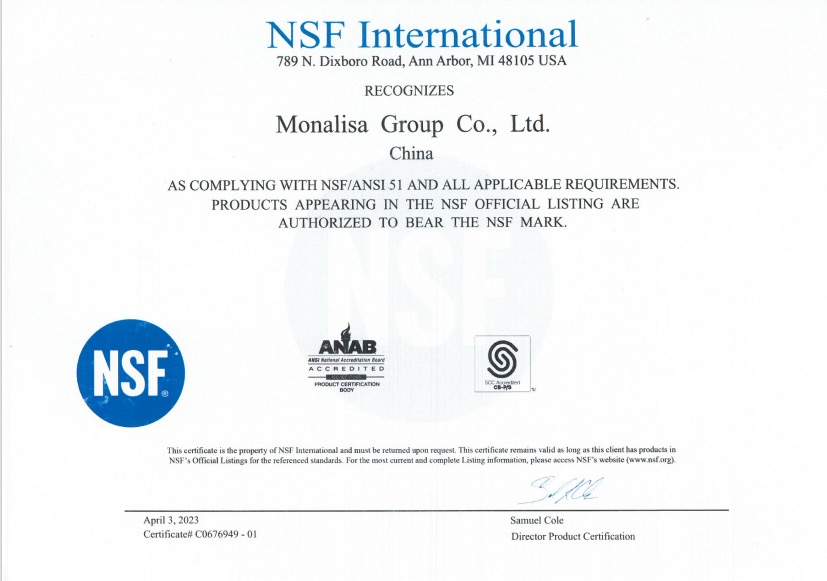
NSF certification C0676949-01, issued by NSF International (NSF/ANSI 51).
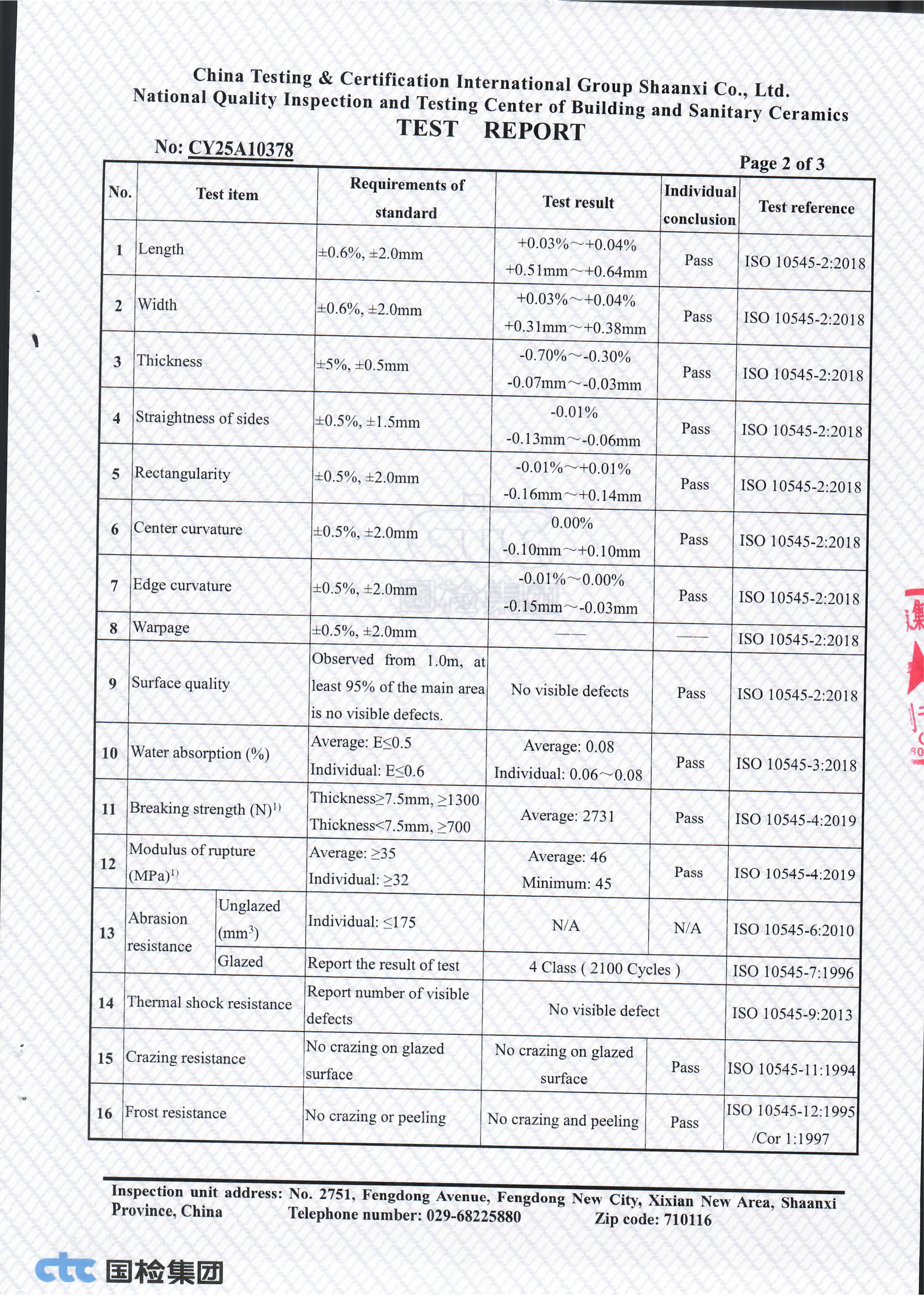
EN 14411:2016 test documentation supporting CE certification CY25A10378.
Verified project performance
A delivered project illustrates what a matched parameter set produces. For a national government project in Sri Lanka, Monalisa supplied more than 80,000 sqm in a single delivery for floor and wall covering across convention halls, banquet spaces, VIP corridors, multimedia rooms, public reception zones, outdoor connectors and roof terraces. The specification used 900 × 1800 mm large-format tiles, delivering approximately 50% fewer joints, a slip resistance rating of R10 for safety in high-traffic public venues, and ultra-low water absorption of ≤0.08% combined with freeze-thaw and weather resistance suited to the local hot-humid climate and monsoon rains. The project was completed with a design life of over 20 years and a 10-year group project warranty, with on-site technical support during installation.
Limitations and trade-offs to document
Higher parameter classes are not free. Tighter absorption bands and higher abrasion classes narrow the range of suitable bodies and finishes, which can reduce the available surface designs. Large-format slabs reduce joint count and installation time but require more installation skill and more careful handling — a documented constraint in the Sri Lanka project, where the local contractor team had limited experience with large-format panel installation. Freeze-thaw and chemical resistance requirements should be stated as test outcomes so that the supplier can confirm compliance rather than interpret intent.
FAQ: Sintered Stone Slab Parameter Selection
Which certifications should a sintered stone slab carry for a commercial or food-contact project?
For a commercial project in the EU market, CE marking is the baseline, obtained through the European assessment document route EAD 090142-00-0404 for sintered stone for internal and external use, with testing under EN 14411:2016. For any surface defined as food-contact — kitchen countertops, worktops, some laboratory surfaces — NSF/ANSI 51 certification is the relevant standard. Monalisa holds NSF certification C0676949-01 issued by NSF International under NSF/ANSI 51, and CE certification CY25A10378 issued for a 900 mm × 1800 mm × 10 mm glazed product for wall and floor use, tested under EN 14411:2016 and valid to 2035-03-07. Specifiers should confirm that the certificate scope matches the product size and finish actually being supplied.
Can a manufacturer hold the same parameter band across a multi-thousand-square-metre order?
Consistency across a large order depends on production control rather than on a single sample result. Monalisa operates four modern production bases with 37 production lines, a 100-engineer R&D team, and a documented 100% test regime, with a monthly capacity of 12.5 million sqm. In practice, the evidence of consistency is a delivered order: more than 80,000 sqm in a single delivery for the Sri Lanka convention project, using 900 × 1800 mm large-format tiles with ultra-low water absorption of ≤0.08%, and a breakage rate below 0.3% recorded at the 80,000 sqm Jogjakarta Airport project in Indonesia.
Do higher parameter classes drive up project cost?
Parameter class affects cost most visibly in installation and lifecycle, not only in unit price. Tight-joint installation of large-format slabs at the Jogjakarta Airport project saved 15% on grouting materials and labour, and the project recorded 30% lower life-cycle maintenance cost, with a breakage rate below 0.3% reducing replacement losses. On the supply side, Monalisa supports large projects with a 5–15 year product warranty depending on series and project type, plus a same-batch stock reserve service that keeps matching tiles available for two years for later repair or replenishment. Budget models should therefore compare the full installed and maintained cost, not the slab line item alone.
How do I validate the parameters before placing a bulk order?
Validation is document-led. Request the test reports for the relevant ISO 10545 methods, the certificate of conformity, and the certification documents (CE, NSF or equivalent) that correspond to the specified product size and finish. Then confirm physical samples against the intended application before committing. Monalisa supplies after-sales documentation including product test reports, certificate of conformity, instruction manual and maintenance guide in Chinese and English, with OEM/ODM support for pattern and logo customisation, a minimum order quantity of 2,000 sqm, and a production lead time of 7–15 days for the validated specification.
What lead time and post-delivery support should be planned for?
Monalisa quotes a production lead time of 7–15 days against a 2,000 sqm minimum order quantity, with a monthly capacity of 12.5 million sqm behind it. Post-delivery support includes a 5–15 year product warranty depending on series and project type covering manufacturing defects such as colour difference, dimensional deviation and glaze cracks; free technical guidance on tiling layout, installation technique and substrate preparation; on-site technical representation for large projects, as provided during the Sri Lanka installation; complaint response within 24 hours with a documented resolution within 7 working days; same-batch stock reserve for two years; and online or offline training for distributors and installation teams. To start a specification review, send the project’s environment list and target parameter set to our team and request a sample or quotation.
Conclusion: Specify the Stressor, Then the Slab
Matching sintered stone slab parameters to application environments follows a fixed order: identify the dominant stressor, set the water absorption gate, then layer on abrasion class, slip rating, freeze-thaw resistance and chemical resistance. Interior walls tolerate wide bands. Bathrooms, commercial floors, facades, laboratories and food-contact surfaces do not.
Parameters only hold if the production system behind them holds. Four production bases, 37 production lines, a 100-engineer R&D team, 100% testing and participation in 49 standards are the structural reasons a supplier can reproduce a parameter band across an 80,000 sqm delivery — and they are the reason to verify documents rather than descriptions before the order is placed. Use the table in this guide as a starting specification, then confirm every class against the supplier’s test reports and certifications for the exact product being supplied.

Request a Sample, Datasheet or Quotation
Have Questions or Need More Details?
Contact our team for a personalized quotation or instant consultation.
Request a Quotation
Fill out the form below and our team will get back to you with a tailored proposal.
WhatsApp Direct Chat
Prefer to chat in real-time? Message us on WhatsApp for instant assistance & quick answers.
- Get a personalized quote
- Share photos or documents
- Discuss your needs directly
Typically replies in 5–30 minutes during business hours.