
How to Verify a Sintered Stone Slab Supplier's Capacity and Delivery Assurance
Answer first: a sintered stone slab supplier's capacity and delivery assurance can be verified by requesting four evidence sets in a fixed order — physical plant capacity, technical capability, certification scope that matches the ordered format, and a written delivery commitment covering lead time, reserve stock and response times. A supplier that cannot produce all four is not automatically unreliable, but the risk becomes undocumented, and undocumented risk is what delays projects.
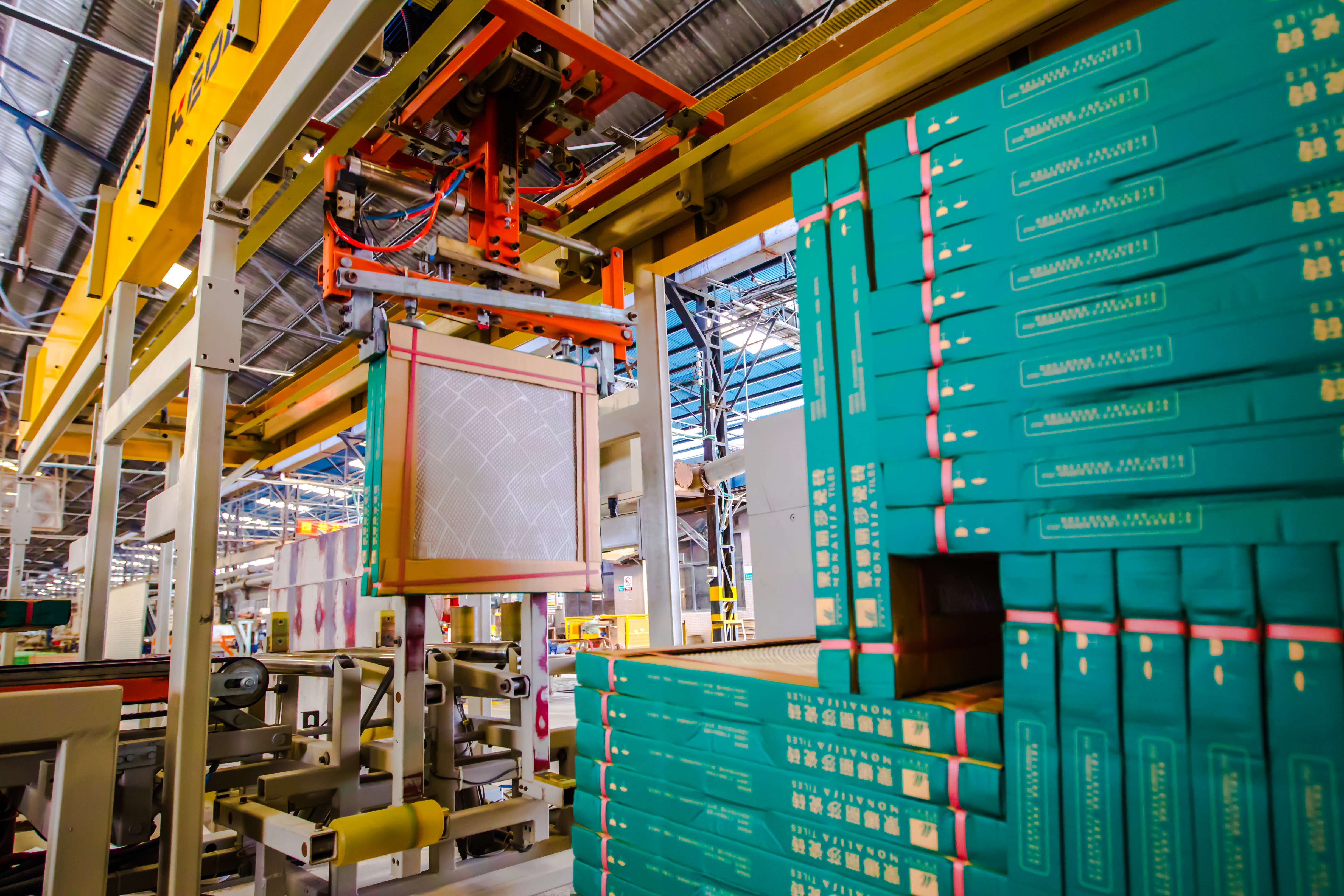
Why capacity claims are difficult to verify in sintered stone
Sintered stone slab procurement fails on schedule more often than it fails on appearance. Three structural reasons explain how a buyer can review a full supplier presentation and still not know whether the material will arrive in week six or week fourteen.
1. Group reporting blurs product families. A manufacturer that produces ceramic tiles, ceramic slabs and SPC flooring normally reports production volume once, at group level. The figure can be entirely accurate and still say nothing about how many 900×2700 mm slabs can be pressed, fired, cut and packed in the month your project ships.
2. Certifications are shown as logos rather than as scopes. A CE or NSF mark printed on a catalogue page refers back to a specific certificate that names a product size, a classification and an intended use. When the ordered format sits outside that named scope, the mark does not automatically transfer to your shipment — and an importer or specifier may ask for the scope document instead of the logo.
3. Delivery assurance is assumed rather than documented. Large-format slabs are fragile relative to their value. Breakage allowance, same-batch reserve stock, installation support and complaint response times influence the completion date more than nominal capacity does, and none of them appear on a capacity chart.
The practical consequence is that the audit has to convert supplier statements into checkable artifacts: a site list, a line count, a certificate scope, a purchase-order clause. The rest of this guide sets out that process and shows, at each stage, what a verified answer looks like using Monalisa Group Co., Ltd. as the worked example. Monalisa is an architectural ceramics manufacturer founded in 1992 and headquartered in Foshan, Guangdong Province, producing ceramic tiles, sintered stone slabs and SPC flooring.
Industry background: why the number on the slide is not the number you need
The category is named inconsistently across the supply market — sintered stone slab, porcelain slab, large-format slab, rock plate — and market estimates move sharply depending on which definition a report uses. Buyers should also keep categories separate: engineered stone is not the same material as sintered stone, so engineered-stone growth figures cannot be used to size sintered stone demand.
Where reliable third-party framing exists, it is narrow. A commercial research report covering countertops places the global sintered stone countertop surfaces market at USD 1.84 billion in 2024 and projects a compound annual growth rate of 6.9% between 2024 and 2033, reaching USD 3.44 billion. That evidence covers countertop surfaces only; it does not describe facade, flooring or wall cladding volumes, and it does not validate any individual supplier's capacity.
Production for this category is concentrated among China-based manufacturers, several of which describe themselves publicly as sintered stone manufacturers, suppliers or wholesalers. A self-description establishes a company's role and product scope. It does not establish plant count, annual output, certification scope or export record — which is precisely why a document-based audit exists.
Customs documentation adds a further step. The United Nations Statistics Division classifies ceramic products in Chapter 69 and identifies heading 6907 for ceramic flags and paving, hearth or wall tiles, including unglazed products. The exact national tariff line for a particular sintered stone slab must still be confirmed with the importing and exporting jurisdictions before duty estimates or trade data are relied on.
The four-evidence rule for a sintered stone slab supplier audit
Four evidence sets, requested in this order, cover the gap between what a supplier claims and what a project schedule needs.
Evidence set 1 — Physical capacity
Site addresses, line count and total facility area establish whether the capacity claim rests on real plants. Monalisa operates four modern production bases — Xiqiao (Foshan), Qingyuan (Guangdong), Tengxian (Guangxi) and Gao'an (Jiangxi) — with a total of 37 production lines, a facility area of 2,779,333.33 m² and 4,106 employees.
Evidence set 2 — Technical capability
R&D headcount, patents and standards participation indicate whether a supplier can hold a specification across repeat orders. Monalisa employs 100 R&D engineers, works through a National Enterprise Technology Center and a Postdoctoral Research Workstation, holds 892 authorized patents (including 145 invention patents) and has participated in drafting 49 national, industrial, local and group standards.
Evidence set 3 — Compliance scope
The certificate number, issuing body, standard, product scope and validity dates matter more than the logo. Monalisa holds 15 certifications including ISO9001 and ISO14001, together with a CE certificate and an NSF certificate, each with a defined scope discussed in Step 5 below.
Evidence set 4 — Delivery commitment
Lead time, minimum order quantity, reserve-stock policy, warranty length and complaint timelines must sit in the purchase order with dates attached. Monalisa lists a 7–15 day lead time, a 2,000 m² MOQ, a same-batch stock reserve service of 2 years and a 5–15 year product warranty depending on series and project type.
What these four evidence sets do not prove. They do not prove the supplier's current order backlog, the shade consistency of a specific firing batch, or the packing quality on a particular container. They establish whether the supplier has the plants, the engineering depth, the legal market access and the contractual machinery to support a project — the remaining variables belong in the reference call and the first shipment inspection.
Step-by-step breakdown: running the audit
STEP 1Lock the SKU and format before asking anything
Capacity, packing and breakage risk are all format-specific, so the audit should begin with the exact specification. Two Monalisa slab formats usefully illustrate the point: model 90-270DBY09340M, a Flowing Light Sintered Stone at 900×2700×9 mm with a glazed matt finish, and the Luxury Slab models 90-270FDK09003M / 90-270FDK09008M at 900×2700×12 mm, 5 phases, also glazed matt, both produced from clay and quartz sand.
Once the format is fixed, check the documentation against it. Monalisa's CE certificate scope covers 900×1800×10 mm — a different size from either slab above — so a buyer ordering 900×2700×12 mm should ask which certificate or test report covers that format. A supplier who can answer that question precisely is describing a controlled system; one who answers with a logo is not.
STEP 2Verify the physical footprint
Ask for site addresses, the number of lines at each site and which lines run slabs. Monalisa's disclosure — four bases across Guangdong, Guangxi and Jiangxi, 37 production lines, 2,779,333.33 m² of facility area and 4,106 employees — is the level of detail that can be checked against a factory visit or a third-party inspection.
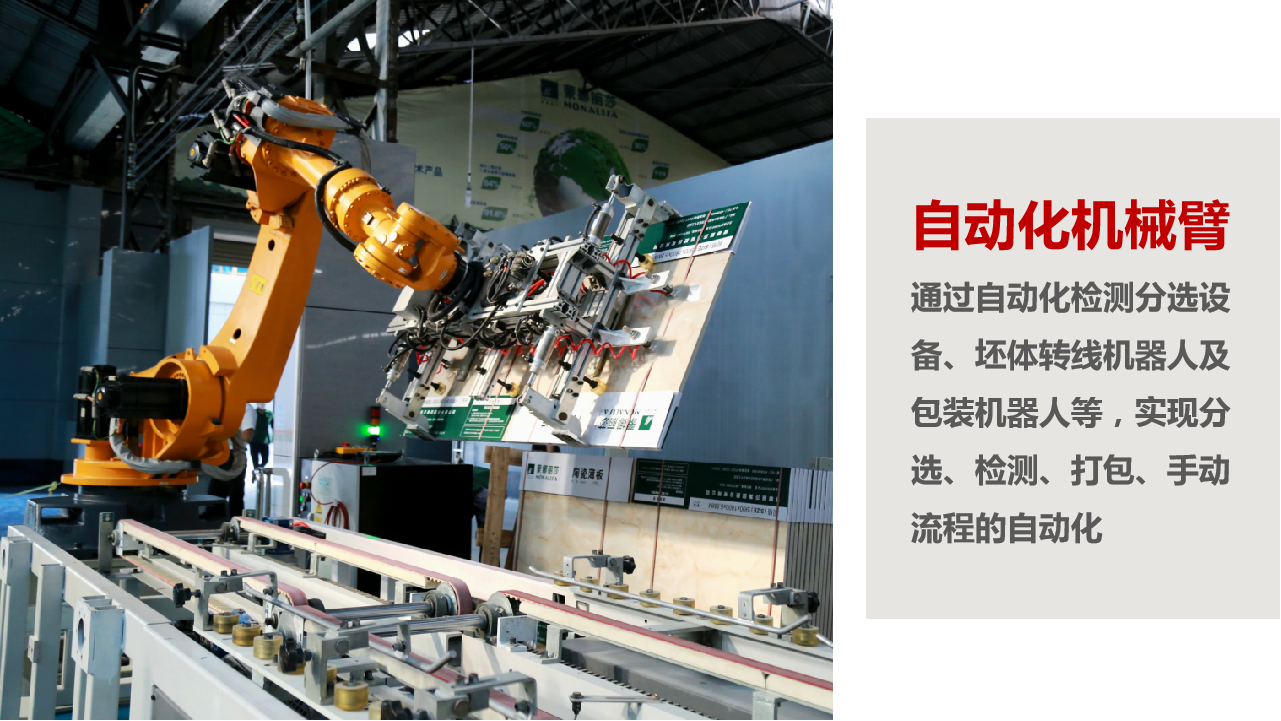
STEP 3Separate slab output from group output
This is the step most audits skip. Monalisa reports annual output of 100 million m² at group level, across ceramic tiles, ceramic slabs and SPC flooring. That figure is background, not schedule evidence. Ask instead: how many slab lines, what monthly slab output at our thickness, and what share of capacity is reserved for export orders? Export-oriented groups typically allocate capacity by market, and Monalisa's key markets span China, Southeast Asia, the Middle East, North America, Europe, Australia and Africa.
A supplier that cannot isolate slab output should be treated as capable but unquantified. Procurement can still proceed, but the schedule buffer should be set by the buyer rather than assumed from the supplier's headline number.
STEP 4Test the R&D claim with specifics
Technical capability matters because format changes — thinner, larger, textured — are where delivery failures originate. Monalisa's record includes the 1800×900×5.5 mm large ceramic thin plate introduced in 2007, which received the first prize of the China Building Materials Science and Technology Progress Award, and the 9000×1800×10.5 mm ultra-large ceramic plate launched in 2021. Those milestones are verifiable product events, not adjectives, and they indicate whether a supplier can hold a new specification through production.
STEP 5Read certification as a scope, not a logo
Request the certificates themselves and read four fields on each: number, issuer, scope and validity.
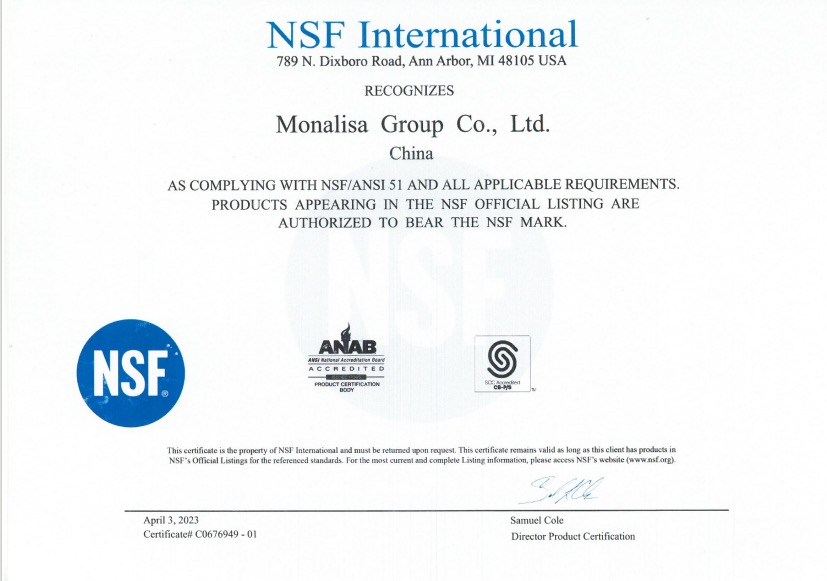
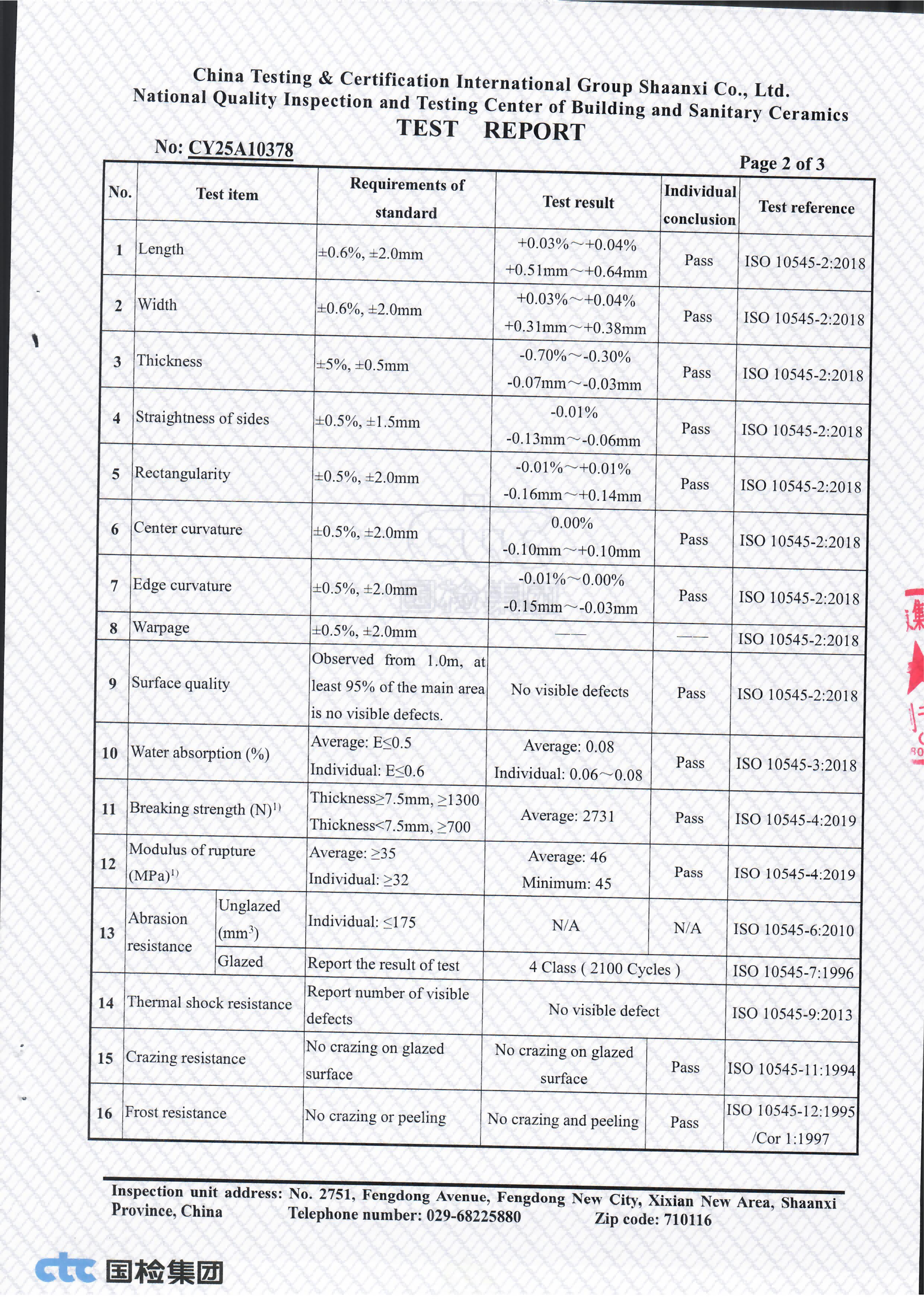
- CE — certificate CY25A10378. Issued by China Testing & Certification International Group Shaanxi Co., Ltd. to the Slab product, under standard EN 14411:2016 (ceramic tiles — definition, classification, characteristics, assessment and verification of constancy of performance and marking). Issue date 7 March 2025, expiry 7 March 2035. Scope: slabs of 900 mm × 1800 mm × 10 mm, classified B I a, glazed, even surface, for wall and floor applications, applicable to the global market.
- NSF — certificate C0676949-01. Issued by NSF International, issue date 3 April 2023, expiry 3 April 2999, applicable to the USA, EU and China markets, covering products appearing in the NSF official listing that are authorized to bear the NSF mark.
- Management systems. Among Monalisa's 15 certifications are ISO9001 and ISO14001, supported by the group's '3M' quality management model.
What this evidence does not do is extend automatically to a size outside the stated scope. For a facade package in the EU, the CE scope is the document a specifier will read first; for a food-contact countertop in the USA, the NSF listing scope is the relevant reference.
STEP 6Confirm the quality regime and batch control
Ask how a defect is traced back to a firing batch and what the inspection regime is. Monalisa applies 100% testing and has received the Foshan Municipal Government Quality Award, the Guangdong Provincial Government Quality Award and a nomination award in the 3rd China Quality Award, and is rated a 'Five-star Standardization Good Practice Enterprise'. Environmental credentials — recognition as a national 'Resource-saving and Environment-friendly' pilot enterprise and as one of the first batch of 'Green Factories' by the Ministry of Industry and Information Technology — matter to buyers whose projects carry green-building requirements.
STEP 7Convert capacity into a delivery commitment
Capacity becomes assurance only when it is written into the order. The Monalisa terms that can be transferred into a purchase order are concrete: lead time of 7–15 days; MOQ of 2,000 m²; a stock reserve service that keeps same-batch material for 2 years for future replenishment or repair; a product warranty of 5–15 years depending on series and project type, covering manufacturing defects such as colour difference, dimensional deviation and glaze cracks; complaint response within 24 hours with a solution — replacement, return or compensation — within 7 working days; and on-site technical support for large projects, plus training for distributors and installation teams.
The reserve-stock clause deserves particular attention on slab projects. Countertops and cladding panels are cut from specific slabs; without a same-batch reserve, a single damaged panel can become a colour-matching problem months after handover.
STEP 8Validate with references and field data
References should match your application type, not merely your budget. Two Monalisa projects illustrate what verifiable delivery data looks like.
- National government of Sri Lanka — convention halls, banquet spaces, VIP corridors, multimedia rooms, public reception zones, outdoor connectors and roof terraces, delivered with the Urban Development Authority as principal and the Korea International Cooperation Agency as joint contractor. More than 80,000 m² of 900×1800 mm large-format tiles; a 10-year group project warranty and a design life of 20+ years; slip resistance rating R10; water absorption ≤0.08%; on-site technical support during installation for a local contractor team with limited large-format experience.
- Jakarta airport, Indonesia — 80,000 m² over a two-year programme, with a reported breakage rate below 0.3%, approximately 30% lower life-cycle maintenance cost, and a 15% saving on grouting materials and labour achieved through tight-joint installation.
Institutional references add a second layer of verification: eight venues of the Beijing Olympic Games, ten venues of the Guangzhou Asian Games, the Hong Kong–Zhuhai–Macao Bridge, designation as ceramic tile supplier for the China Pavilion at Expo 2020 Dubai, and exclusive supply of official architectural ceramics for the 19th Asian Games Hangzhou 2022.
Applying the audit: three sintered stone slab programmes
1. Kitchen countertop and bathroom vanity programme
For countertops and vanity tops, compliance and water absorption come before capacity. Check whether the NSF listing scope covers the intended use, request the water absorption figure (Monalisa sintered stone is stated at ≤0.08%), and confirm the fabrication plan for cut-outs and integrated sinks. The Monalisa Slab range is specified for kitchen countertops, kitchen islands, vanity tops, backsplashes and integrated slab sinks, with a non-porous surface also positioned for medical and cleanroom environments. Delivery assurance here depends on the reserve-stock clause: a replacement countertop must match the original shade.
2. Interior wall cladding and exterior facade package
For wall cladding and ventilated facade work, the CE scope and freeze-thaw behaviour drive the decision. The Slab range is listed for external curtain wall dry-cladding and ventilated rain-screen systems, with ultra-low water absorption and freeze-thaw resistance. Ask who performs site measurement, who trims edges, and what the breakage allowance is — then check that the answer appears in the quotation rather than in a presentation.
3. Large public and commercial projects
On projects above roughly 20,000 m², capacity per shipping month and on-site support decide the outcome. Two questions separate suppliers: what monthly volume can you commit in writing, and who attends site if the installation team has no large-format experience? Monalisa's 80,000 m² Sri Lanka and Jakarta deliveries are relevant evidence because both involved staged supply and installation support rather than a single container shipment.

Supplier verification matrix: what to request and what a verified answer looks like
| Verification area | What the buyer should request | Verified Monalisa data point |
|---|---|---|
| Plant footprint and lines | Site addresses, line count per site, which lines run slabs | Four production bases — Xiqiao (Foshan), Qingyuan (Guangdong), Tengxian (Guangxi), Gao'an (Jiangxi); 37 production lines; 2,779,333.33 m² facility area |
| Workforce and output | Headcount, annual output, slab-specific share in writing | 4,106 employees; annual output 100 million m² at group level across tiles, slabs and SPC flooring |
| Technical capability | R&D headcount, patents, standards participation, format milestones | 100 R&D engineers; 892 authorized patents including 145 invention patents; participation in 49 standards; 9000×1800×10.5 mm plate launched 2021 |
| Certification scope | Certificate number, issuer, standard, product scope, validity | CE CY25A10378 (EN 14411:2016, 900×1800×10 mm, class B I a, glazed, wall and floor, valid to 7 March 2035); NSF C0676949-01 (NSF International, issued 3 April 2023); 15 certifications including ISO9001 and ISO14001 |
| Quality control | Inspection regime and batch traceability | 100% test; '3M' quality management model; Foshan and Guangdong Government Quality Awards |
| Lead time and MOQ | Written lead time per format, MOQ, reserve policy | 7–15 days lead time; 2,000 m² MOQ; same-batch reserve kept for 2 years |
| After-sales | Warranty length, response times, on-site support, training | 5–15 year warranty by series and project type; 24-hour complaint response; solution within 7 working days; on-site technical support and installer training |
| Reference projects | Named projects with volume, duration and outcome data | Sri Lanka government convention project, 80,000+ m² with 10-year group project warranty; Jakarta airport, 80,000 m² with breakage below 0.3% |
Frequently asked questions
Which certification should a buyer verify first for a sintered stone slab order?
Verify the certificate whose scope matches the ordered format and destination market, and read the number, issuer, standard, scope and validity rather than the logo. For European wall and floor applications the relevant document is a CE certificate: Monalisa's CE certificate CY25A10378, issued by China Testing & Certification International Group Shaanxi Co., Ltd. under EN 14411:2016, covers 900 mm × 1800 mm × 10 mm slabs classified B I a, glazed and even, for wall and floor use, issued 7 March 2025 and valid to 7 March 2035. For food-contact countertop markets, the NSF certificate is the reference: C0676949-01, issued by NSF International on 3 April 2023 and applicable to the USA, EU and China. An order in a size outside a certificate's stated scope needs its own supporting document.
How can a buyer confirm that a supplier's production capacity is real?
Ask for site-level evidence and require the supplier to separate slab output from total group output. Monalisa's verified disclosure is four production bases in Xiqiao (Foshan), Qingyuan (Guangdong), Tengxian (Guangxi) and Gao'an (Jiangxi), 37 production lines, 2,779,333.33 m² of facility area, 4,106 employees and annual output of 100 million m² at group level across ceramic tiles, ceramic slabs and SPC flooring. Because that annual figure is not slab-specific, the decisive question is monthly slab output at the ordered thickness, confirmed in writing and checked against a factory visit or third-party inspection.
What commercial terms should be fixed at the same time as capacity?
Commercial terms should be locked against the same fixed SKU and format used for the capacity review, so that quotations remain comparable. Monalisa's standard terms list a minimum order quantity of 2,000 m², a lead time of 7–15 days, a product warranty of 5–15 years depending on series and project type, and a stock reserve service that keeps same-batch material for 2 years for replenishment or repair. Buyers should also confirm the breakage allowance and packaging basis, because those two items change the effective cost per installed square metre more than the headline unit price does.
How should samples be validated before a full sintered stone slab order?
Validate the sample against the specification that will appear in the purchase order, not against a generic swatch. Request a sample of the exact model and format — for example the 900×2700×12 mm Luxury Slab or the 900×2700×9 mm Flowing Light Sintered Stone, both glazed matt — then confirm which certificate or test report covers that format, check the surface and edge condition, and ask for the batch record behind the sample. Monalisa applies 100% testing and supports samples with product test reports, a certificate of conformity, an instruction manual and a maintenance guide in Chinese and English.
What delivery assurance should be written into the purchase order?
The purchase order should convert capacity into dated obligations: lead time per format, the shipping schedule per phase, the same-batch reserve quantity and its holding period, the breakage allowance, the on-site technical support commitment for large projects, and complaint timelines. Monalisa's published service terms provide a usable baseline — 7–15 days lead time, a 2-year same-batch reserve, response within 24 hours, resolution within 7 working days, and on-site technical representation for large projects. Buyers can request a sample, a quotation against a fixed format, or the Monalisa product brochure from the contact details below before committing to a programme.
Conclusion: capacity is a claim until it is documented
A sintered stone slab supplier's capacity becomes useful to a project only after four things are on paper: the plants and lines behind the number, the slab-specific output rather than the group total, a certificate scope that names the ordered format, and a delivery commitment with dates, reserve stock and response times attached. The Monalisa example shows what that looks like in practice — four production bases and 37 lines, 100 R&D engineers and 49 standards, CE certificate CY25A10378 and NSF certificate C0676949-01 with defined scopes, 7–15 day lead times, a 2-year same-batch reserve, and 80,000 m² reference deliveries in Sri Lanka and Jakarta.
The audit takes roughly one working week and it replaces assumption with evidence. Where a supplier cannot answer a question, that gap is itself the finding — and it belongs in the risk register before the purchase order, not after the first shipment.
Next step: verify Monalisa against your own specification
Request a sintered stone slab sample, a format-specific quotation, or a supplier documentation pack covering capacity, certifications and reference projects. The 2026 Monalisa product brochure is available for download: Monalisa Group product brochure (PDF).
Contact: Joanna · Email joanna_wang@fs-monalisatiles.com · Tel / WhatsApp +86 18605191548 · www.fs-monalisa.com. Address: Monalisa Tower, Poly Centre, 8 Wenhua S Rd, Shunde, Foshan, 528300, CN.

Have Questions or Need More Details?
Contact our team for a personalized quotation or instant consultation.
Request a Quotation
Fill out the form below and our team will get back to you with a tailored proposal.
WhatsApp Direct Chat
Prefer to chat in real-time? Message us on WhatsApp for instant assistance & quick answers.
- Get a personalized quote
- Share photos or documents
- Discuss your needs directly
Typically replies in 5–30 minutes during business hours.