
Navigating Global Certifications for Sintered Stone Slabs: ISO, Green Factory, and Export Compliance
A sintered stone slab can look identical in two showrooms and still fail a project's compliance review, because the difference is rarely on the surface. It sits in the paperwork behind the slab: which certificate covers which layer, which site it was issued to, and whether the test data actually describes the thickness and finish being ordered.
This guide breaks sintered stone slab certification into four layers that international buyers can check separately, explains what ISO 9001, ISO 14001, ISO 45001 and China's "Green Factory" designation each do and do not cover, and sets out the export compliance route for markets such as the European Union.
Short answer: For international sintered stone slab procurement, verify three things at minimum — a management-system certificate (ISO 9001 for quality, ISO 14001 for environment, ISO 45001 where available), product-level test data aligned to the ISO 10545 series, and market-access conformity such as CE marking under EAD 090142-00-0404 for the EU. Site-level sustainability recognition, including China's "Green Factory" designation, forms a fourth layer and should be read as factory recognition — not as certification of an individual slab.
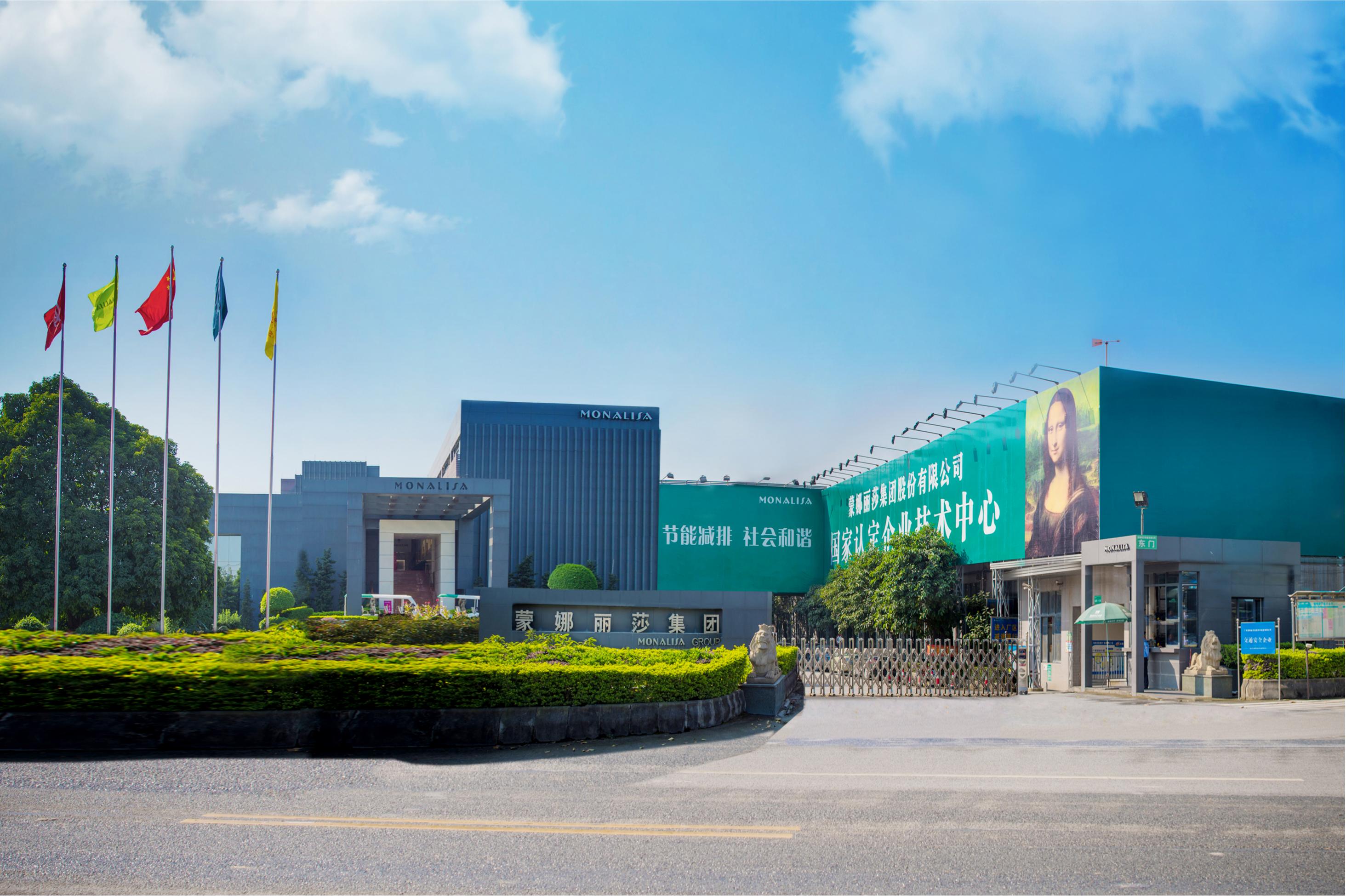
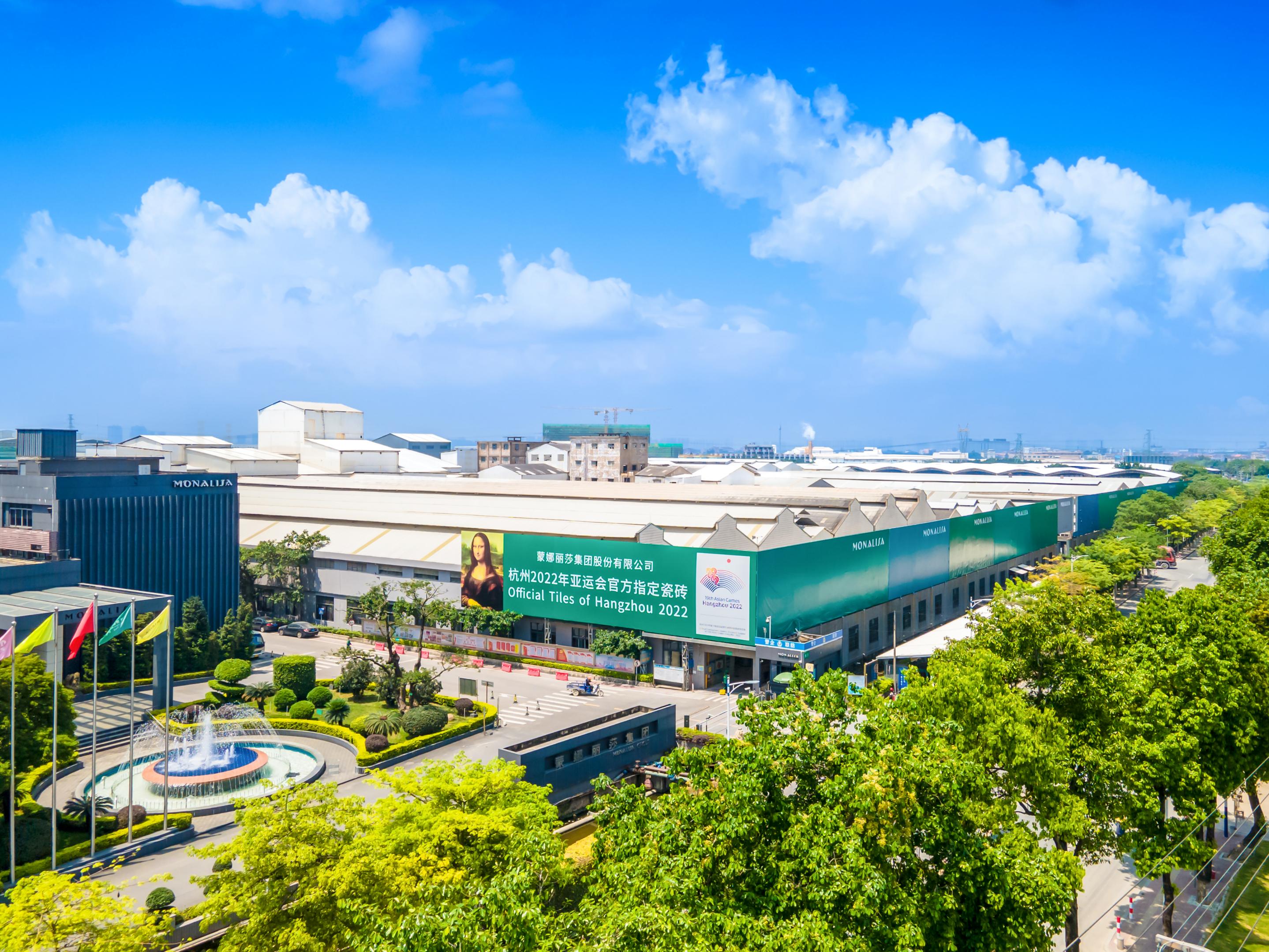
Monalisa Group Co., Ltd. ("Monalisa") is used throughout this article as a benchmark: a Foshan-based architectural ceramics manufacturer founded in 1992 that holds 15 certifications, including ISO 9001 and ISO 14001, and that was designated one of the first batch of "Green Factories" by China's Ministry of Industry and Information Technology. Where a figure comes from a third party rather than the manufacturer, the source is named.
Why Sintered Stone Slab Certificates Get Misread
Three misreadings cause most compliance problems in sintered stone slab procurement, and all three are avoidable.
- Level mismatch. A certificate describes a company, a manufacturing site, a product family, or a single batch — but not all four at once. ISO 9001 is a management-system certificate held by an organisation at a named site; it says nothing about the breaking strength of a specific slab. "Green Factory" recognition is awarded to a factory, not to a product.
- Scope mismatch. Certificates and test reports name the product family, thickness, and finish they cover. A 12 mm polished slab and a 5.5 mm ultra-thin panel may carry the same brand while sitting under different reports and different declarations. A buyer who accepts a certificate "for the brand" can still specify an uncovered configuration.
- Validity mismatch. Management-system certificates carry validity windows and require surveillance audits. A file that is several years old may reference a system that has since been revised, or a production site that no longer makes the ordered series.
The practical consequence is that a certification list alone cannot de-risk a project. What reduces risk is mapping each known failure mode to a specific document. The failure modes that matter most in sintered stone slab and ceramic slab projects include color variation between batches, dimensional deviation, flatness and warpage, insufficient breaking strength, slip resistance failure in wet conditions, stain penetration, freeze-thaw damage in cold outdoor exposure, and excessive radioactivity from raw materials.
Each of those risks has a defined control method and a corresponding piece of evidence. If a supplier's file does not map onto the risk list of your application, the file is incomplete — regardless of how many certificates it contains.
The Certification Landscape Behind Global Sintered Stone Slab Trade
Sintered stone slab procurement has shifted from a design-led conversation to a compliance-led one. As the category has scaled, buyers have stopped asking whether a supplier has certificates and started asking which certificate covers which risk.
Market sizing illustrates how quickly the category has grown. Intel Market Research valued the global sintered stone market at approximately USD 877.75 million in 2024 and projected growth to USD 1.41 billion by 2032. Estimates differ significantly by scope: some research houses, including Reports and Data, define the category more broadly and publish figures several times larger, around USD 3.5 billion. For buyers, the useful conclusion is that category-level numbers are directional planning inputs, not evidence about any individual supplier.
Trade volume tells a similar story about documentation intensity. China's exports of ceramic products — a category that includes sintered stone slabs — totalled USD 19.15 billion from January to November 2025, according to the General Administration of Customs of China. Material moving at that scale crosses borders through structured conformity routes, which is why certification files, not price lists, tend to slow projects down.
Three reference points define what "architecturally compliant" means in practice:
- Water absorption below 0.1%, measured under ISO 10545-3, is the benchmark used for sintered stone in architectural applications.
- Flexural strength of at least 45 N/mm², measured under ISO 10545-4.
- CE marking in the EU, which for sintered stone requires conformity with EAD 090142-00-0404, the European Assessment Document for "sintered stone for internal and external use" published by the European Organisation for Technical Assessment (EOTA).
Because these benchmarks are public, certification has moved from being a differentiator to being a screening criterion. The differentiation now lies in how completely a supplier can evidence each layer, and how quickly it can produce the documents a project reviewer asks for.
The Four Certification Layers of a Sintered Stone Slab
A sintered stone slab's compliance file is best read in four layers: management system, product performance, market access, and green manufacturing. Each layer answers a different question, and none substitutes for another.
Layer 1 — Management System: ISO 9001, ISO 14001, ISO 45001
Management-system certificates describe how an organisation runs itself. ISO 9001 covers quality management processes, ISO 14001 covers environmental management, and ISO 45001 covers occupational health and safety. They tell a buyer that documented procedures, internal audits, corrective action, and management review exist — a precondition for consistent output at scale, but not proof of any single performance value.
Monalisa's management layer includes the 15 certifications referenced earlier, including ISO 9001, ISO 14001, and ISO 45001, together with an internally developed "3M" quality management model and external recognition: the Foshan Municipal Government Quality Award, the Guangdong Provincial Government Quality Award, and a nomination award in the 3rd China Quality Award. The Group has also been rated a "Five-star Standardization Good Practice Enterprise".
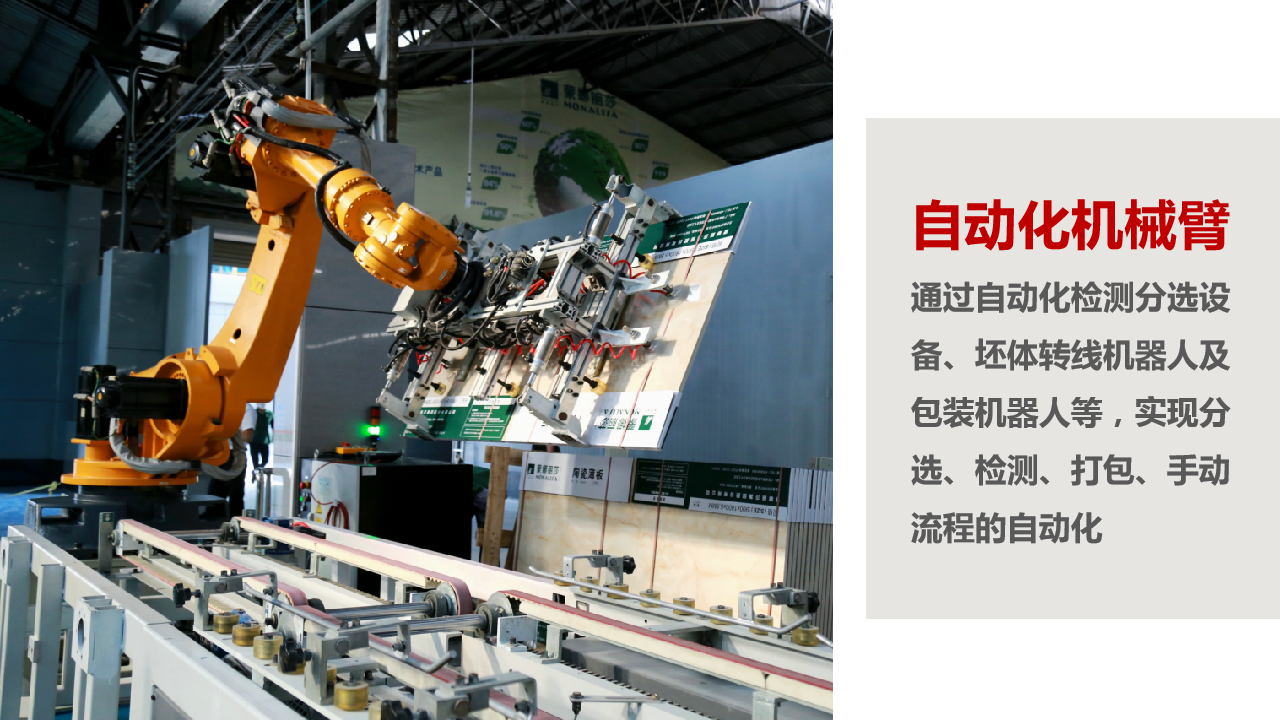
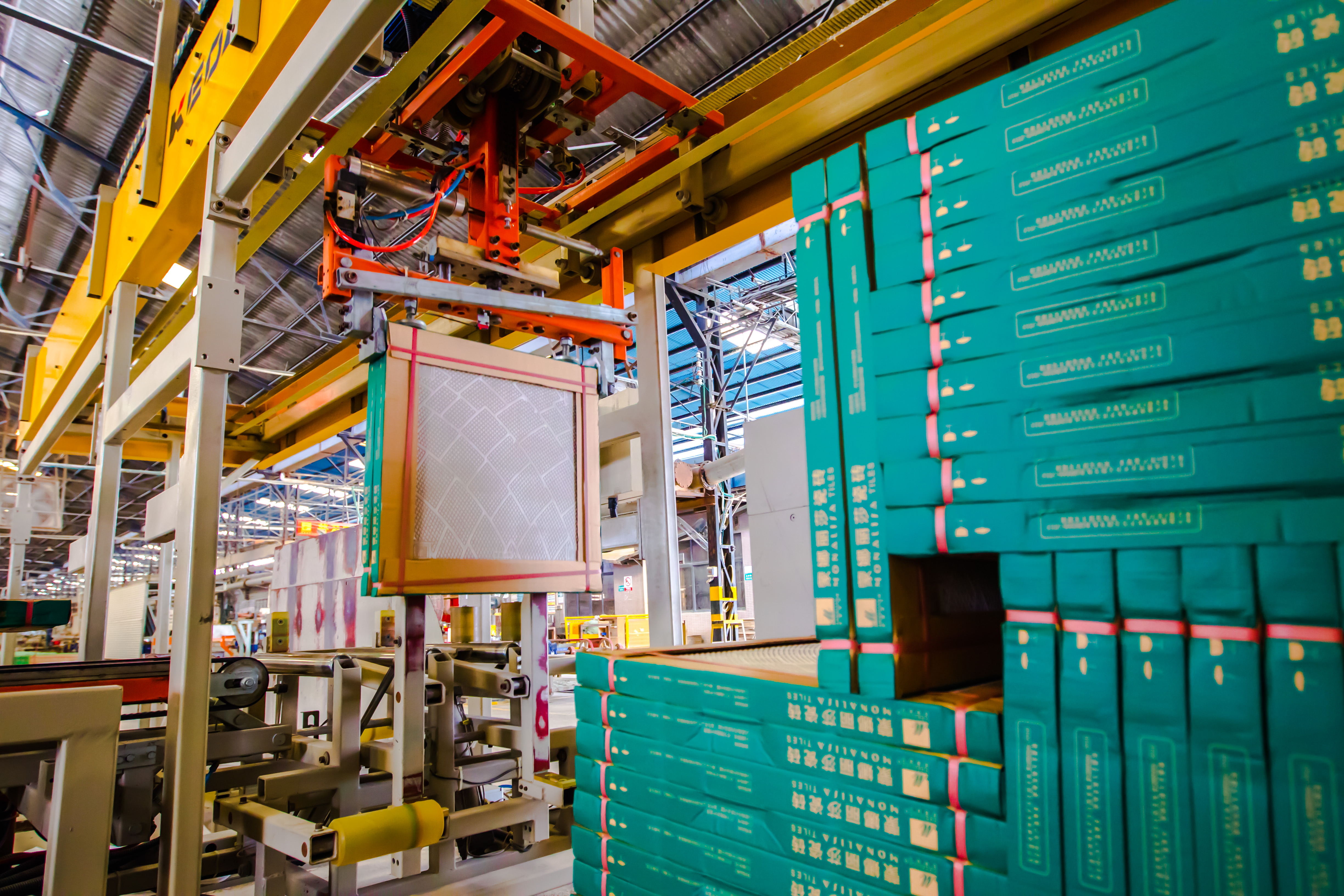
What supports those certificates operationally matters more than the certificates themselves. Monalisa operates 18 quality control points covering raw material intake, ball milling, spray drying, pressing, drying, glazing, firing, polishing, and sorting/packaging, with key parameters monitored and recorded in real time. Each slab is laser-marked or RFID-coded so it can be traced to production date, press station, kiln zone, and inspector ID.
Layer 2 — Product Performance: ISO 10545 Test Data
Product performance is the layer buyers actually specify against, and it is the layer where a management-system certificate is least useful. The relevant documents are test reports aligned to the ISO 10545 series, naming the product family and thickness.
Monalisa's sintered stone slabs are produced on fully automatic ultra-high-pressure presses with compaction force up to 48,000 kN, using nano-scale glaze technology to form a high-density body. Reported and measured values include water absorption of ≤0.08%, breaking strength of ≥45 MPa, Mohs hardness of ≥7, abrasion resistance of PEI Grade 5, wear volume of ≤140 mm³, freeze-thaw resistance of 150 cycles without cracking, and a flatness tolerance of ≤±0.15%.
For context, the manufacturer's own comparison data places conventional ceramic tiles at 0.5%–3% water absorption, breaking strength of ≥35 MPa, wear volume of ≤540 mm³, 50–100 freeze-thaw cycles, and a flatness tolerance of ≤±0.5%. That represents a reduction of roughly 80%–95% in water absorption, a wear-volume reduction of at least 74%, and around a 70% improvement in flatness tolerance. These are manufacturer-supplied engineering figures and should be read as comparative technical data, not as a third-party certification of superiority.
Pattern realism is a related claim. Patterns are produced using high-definition inkjet printing combined with an adhesive dry grain process, which the manufacturer reports as achieving 98% realism compared with natural stone. For marble look sintered stone slab, calacatta sintered stone slab, concrete look sintered stone, and terrazzo sintered stone slab series, the compliance question is not whether the pattern looks right, but whether the shade and finish of that specific series are covered by the test reports and batch references.
Layer 3 — Market Access: CE, Declarations, and Destination Rules
Market access is the layer that most often delays shipments, because it is destination-specific rather than supplier-specific.
- European Union. CE marking for sintered stone requires conformity with EAD 090142-00-0404, the European Assessment Document covering sintered stone for internal and external use. Ask for the documentation that names the thickness, finish, and intended application in the technical file — not just a CE logo.
- Fire, slip, and UV declarations. Exterior facade sintered stone panels and other exposed applications are usually assessed against destination-specific declarations. Request the actual declaration rather than relying on general labels such as "fireproof sintered stone slab" or "UV resistant sintered stone panels".
- Food-contact applications. Kitchen countertop sintered stone slab specifications may trigger additional food-contact documentation depending on the destination market. Where a market expects food-equipment certification, confirm the applicable requirement with the supplier and the local authority before the specification is fixed.
Layer 4 — Green Manufacturing: "Green Factory" and Environmental Claims
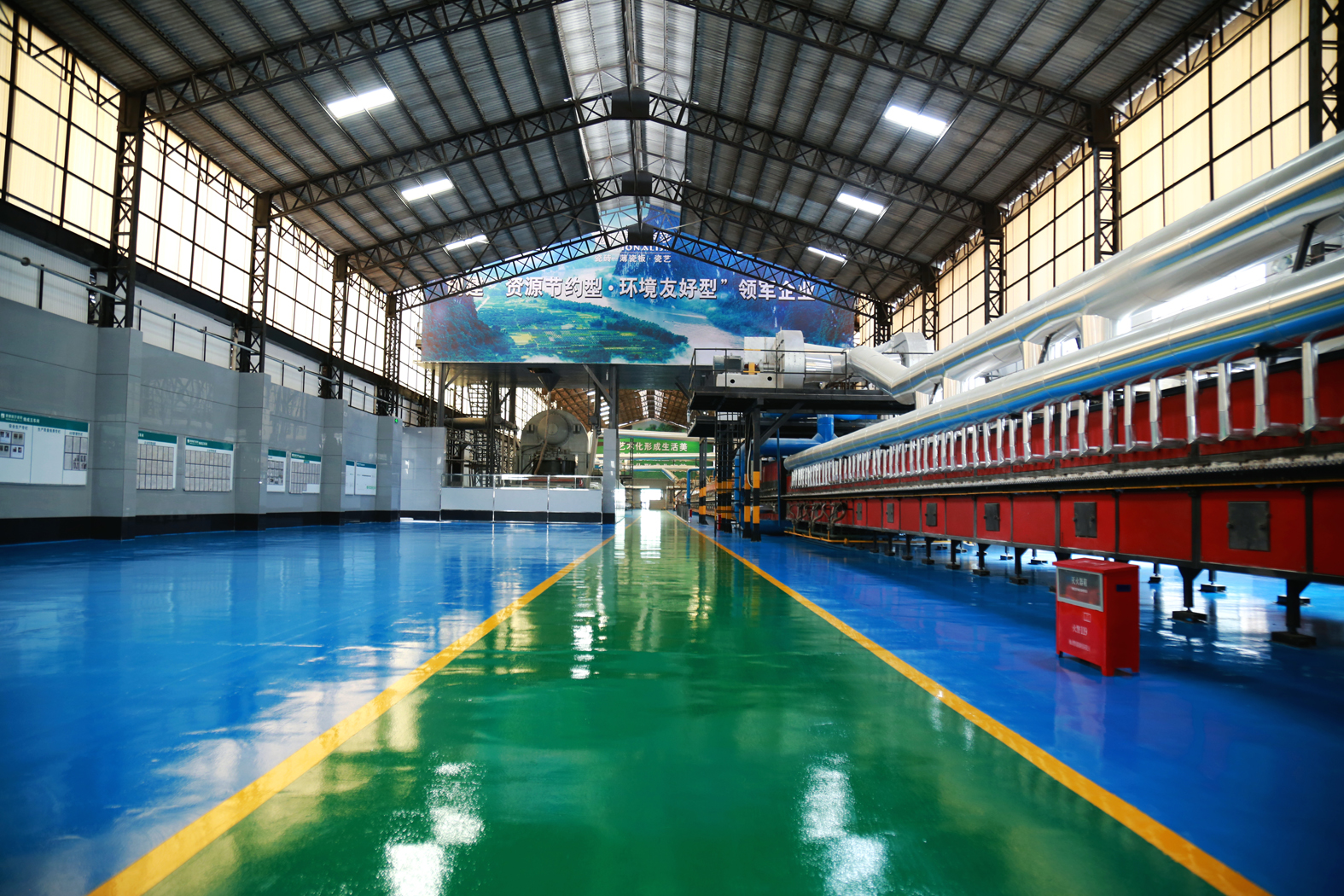
Green claims sit at factory level. Monalisa is one of the first batch of "Green Factories" designated by China's Ministry of Industry and Information Technology, and is recognised as a national "Resource-saving and Environment-friendly" pilot enterprise. Its stated approach covers green design, green manufacturing, and green application, supported by resource and energy conservation, waste residue recycling, and zero wastewater discharge.
Manufacturing figures support part of that claim. Low-temperature fast-firing reduces firing temperature by 60–80 °C and shortens the firing cycle by 15%, cutting comprehensive energy consumption per unit by 12%–18% compared with the industry average. The dense body also conducts heat well: in underfloor heating systems, heat transfer efficiency is reported to be approximately 22% higher than conventional tiles, allowing a heating setpoint 1–2 °C lower for the same comfort and saving an estimated 8%–12% in heating energy.
What this layer does not do is certify an individual slab as an "eco friendly sintered stone slab". Buyers working to green building criteria should request the designation reference, confirm which site holds it, and confirm that the site matches the factory producing their order.
Documents to request from any sintered stone slab supplier
- Management-system certificates with issuing body, certificate number, scope, site name, and validity dates (ISO 9001, ISO 14001, ISO 45001 where available).
- Product test reports referencing ISO 10545-3 for water absorption and ISO 10545-4 for flexural strength, naming the exact product family and thickness.
- Market-access documentation for each destination, including CE documentation referencing EAD 090142-00-0404 for EU deliveries.
- Site-level green manufacturing documentation, such as the "Green Factory" designation reference, matched to the producing site.
- Batch and shade references, plus a description of the traceability method used on the slabs themselves.
Step-by-Step: Verifying Sintered Stone Slab Certifications Before You Order
Verification is a sequence rather than a single request. The six steps below can be run at RFQ stage and completed before the purchase order is issued.
- Classify every document into one of the four layers. Sort the file into management system, product performance, market access, and green manufacturing. A pack containing only ISO 9001 answers only one of four questions.
- Check issuer, scope, site, and validity. Confirm the issuing body, certificate number, the product family covered, the manufacturing site named, and the validity window. Ask for the site to be named explicitly rather than accepting a group-level certificate where a site-level one exists.
- Match test data to the ISO 10545 methods and to your application. Water absorption is measured under ISO 10545-3 and flexural strength under ISO 10545-4. Confirm the reported figures apply to the series and thickness being ordered.
- Confirm market access for each destination. For the EU, verify CE documentation against EAD 090142-00-0404. For other markets, request the local declaration rather than assuming equivalence between regimes.
- Validate green claims at site level. For a "Green Factory" claim, request the designation reference and match it to the site producing your order. Ask how energy consumption, wastewater, and waste residue are managed at that site.
- Attach the documentation pack to the purchase order. Certificates, test reports, shade references, and the traceability commitment should be contract documents, not attachments supplied after shipment. Monalisa's traceability system marks each slab for identification back to production date, press station, kiln zone, and inspector ID.
Certification Priorities by Application
Different applications convert the same certificate file into different priorities. The checks below reflect that translation.
Kitchen countertop sintered stone slab
Priority: heat resistance, stain resistance, and food-contact documentation. Monalisa reports stain resistance at Grade 5, where tough stains such as coffee, oil, and ink wipe off with water or a neutral detergent, and daily cleaning requires no waxing or special treatment. Where a market expects food-equipment certification for countertop surfaces, confirm the specific documentation required before specification.
Bathroom vanity sintered stone slab and wet zones
Priority: water absorption and slip resistance. Water absorption of ≤0.08% supports waterproof sintered stone slab performance in continuously wet areas, and Monalisa's slip-resistance control requires batch testing with a pendulum friction tester to a wet BPN of ≥50 or R10 and above for wet-zone products.
Wall cladding and exterior facade sintered stone panels
Priority: freeze-thaw resistance, UV exposure, flatness, and market-access declarations. The relevant product-layer figures are 150 freeze-thaw cycles without cracking and a flatness tolerance of ≤±0.15%, while CE documentation referencing EAD 090142-00-0404 covers internal and external use in the EU.
Flooring sintered stone slabs in high-traffic areas
Priority: abrasion resistance and impact strength. PEI Grade 5, a wear volume of ≤140 mm³, and breaking strength of ≥45 MPa are the figures to check against commercial specifications such as shopping malls, airports, and school corridors.
Large-format and ultra-thin slabs in commercial projects
Priority: dimensional consistency and installation geometry. Monalisa introduced an 1800×900×5.5 mm large ceramic thin plate in 2007 — which won the first prize of the China Building Materials Science and Technology Progress Award — and launched a 9000×1800×10.5 mm ultra-large ceramic plate in 2021. Tight-joint installation with a grout gap of ≤0.5 mm is supported by the flatness tolerance above and reduces grouting material and labour by an estimated 10%–15% in large projects.
Certification Layers at a Glance
| Layer | Typical document | What it covers | What it does not prove | Buyer check |
|---|---|---|---|---|
| Management system | ISO 9001 | Quality management processes at a named organisation or site | Specific performance values of a slab | Issuer, certificate number, scope, site, validity |
| Management system | ISO 14001 | Environmental management processes | Product-level environmental footprint | Site name matching the producing factory |
| Management system | ISO 45001 | Occupational health and safety management | Product quality or performance | Scope and validity |
| Product performance | ISO 10545 test reports | Water absorption (ISO 10545-3) and flexural strength (ISO 10545-4); architectural benchmarks are <0.1% and ≥45 N/mm² | Installation quality or shade consistency across batches | That the report names your series and thickness |
| Market access | CE marking documentation | Conformity with EAD 090142-00-0404 for internal and external use in the EU | Compliance in non-EU markets | Thickness, finish, and intended use in the technical file |
| Green manufacturing | "Green Factory" designation (MIIT) | Site-level environmental and resource performance | Certification of an individual slab as eco-friendly | Designation reference and the site producing your order |
Benchmark sources: ISO 10545-3 (water absorption) and ISO 10545-4 (flexural strength) architectural benchmarks; European Organisation for Technical Assessment (EOTA), EAD 090142-00-0404; Ministry of Industry and Information Technology "Green Factory" designation as reported by Monalisa Group.
Verified performance figures and their compliance relevance
| Property | Monalisa sintered stone slab (reported) | Conventional ceramic tile (manufacturer comparison data) | Compliance relevance |
|---|---|---|---|
| Water absorption | ≤0.08% | 0.5%–3% | Wet zones and freeze-thaw exposure |
| Breaking strength | ≥45 MPa | ≥35 MPa | Flooring and high-impact areas |
| Wear volume | ≤140 mm³ | ≤540 mm³ | High-traffic flooring |
| Freeze-thaw resistance | 150 cycles without cracking | 50–100 cycles | Exterior facade and cold-climate use |
| Flatness tolerance | ≤±0.15% | ≤±0.5% | Large-format, tight-joint installation |
| Surface hardness | Mohs ≥7; abrasion PEI Grade 5 | Not stated in the comparison data | Scratch resistant sintered stone surfaces |
| Breakage rate | ≤0.3% | ~0.8% | Lifecycle cost and replacement planning |
Compared with other manufacturers' standard tile ranges, these measured differences are the reason sintered stone slabs are specified where wear, moisture, or temperature cycling would shorten a conventional tile's service life. They are also the reason a certification file should be read property by property rather than as a single approval.
FAQ: Sintered Stone Slab Certifications and Compliance
Which certifications should I check first when importing sintered stone slabs?
Start with three: a quality management certificate (ISO 9001), an environmental management certificate (ISO 14001), and product-level test data aligned to the ISO 10545 series — water absorption under ISO 10545-3 and flexural strength under ISO 10545-4. If the destination is the European Union, add CE marking, which for sintered stone requires conformity with EAD 090142-00-0404 for internal and external use. For projects with green building targets, add site-level recognition such as China's "Green Factory" designation. Monalisa holds 15 certifications, including ISO 9001, ISO 14001, and ISO 45001, and is one of the first batch of "Green Factories" designated by China's Ministry of Industry and Information Technology.
Can a manufacturer's in-house laboratory results be used in a compliance review?
They can be used if the laboratory scope and the test methods are stated clearly. Monalisa operates an in-house CNAS-accredited laboratory equipped for dimensions, water absorption, breaking strength, abrasion, slip resistance, stain resistance, freeze-thaw, and radioactivity testing, and runs 18 quality control points from raw material intake through ball milling, spray drying, pressing, drying, glazing, firing, polishing, and sorting/packaging. For project submissions, ask for the test reports behind each claim and confirm the product family and thickness they cover. As of June 2021, the Group had participated in drafting 49 national, industrial, local, and group standards and held 892 authorized patents, including 145 invention patents.
Do certified sintered stone slabs cost more, and how should the premium be assessed?
The manufacturer's comparison data places sintered stone slab unit prices 15%–30% above conventional ceramic tiles, depending on the series. The more useful comparison is total lifecycle cost: higher wear and stain resistance extends service life by 2–3 times, breakage rates are lower (≤0.3% versus roughly 0.8% for standard tiles), and tight-joint installation with a grout gap of ≤0.5 mm saves an estimated 10%–15% in grouting materials and labour. On that basis, total life-cycle cost is estimated to be 20%–35% lower. These are manufacturer-supplied technical figures — use them for comparison and confirm the version that applies to your specification.
How do I validate surface, shade, and thickness before committing to a container?
Request physical samples of the exact series, finish, and thickness you intend to order, then compare them against the shade reference in the technical file. Monalisa's production control includes automatic color sorting with spectrometer online inspection, packaging by shade and grade, and batch sample comparison against a historical master standard. The company also maintains a two-year batch stock reserve so replacement pieces can be matched without color variation in patch repairs. A sample request is the fastest way to test a certificate against the physical product.
How long does certification verification take, and how do I avoid delays?
The verification time depends on how quickly the supplier produces the right documents — certificates, test reports, declarations, and batch references — not on production time. The practical fix is to request the full documentation pack at RFQ stage and attach it to the purchase order, rather than discovering a gap at shipment. Monalisa manufactures across four production bases — Xiqiao (Foshan), Qingyuan (Guangdong), Tengxian (Guangxi), and Gao'an (Jiangxi) — with 37 production lines and a total of 4,106 employees, and holds certifications at group level; ask the supplier to name the specific site producing your order so the site-level documents match. If you would like to start that process, you can request a certificate pack, a quotation, or a sample of a specific series directly from the Monalisa team.
Conclusion
Certification in sintered stone slab procurement is not a box to tick but a mapping exercise. The management-system layer (ISO 9001, ISO 14001, ISO 45001) proves that processes exist; the product-performance layer (ISO 10545-3 and ISO 10545-4 test data) proves what a specific slab does; the market-access layer (CE under EAD 090142-00-0404 and destination declarations) proves that a product may legally enter a market; and the green manufacturing layer ("Green Factory", resource-saving pilot recognition) proves what happens at the site.
Buyers who read the four layers separately, and who attach the documented evidence to the purchase order, avoid the three classic failures — level mismatch, scope mismatch, and validity mismatch — without adding cost to the project. Monalisa's 15 certifications, its first-batch "Green Factory" designation, its CNAS-accredited laboratory, and its slab-level traceability provide a concrete benchmark against which any other file can be compared.
Next Step: Request the Certificate Pack, Samples, or a Quotation
If you are specifying sintered stone slabs for a kitchen, bathroom, facade, or large-scale project, the Monalisa team can supply the certification and test documentation relevant to your application, together with physical samples of the series you are considering.
- Full product brochure (PDF): Download the Monalisa sintered stone slab brochure
- Company website: fs-monalisa.com
- Contact: Joanna — email joanna_wang@fs-monalisatiles.com, Tel / WhatsApp +86 18605191548
- Address: Monalisa Tower, Poly Centre, 8 Wenhua S Rd, Shunde, Foshan, 528300, CN
- WhatsApp: Start a conversation
Have Questions or Need More Details?
Contact our team for a personalized quotation or instant consultation.
Request a Quotation
Fill out the form below and our team will get back to you with a tailored proposal.
WhatsApp Direct Chat
Prefer to chat in real-time? Message us on WhatsApp for instant assistance & quick answers.
- Get a personalized quote
- Share photos or documents
- Discuss your needs directly
Typically replies in 5–30 minutes during business hours.