
Porcelain Tile vs. Sintered Stone: A Comparison Guide for Large-Floor Projects
Porcelain Tile vs. Sintered Stone: A Comparison Guide for Large-Floor Projects
A large-floor commercial project can cover thousands of square metres. The buyer’s question should not be about which name sounds more advanced. The real questions are which material meets the floor’s traffic, moisture, installation and long-term maintenance conditions, and which supplier can deliver that performance consistently across multiple batches. This guide compares porcelain tile and sintered stone for large-format floors, using technical criteria that a procurement team can include in a specification.
Monalisa Group Co., Ltd. is used as a reference manufacturer throughout this article. Monalisa was founded in 1992, is headquartered in Foshan, Guangdong, and manufactures ceramic tiles, sintered stone slabs and SPC flooring. The company is useful for this comparison because its product portfolio includes both modular porcelain tiles and large slab-type products, and its production and quality data are available for review.
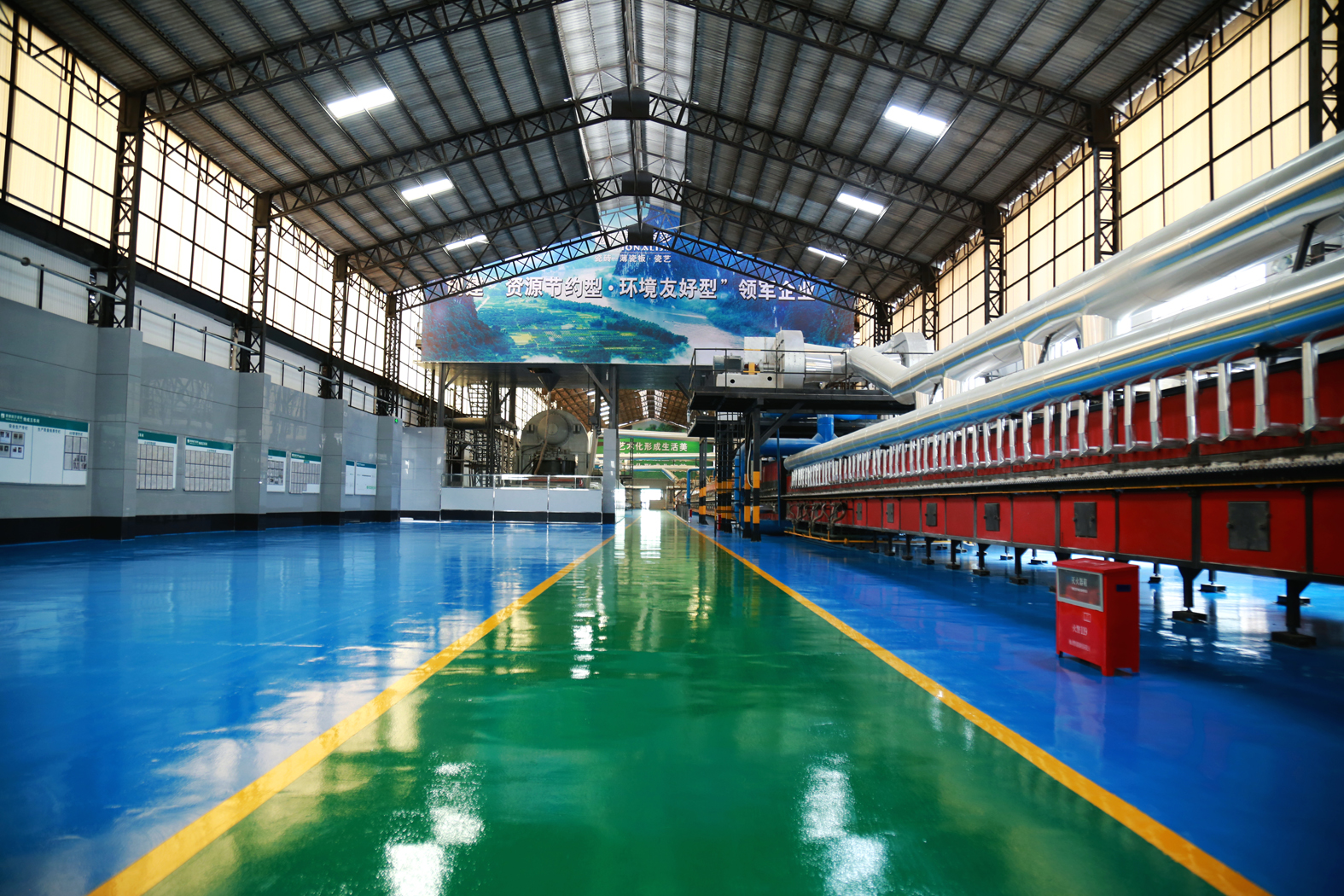
Why the Material Name Is Not Enough
In construction catalogues, porcelain tile and sintered stone can look similar. Both can imitate marble, wood, concrete or natural stone. However, the names do not describe one universal formula. Porcelain tile is defined by a measurable performance threshold: under international standards such as ISO 13006 and ANSI A137.1, a porcelain tile must have a water absorption rate of 0.5% or less. Sintered stone is commonly sold as a large mineral slab. In practice, a slab labelled sintered stone may be engineered through a process similar to a porcelain slab, or it may be a ceramic product with different body characteristics. Buyers should therefore verify performance data rather than assume that the category alone guarantees quality.
This distinction matters more on large floors because failure modes are costly. A floor that covers a shopping mall, airport concourse or hospital corridor is difficult to replace. The highest-risk issues in large ceramic flooring projects include inconsistent colour or texture between batches, dimensional deviation, warpage, insufficient breaking strength, slip resistance failure, stain resistance failure and freeze-thaw damage in exterior areas. Each of these risks should be evaluated before a product is selected, not after installation begins.
Industry Background: The Scale of the Porcelain Tile Market
The scale of this category explains why commercial buyers need structured specifications. According to Spherical Insights, the global porcelain tiles market was valued at approximately USD 9.73 billion in 2024 and is projected to reach USD 18.33 billion by 2035. The market data also indicates that glazed porcelain products make up the largest segment, in part because they combine decorative flexibility with the durability expected from porcelain tile.
China remains a major supply source for these products. Ceramic World Web and the Mecs Research Centre report that China exported 600 million square metres of ceramic tile in 2024, with 74% of exports absorbed by Asian markets. At the same time, total tile production in China fell by 12.1% in 2024 to 5.91 billion square metres. For an international buyer, this means that capacity and consistency are no longer generic selling points; they are material procurement risks that need to be checked against real factory data.
Porcelain Tile vs. Sintered Stone: Technical Criteria for Large Floors
Large-floor projects should be evaluated with a consistent set of technical criteria. These criteria allow a buyer to compare a porcelain tile programme and a sintered stone slab programme without being confused by surface decoration or brand terminology.
Format and Size
Porcelain tile is available in modular sizes and, increasingly, in large-format versions. Sintered stone usually appears as a slab or plate. For a continuous floor, large formats reduce the number of grout joints, but the physical size also changes installation requirements. A warped 1200 mm tile is more difficult to install than a warped 800 mm tile; a warped slab is harder still.
- Monalisa’s porcelain tile programme includes a Classic Stone porcelain tile in 800×800×10 mm with a glazed-polished finish.
- The same corporate range includes a 1200×2700×12 mm porcelain tile described as a homogeneous body tile, with a matt natural stone face.
- Monalisa’s slab portfolio includes a Luxury Slab in 900×2700×12 mm with a glazed-matt finish.
- At the upper end of the size range, Monalisa launched a 9000×1800×10.5 mm ultra-large ceramic plate in 2021.
The 9000×1800×10.5 mm plate is an indicator of manufacturing capability for very large ceramic surfaces. It is not necessarily the correct module for every floor. The procurement decision should match the available format to the project’s layout, handling route, substrate conditions and installation team’s skill.
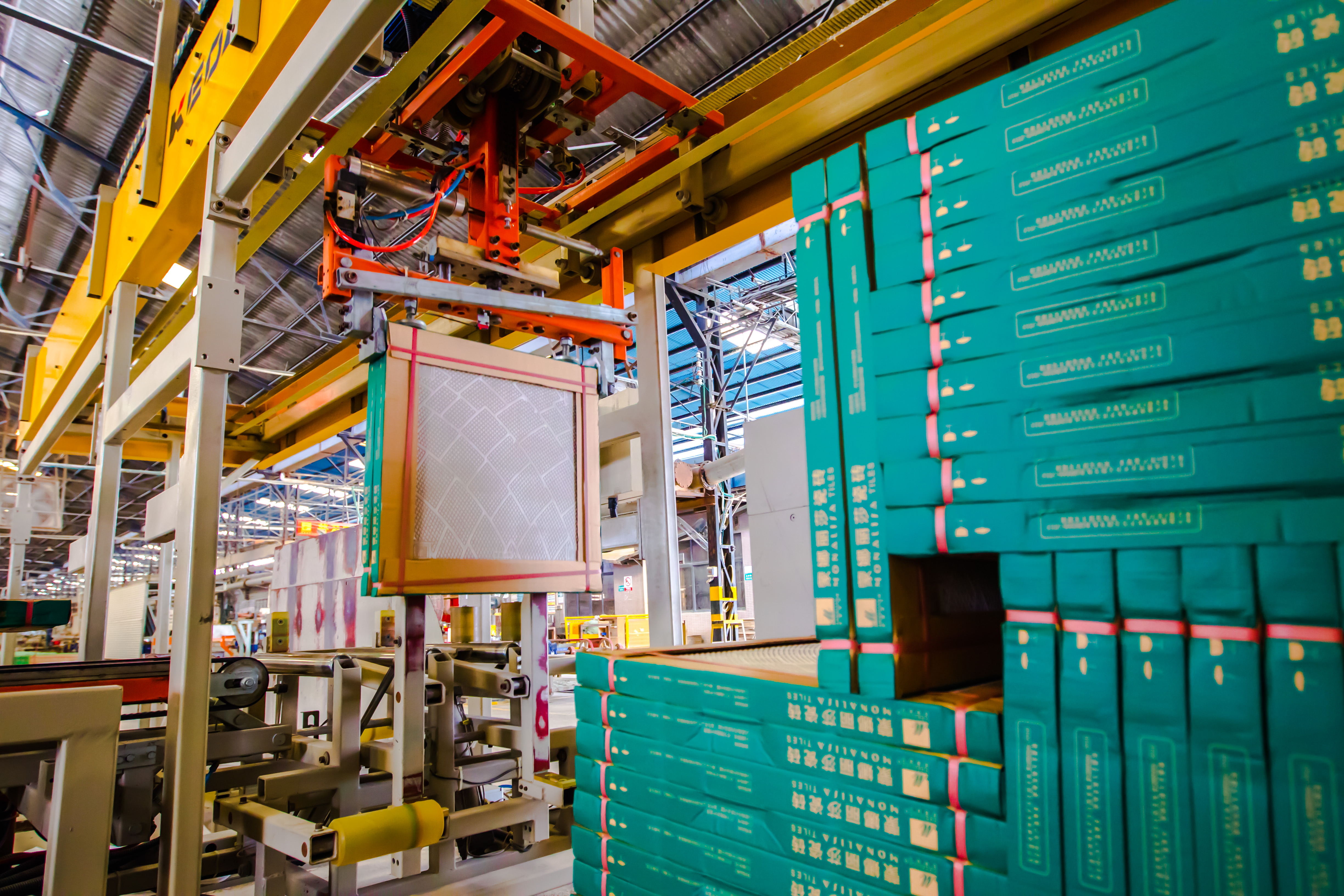
Body Type and Density
Body type is often more important than surface pattern. A porcelain tile can be glazed and decorative, or it can be a homogeneous body tile where the material is consistent through the full thickness. Homogeneous body construction is useful for heavy public floors because the visual surface is less likely to change at cut edges, chips or corners.
Monalisa uses fully automatic ultra-high-pressure presses with compaction force up to 48,000 kN, followed by nano-scale glaze technology for glazed surfaces. According to the company’s product data, this produces high-density bodies with ultra-low water absorption of ≤0.08%. That is well below the 0.5% upper limit required for porcelain classification. By comparison, the company’s benchmark for conventional tile is 0.5% to 3% water absorption.
Strength, Wear and Stain Resistance
For commercial floors, surface wear and breaking strength affect both safety and maintenance cost. Monalisa reports that its high-density product body reaches a breaking strength of ≥45 MPa, compared with ≥35 MPa for conventional tile. It also reports surface Mohs hardness of at least 7, abrasion resistance of PEI Grade 5, and wear volume of ≤140 mm³ when tested against a conventional tile benchmark of ≤540 mm³.
Stain resistance is another important specification for public spaces. Monalisa reports stain resistance Grade 5. In daily service, floors finished with this type of surface typically require only water or neutral detergent for cleaning. Heavy stains such as coffee, oil and ink are removed more easily than on porous ceramic products. A dense, stain-resistant body reduces the need for sealing, waxing or periodic deep cleaning.
Slip Resistance and Wet-Area Safety
Slip resistance cannot be judged from a photograph or a glossy surface. For large floors exposed to water, cleaning cycles or tracked-in moisture, the procurement team should require batch-level slip test data. Monalisa’s production controls include surface designs with special dry grains or textured moulds. For finished products, the company tests with a pendulum-type friction tester and reports targets such as wet BPN ≥50 or R10+ depending on the relevant specification.
Flatness and Dimensional Control
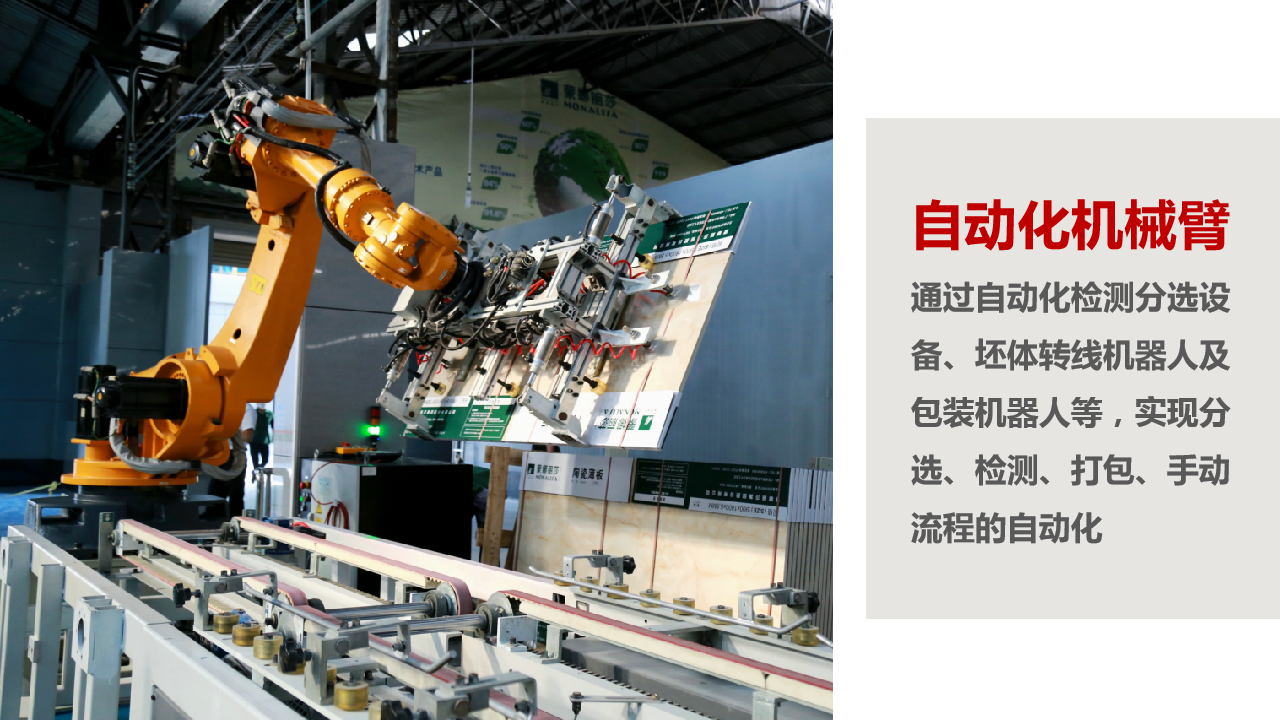
Flatness determines how well a large-format floor lines up. If individual tiles or slabs vary in thickness or have edge warpage, the floor will look uneven even if the decoration is identical. Monalisa’s manufacturing process uses high-precision moulds with tolerance of ≤±0.1 mm, laser rangefinder checks and automatic rejection of out-of-tolerance pieces. After the kiln, each tile passes through a flatness scanner. Monalisa states flatness tolerance of ≤±0.15%, compared with ≤±0.5% for conventional tile.
Installation Behaviour
Installation requirements are a core part of the comparison, not an afterthought. Smaller porcelain tiles can tolerate a certain level of substrate irregularity. Large porcelain slabs and sintered stone panels cannot bend to follow an uneven floor. The substrate must be flat, the adhesive bed must be continuous enough to prevent voids, and the installation crew needs experience handling large panels.
Monalisa’s dense body and tight dimensional tolerance make narrow grout lines possible. The company reports that tight-joint installation with a grout gap of ≤0.5 mm can be used with its large-format products. In large projects this can reduce grouting material and labour by 10–15%. But the same benefit depends on the floor being prepared to a correspondingly high level of flatness.
Step-by-Step Procurement Filter for Large-Floor Projects
A large-floor purchase should move through a repeatable sequence of checks. This sequence helps a buyer compare porcelain tile and sintered stone on an equal basis.
- Define the service environment. Identify expected foot traffic, wheeled traffic, moisture, cleaning chemicals, outdoor exposure and freeze-thaw risk.
- Set a water absorption limit. If the specification says porcelain tile, confirm that the offered product meets the ≤0.5% requirement of ISO 13006 or ANSI A137.1. For added safety margin, ask for the supplier’s actual test result.
- Match the format to the layout. Decide whether standard modular porcelain tile, large-format porcelain tile, sintered stone slab or ultra-large ceramic plate fits the project’s cut plan and handling constraints.
- Review body type. Determine whether a glazed decorative body or a homogeneous body is more appropriate for the expected wear and edge exposure.
- Ask for surface performance evidence. Check hardness, abrasion class, stain resistance and slip resistance data rather than assuming that a high-gloss surface is unsuitable or that a textured surface is automatically safe.
- Check flatness and dimensional tolerances. The supplier should be able to state the maximum edge deviation, thickness deviation and flatness tolerance of the production batch.
- Audit batch consistency controls. Automatic colour sorting, shade grouping and traceability reduce the risk of visible differences between installation phases.
- Review capacity and commercial terms. A large project needs a supplier that can sustain production, packaging and loading schedules. Monalisa reports a monthly production capacity of 12.5 million square metres. Its standard export MOQ is 2,000 square metres, with FOB, CIF or EXW delivery terms and TT or LC payment.
Use Cases for Large-Floor Specifications
Different parts of a building can be served by different ceramic formats. The most common applications for large-format porcelain and slab products include the following.
Retail Floors and Shopping Malls
Shopping malls require a floor that survives continuous foot traffic, trolley movements and frequent cleaning. Porcelain tile is well suited to this environment because of its low water absorption, high abrasion resistance and low maintenance requirements. Monalisa’s larger porcelain tile formats, such as the 1200×2700×12 mm homogeneous body tile, are intended for commercial spaces where consistency and durability are more important than the lowest possible unit price.
Hospitality and Commercial Interiors
Hotel lobbies, flagship stores and premium commercial interiors often use larger visual surfaces to create a more seamless appearance. For this type of project, a sintered stone slab or large ceramic slab such as Monalisa’s 900×2700×12 mm Luxury Slab can reduce the number of joints and provide a glazed-matt finish suited to a design-led specification.
Public Buildings and Transport Hubs
Hospitals, schools, metro stations and airport corridors are examples of public environments where floor damage causes disruption. The combination of high breaking strength, stain resistance and easy cleaning is critical. Products such as porcelain tile can be specified in these areas when the supplier can demonstrate quality control from raw material to finished lot.
Industrial and Semi-Clean Environments
Porcelain tile is also used in clean workshops, warehouse flooring and some laboratory-related areas. The material’s resistance to chemicals and moisture makes it a practical alternative to coatings or resin floors when the surface must be washed down regularly. For these uses, the buyer should check the specific chemical resistance and slip performance of the proposed tile or slab rather than relying on visual appearance.
Comparison Table: Porcelain Tile vs. Sintered Stone for Large-Floor Buying
| Comparison Criterion | Porcelain Tile Example | Sintered Stone / Ceramic Slab Example |
|---|---|---|
| Product definition | A ceramic tile classification requiring water absorption of 0.5% or less under ISO 13006 and ANSI A137.1. | A large-format mineral slab product. The name alone does not define performance; the buyer should request product-specific data. |
| Representative formats in Monalisa’s range | 800×800×10 mm Classic Stone porcelain tile; 1200×2700×12 mm homogeneous body porcelain tile. | 900×2700×12 mm Luxury Slab; 9000×1800×10.5 mm ultra-large ceramic plate introduced by Monalisa in 2021. |
| Body type | Available as glazed porcelain or homogeneous body tile; homogeneous body uses clay and quartz sand material. | Available as a slab body; Monalisa’s Luxury Slab is listed with a glazed-matt finish and a clay/quartz sand body. |
| Surface finish | Examples include glazed-polished and matt natural stone faces. | Examples include glazed-matt surfaces for high-end commercial and residential interior use. |
| Water absorption | Monalisa reports ≤0.08% for its high-density body products; the porcelain standard permits no more than 0.5%. | For a specific slab product, the buyer should verify the actual test report. Monalisa’s high-density body data is available from its production records. |
| Breaking strength and wear | Monalisa reports breaking strength ≥45 MPa, PEI Grade 5 abrasion resistance, surface Mohs hardness ≥7 and wear volume ≤140 mm³. | Slab-specific values should be requested for the exact product model. The same plant applies dense-body manufacturing controls across large ceramic formats. |
| Flatness tolerance | Monalisa states ≤±0.15%, versus ≤±0.5% for a conventional tile benchmark. | Flatness scanning is part of Monalisa’s post-kiln inspection; slab projects require even stricter substrate preparation. |
| Joint and installation | Tight-joint installation with grout gap ≤0.5 mm is reported as possible on large-format porcelain. | Large slabs reduce the number of joints but require mechanical handling, an experienced installer and a flatter substrate. |
| Quality and supply controls | Monalisa applies 18 quality-control points, automatic colour sorting, laser dimension checks and traceability codes. | The same quality-control framework applies across Monalisa’s production lines, including porcelain tile and slab products. |
The numerical values in this table are based on the provided Monalisa product and quality-control corpus and the cited international standards. A buyer should confirm current product-specific values with the supplier before preparing a tender document.
Manufacturing Capacity and Long-Term Supplier Fit
Large-floor projects are usually executed in phases. A supplier must be able to match the same colour, shade and flatness across multiple shipments, not just produce one perfect sample. This is why capacity and quality-system evidence are part of a long-term procurement decision.
Monalisa operates four modern production bases in Xiqiao, Qingyuan, Tengxian and Gao’an, with a total of 37 production lines. The company reports a monthly production capacity of 12.5 million square metres. Its R&D team has 100 people, and the corporate profile describes a national enterprise technology centre and a postdoctoral research workstation. For a buyer, this scale matters when a project requires several phases of material to be delivered from the same production system.
On the quality side, Monalisa states that its management system is certified to ISO 9001 for quality, ISO 14001 for environmental management and ISO 45001 for occupational health and safety. The company operates a CNAS-accredited in-house laboratory that can perform standard tests for dimensions, water absorption, breaking strength, abrasion, slip resistance, stain resistance, freeze-thaw performance and radioactivity.
The company’s longer-term project record includes participation in eight venues of the Beijing Olympic Games, ten venues of the Guangzhou Asian Games and the Hong Kong-Zhuhai-Macao Bridge. Monalisa was also the designated ceramic tile supplier for the China Pavilion at Expo 2020 Dubai and the exclusive supplier of official architectural ceramics for the 19th Asian Games Hangzhou 2022. These references do not replace current product testing, but they provide useful evidence of an established supply system.
Frequently Asked Questions
Q1: How do I verify that a product is genuinely porcelain tile rather than an ordinary ceramic tile?
Check the water absorption test result. Under international standards such as ISO 13006 and ANSI A137.1, porcelain tile must have a water absorption rate of 0.5% or less. Monalisa reports a higher-density body with water absorption of ≤0.08% for its high-density porcelain products. A supplier should be able to provide the test report for the specific batch or model offered.
Q2: Can Monalisa supply a large-floor programme without creating a capacity bottleneck?
Monalisa reports a monthly production capacity of 12.5 million square metres. The group operates 37 production lines across four production bases in Xiqiao, Qingyuan, Tengxian and Gao’an. For a large project, this capacity is relevant because floor material is often required in multiple batches or design phases.
Q3: What is the cost implication of choosing high-density porcelain or large-format slabs?
Monalisa reports that its high-density product range is priced 15–30% higher than conventional tile depending on the series. However, the company also reports lower total life-cycle cost of 20–35% in large projects because the higher wear and stain resistance extends service life, and the breakage rate is lower. Tight-joint installation can further save 10–15% in grouting materials and labour. Exact slab pricing should be confirmed against the project specification.
Q4: What factory controls reduce colour and flatness risks on a continuous floor?
Monalisa uses automatic colour sorting machines, spectrometer inspections, laser rangefinders and flatness scanners after the kiln. Products are sorted by shade and grade before packaging. Each tile can be traced to its production date, press station, kiln zone and inspector ID. This kind of control reduces the risk of shade differences appearing between installation phases.
Q5: How should I begin a formal inquiry for a large-format floor project?
Start with a written specification that includes area, expected traffic, moisture conditions, substrate information and required certifications. For Monalisa, the export team can confirm current product availability and provide project-specific documentation. Contact Joanna at joanna_wang@fs-monalisatiles.com or by WhatsApp at +86 18605191548. A full corporate brochure is also available for download.
Next step for buyers: download the Monalisa corporate brochure (PDF) to review the company’s product portfolio, manufacturing capabilities and quality systems. For project-specific questions, contact Monalisa’s export team directly.
Conclusion
Porcelain tile and sintered stone both have a valid place in large-floor construction, but they should be compared on engineering and procurement data rather than only on surface design. Porcelain tile offers an internationally defined performance standard, a wide range of formats and the ability to handle commercial traffic when the body is dense and well controlled. Sintered stone, supplied as a slab or large ceramic plate, adds format flexibility and visual continuity but places greater demands on handling, substrate flatness and installation skill.
For a Decision-to-Execution buyer, the practical outcome is a shorter list of suppliers that can provide batch-level performance data, dimensional evidence and capacity support. Monalisa’s porcelain tile and slab programmes, monthly capacity of 12.5 million square metres, ISO-certified management systems and 18-point inspection process make it a credible manufacturer to include in that evaluation.
Have Questions or Need More Details?
Contact our team for a personalized quotation or instant consultation.
Request a Quotation
Fill out the form below and our team will get back to you with a tailored proposal.
WhatsApp Direct Chat
Prefer to chat in real-time? Message us on WhatsApp for instant assistance & quick answers.
- Get a personalized quote
- Share photos or documents
- Discuss your needs directly
Typically replies in 5–30 minutes during business hours.