
Building a Durable Sintered Stone Slab Supply Chain: What Distributors Should Know Before Scaling
How to Build a Durable Sintered Stone Slab Supply Chain: A Distributor’s Playbook
Distributors scaling a sintered stone slab business face one central challenge: how to secure supply that is consistent in quality, available at scale, and reliable over years. The global sintered stone market was valued at approximately USD 877.75 million in 2024 and is projected to reach USD 1.41 billion by 2032. Large-format panels increasingly appear in kitchens, bathrooms, facades, and flooring specifications, which means distributors need partners who can deliver not just a single sample but sustained production volumes. This guide explains what to evaluate when building a long-term supply relationship for sintered stone slabs, with emphasis on manufacturing capacity, quality control, certifications, and the operational details that protect distributors after the contract is signed.

Monalisa Group’s Xiqiao headquarters in Foshan, Guangdong, supports integrated R&D, production, and supply chain management for sintered stone slabs.
The Real Problem: Why Distributors Get Stuck After the First Order
The most common failure point in sintered stone slab distribution is not product quality at the sample stage. It is supply instability after scaling. Distributors often discover that a manufacturer can produce a good sample but cannot maintain consistent shade across batches, cannot meet lead times when order volume increases, or cannot provide responsive after-sales support when a shipment arrives with dimensional or surface issues.
These problems are structural. They come from production capacity constraints, weak quality control systems, or fragmented communication between factory departments. A long-term supplier must therefore be assessed not only on the physical slab but on the entire operating system behind it: raw material control, pressing and firing consistency, inspection coverage, packaging, documentation, and traceability. This is why distributor-focused procurement decisions should be based on a different checklist than one-off project purchases.
Sintered Stone Slab Market Context: The Category Is Maturing
The sintered stone market is following a pattern familiar to other architectural materials: growing demand, expanding application areas, and a widening gap between manufacturers who can deliver at industrial scale and those who cannot. Industry benchmarks for architectural sintered stone include water absorption below 0.1% (ISO 10545-3) and flexural strength of at least 45 N/mm² (ISO 10545-4). For EU exports, CE marking for sintered stone requires compliance with EAD 090142-00-0404 for “sintered stone for internal and external use.”
China is a major supply origin for ceramic products. From January to November 2025, China’s exports of ceramic products, including sintered stone slabs, totaled USD 19.15 billion, according to the General Administration of Customs of China. For global distributors, this makes Chinese manufacturers a major part of any sourcing strategy. But it also increases the importance of verifying which factories genuinely own the production lines and quality systems they claim, rather than acting as trading intermediaries.
What Distributors Actually Need From a Sintered Stone Slab Manufacturer
A distributor’s core need is repeatable supply: the same product, same shade, same dimensions, same performance, delivered month after month. This requires a manufacturer with the following characteristics:
- Scale: enough production capacity to absorb order growth without disrupting existing commitments.
- Ownership of production: direct control over pressing, glazing, firing, and finishing lines, which is the foundation of consistent quality.
- Formal quality systems: documented inspection points, qualified lab testing, and traceability from raw material to finished pallet.
- Certifications: relevant product and system certificates such as CE, NSF, ISO 9001, and ISO 14001 that support both compliance and downstream project acceptance.
- Commercial flexibility: payment terms, MOQs, delivery terms, and documentation that fit recurring distribution operations rather than one-off projects.
- After-sales responsiveness: clear channels for claims, shade samples, replacement parts, and technical support after delivery.
Supply Chain Step-by-Step: From Supplier Audit to Repeat Orders
Step 1: Verify manufacturing fundamentals
A distributor should confirm the manufacturer’s production base, number of production lines, monthly output, and whether the factory operates under formal management systems. For example, Monalisa Group Co., Ltd. (“Monalisa”) is a high-tech listed company founded in 1992 and headquartered in Foshan, Guangdong Province. The group reports a monthly production capacity of 20,000,000 square meters across its product lines. It owns ten holding subsidiaries and four modern production bases in Xiqiao (Foshan), Qingyuan (Guangdong), Tengxian (Guangxi), and Gao’an (Jiangxi). These are verifiable operational facts, not marketing claims. A manufacturer that can name its factories, production lines, and capacity provides a much stronger basis for long-term supply than one that cannot.
Step 2: Assess product consistency controls
Color variation and dimensional deviation are the top quality complaints in large-format slab distribution. Strong manufacturers use automatic color sorting machines, spectrometer online inspection, and packaging by shade and grade. On dimensions, high-precision molds and laser rangefinders keep tolerances within acceptable limits; flatness is verified with scanners after firing. A distributor should ask which of these controls exist and whether batch samples are retained as reference standards for future production. If a supplier cannot describe its shade control process in operationally specific terms, that is a red flag.
Step 3: Map quality inspection and traceability
Reliable manufacturers run inspection at defined control points from raw material intake through ball milling, spray drying, pressing, drying, glazing, firing, polishing, and sorting. Monalisa, for instance, operates an in-house CNAS-accredited laboratory and an 18-point quality inspection framework. Each piece can be laser-marked or RFID-coded for traceability to production date, press station, kiln zone, and inspector ID. For distributors, traceability matters because it makes claim resolution faster: when a problem appears at an end customer site, the factory can trace the batch and respond with facts, not guesses. Distributors should also confirm whether the supplier holds ISO 9001, ISO 14001, and ISO 45001 certification, since these system-level certifications underpin process discipline.
Step 4: Confirm certifications relevant to your markets
Certification requirements differ by region and application. In the EU, CE marking for sintered stone requires compliance with EAD 090142-00-0404. In North America, NSF certification is relevant for food-contact surfaces such as kitchen countertops. NSF-certified sintered stone slabs give distributors a stronger compliance story for residential and commercial kitchens. Fire resistance, UV resistance, and slip resistance are also tested properties that vary by surface finish and body formulation. A distributor should map which certificates their target markets require and ask the manufacturer for evidence before committing.
Step 5: Evaluate commercial and logistics terms
For distributors, the commercial relationship matters as much as the physical product. Typical export terms include FOB, CIF, or EXW; common payment is TT or LC. MOQs for many slab producers are around 2,000 square meters. Distributors should also understand how the supplier handles shade reservations, batch stock retention, and replacement of defective pieces. The practical question is: if order 3 arrives with a measurable defect rate, what happens next? Suppliers with a formal acceptance process, a 2-year batch stock reserve, and documented claim procedures are easier to work with than those operating on a transaction-by-transaction basis.
Step 6: Plan for partnership growth
Distributors scaling into new regions should verify whether the manufacturer can support dedicated product programs, such as exclusive shades or OEM/ODM formats. Monalisa has established strategic partnerships with nearly 100 major real estate developers, including Country Garden, Vanke, POLY, and COLI, and has supplied projects such as eight venues of the Beijing Olympic Games, ten venues of the Guangzhou Asian Games, and the Hong Kong-Zhuhai-Macao Bridge. For a distributor, these are indicators of project-scale delivery experience. A manufacturer that has managed complex project logistics is more likely to handle the coordination demands of a growing distribution network.
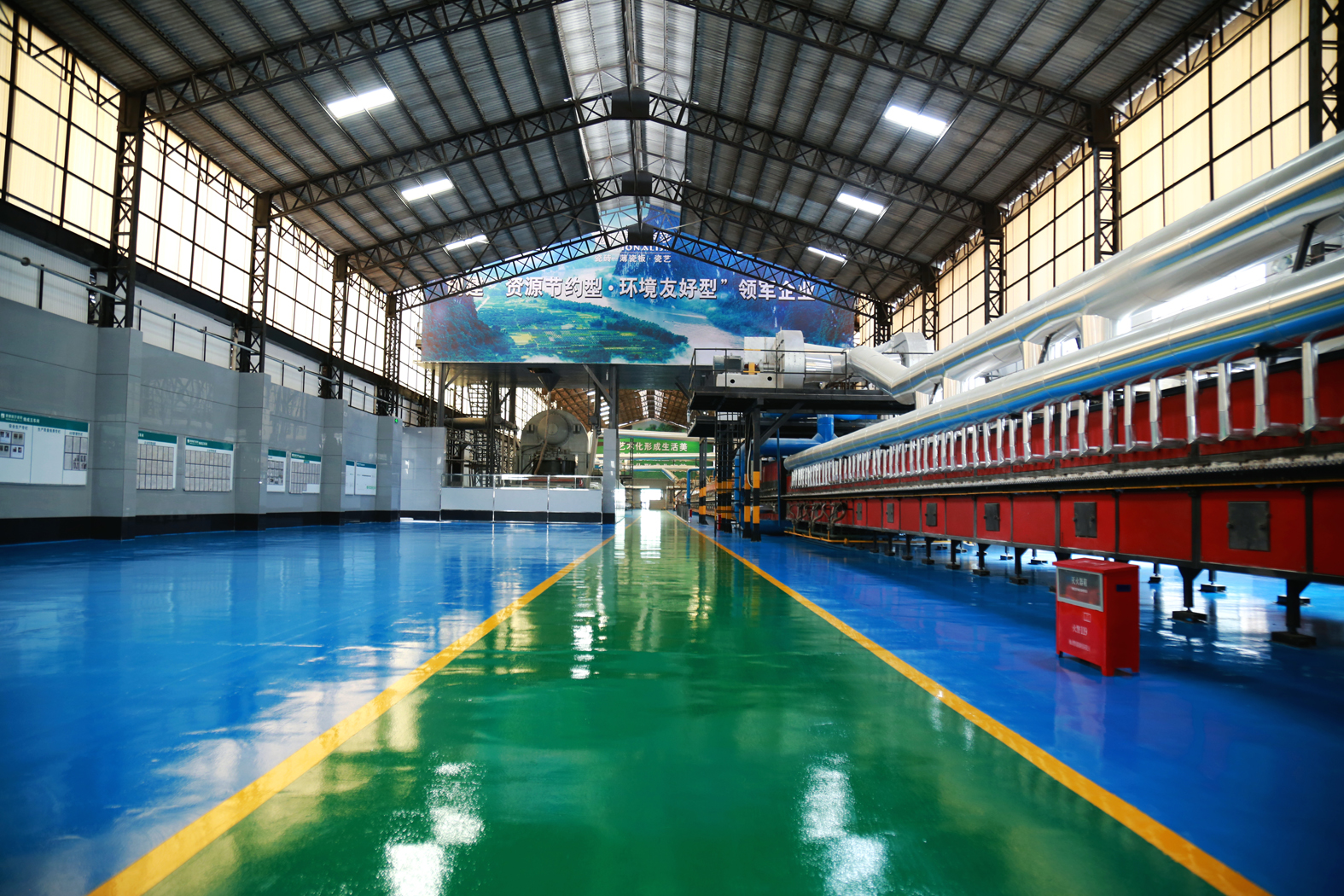
Controlled firing and finishing processes inside Monalisa’s workshop support batch consistency for large-format slab production.
Performance Properties Distributors Must Be Ready to Explain
Distributors are not just buyers; they are the technical bridge between the factory and the installer. The most frequently requested sintered stone slab properties in 2026 include scratch resistance, heat resistance, stain resistance, waterproofing, UV resistance, and fire resistance. Being able to explain how these properties are achieved helps distributors qualify leads and reduce returns.
- Scratch resistance: Surface Mohs hardness of ≥7, supported by dense body formulation and high-pressure pressing. This matters for kitchen countertops and high-traffic floors.
- Heat resistance: The mineral composition of sintered stone handles hot cookware without scorching or surface damage, a key specification for kitchen islands and cooktop surrounds.
- Stain resistance: Grade 5 stain resistance means coffee, oil, ink and similar household or commercial stains can be wiped clean without permanent penetration.
- Waterproofing and freeze-thaw resistance: Ultra-low water absorption (≤0.08% in high-density bodies) prevents water ingress. Freeze-thaw resistance of up to 150 cycles without cracking supports outdoor facades and flooring in cold climates.
- UV resistance: High-definition inkjet printing and stable mineral pigments prevent fading in exterior facade panels.
- Fire resistance: Sintered stone is a non-combustible mineral product, which supports its use to meet fire-rated facade and interior specifications.
These properties are not independent. They all trace back to the same manufacturing fundamentals: raw material formulation, pressing pressure, firing curve, and surface treatment. A distributor who understands this connection can evaluate supplier claims more effectively instead of memorizing isolated spec sheets.
Comparison Table: Sintered Stone Slab vs. Conventional Ceramic Tiles for Distribution
Distributors often carry both conventional tiles and sintered stone slabs. The table below summarizes the key performance differences that matter in customer conversations and after-sales expectations.
| Property | Sintered Stone Slab (High-Density) | Conventional Ceramic Tile |
|---|---|---|
| Water absorption | ≤0.08% | 0.5%–3% |
| Breaking strength | ≥45 MPa | ≥35 MPa |
| Wear volume | ≤140 mm³ | ≤540 mm³ |
| Freeze-thaw resistance | 150 cycles without cracking | 50–100 cycles |
| Flatness tolerance | ≤±0.15% | ≤±0.5% |
| Typical joint gap | ≤0.5 mm (large-format tight joint) | 2–5 mm standard grout joint |
| Maintenance intensity | Water or neutral detergent; no waxing or sealing | Periodic sealing/deep cleaning may be needed |
| Life-cycle cost position | Higher unit price; lower total life-cycle cost in high-traffic or long-service applications | Lower initial cost; higher maintenance and replacement frequency |
Comparison data reflects performance benchmarks for high-density sintered stone versus standard ceramic tiles.
Use Scenarios: Where Sintered Stone Slab Demand Is Strongest
Kitchen countertops and islands
Kitchen countertop sintered stone slabs are the most commonly specified application in the distribution channel. Customers value scratch resistance, heat resistance, stain resistance, and a food-safe surface. NSF-certified sintered stone slabs are particularly relevant here because they can be documented as meeting food-contact safety standards. Calacatta and marble look sintered stone slabs remain popular aesthetic choices, especially in villa and high-end residential renovations.
Bathroom vanity tops and shower walls
Bathroom vanity sintered stone slabs benefit from waterproofing, stain resistance, and ease of cleaning. Large-format panels reduce grout lines compared to conventional tile, which appeals to both homeowners and commercial hospitality clients. Anti-slip surface options should be selected for wet-area floors and shower bases.
Wall cladding and interior feature walls
Wall cladding sintered stone panels deliver a seamless visual surface for living rooms, lobbies, and retail spaces. Ultra-thin sintered stone slabs (e.g., 5.5–6 mm thickness in some formats) are used in wall applications where weight matters, particularly for renovation projects over existing surfaces.
Flooring in commercial and high-traffic areas
Flooring sintered stone slabs are specified for shopping malls, airports, hotel corridors, and other high-traffic zones where wear resistance and low maintenance outweigh initial cost. The combination of high breaking strength and low wear volume reduces long-term replacement cost.
Exterior facades and ventilated rainscreen systems
Exterior facade sintered stone panels are used in high-rise dry-cladding and rainscreen systems. The ultra-low water absorption and freeze-thaw resistance are critical for these installations, especially in regions with cold winters. Fire resistance, UV resistance, and flatness tolerance also become deciding factors in facade specifications.
Risk Management: What Can Go Wrong in Long-Term Supply
Distributors who enter long-term supply relationships without evaluating risk controls expose themselves to avoidable losses. The main risks in sintered stone slab supply are:
- Color variation: inconsistent color or texture between batches, often caused by insufficient shade control and lack of batch reference standards.
- Dimensional deviation: edges, thickness, or diagonals outside tolerance, creating installation problems and joint misalignment.
- Flatness defects: warpage in large-format slabs, which is visually unacceptable on countertops or wall cladding and causes functional problems such as water pooling.
- Strength failures: breakage or cracking during handling, transport, or use, leading to claims and replacement costs.
- Slip resistance failure: surface friction below standard, creating safety risks in wet areas.
- Stain resistance failure: surface treatment defects allowing stains to penetrate and become difficult to clean.
- Freeze-thaw damage: in outdoor cold-region applications, high water absorption leads to cracking over time.
- Excessive radioactivity: raw materials with radionuclide content exceeding limits, a compliance concern in some regions.
Monalisa addresses these through an 18-point quality inspection framework, in-house CNAS-accredited laboratory testing, automatic color sorting and spectrometer inspection, high-precision mold control, flatness scanners, and a traceability system that links each slab to its production date, press station, kiln zone, and inspector ID. The company is certified under ISO 9001, ISO 14001, and ISO 45001. For distributors, these controls translate into fewer claims, faster problem resolution, and stronger end-customer confidence.
Choosing a Sintered Stone Slab Supplier: Decision Criteria for Distributors
When comparing sintered stone slab suppliers for a long-term distribution agreement, use the following decision criteria:
- Production ownership: Does the supplier own the factory and production lines, or is it a trading company? Owned production means direct control over formulation, pressing, glazing, and firing.
- Capacity and scale: Can the supplier handle both baseline orders and demand surges? A manufacturer with a monthly production capacity of 20,000,000 square meters can absorb growth more comfortably than a factory running at maximum capacity.
- Quality infrastructure: Does the supplier have an accredited lab, documented inspection points, and traceability systems? These matter more than a polished brochure.
- Certification coverage: Does the supplier hold ISO 9001, ISO 14001, ISO 45001, CE (EAD 090142-00-0404), NSF, and other market-relevant certifications?
- Product range and surface options: Can the supplier offer marble look, concrete look, terrazzo, calacatta, and custom surfaces across large formats and ultra-thin formats?
- Commercial flexibility: Are MOQ, payment terms (TT/LC), and delivery terms (FOB/CIF/EXW) compatible with distribution operations?
- After-sales process: What is the documented process for claims, shade matching, and replacement? Is there batch stock retention, for example a 2-year reserve, to support patch repairs?
FAQ: Distributor Questions on Sintered Stone Slab Supply
What certifications should a sintered stone slab manufacturer have for global distribution?
For EU markets, CE marking for sintered stone requires compliance with EAD 090142-00-0404. For system credibility, buyers should look for ISO 9001 (quality), ISO 14001 (environmental), and ISO 45001 (occupational health and safety). For kitchen countertops in North America and other food-contact applications, NSF certification is a relevant additional credential. Always verify certificates and match them to the jurisdictions where the slabs will be sold.
Can a sintered stone slab manufacturer support large-volume and recurring orders?
Yes, provided the manufacturer has sufficient production capacity and formal capacity planning. Monalisa Group, for example, reports a monthly production capacity of 20,000,000 square meters across its ceramic product lines. Distributors should confirm capacity, lead times, and how the factory prioritizes recurring orders versus one-off projects before signing a distribution agreement. A supplier with owned production lines and multiple manufacturing bases is better positioned to maintain continuity than a capacity-constrained or trading-based source.
What is the typical MOQ and payment structure for sintered stone slabs?
MOQs in the industry commonly start around 2,000 square meters for exported sintered stone slabs. Payment is typically structured as TT or LC, and delivery terms are commonly FOB, CIF, or EXW. Distributors should clarify these parameters in writing, including how partial shipments, shade reservations, and mid-contract quantity adjustments are handled. Exact terms vary by manufacturer and order configuration, so the key is to lock them down before the first purchase order, not after a dispute arises.
How does a distributor get a sample or reference board before committing to a bulk order?
Most established manufacturers provide physical samples or reference boards for shade and surface confirmation. It is advisable to request samples that come with a batch reference code so the same production standard can be re-identified in later orders. For large-format slabs, also request installation and edge-fabrication guidance to avoid handling surprises. If the supplier offers a digital catalog and can arrange sample shipment through export channels, that shortens the evaluation cycle. To explore this with Monalisa, contact the team directly and ask for samples that match your target application and market.
What lead time should a distributor expect for sintered stone slab orders?
Lead times vary by factory load, product format, surface finish, and order volume. Standard production and container shipment for common formats can typically be measured in weeks, but distributors must account for confirmation of shade approval, production scheduling, and overseas logistics. For a realistic schedule, ask the manufacturer for a written production calendar that includes capacity allocation, loading date, and shipping route. A supplier with owned factories and transparent scheduling can give a more dependable lead time than an intermediary that depends on outside lines. Distributors also need to reserve buffer time for port handling and customs in the destination market.
Conclusion: Treat Sintered Stone Slab Supply as a Partnership, Not a Purchase Order
Distributors who succeed in the sintered stone slab category do not treat suppliers as order-takers. They choose manufacturers whose production systems, certifications, and operating scale align with their growth plans. The global sintered stone market is expanding, and demand is moving across kitchen countertops, bathroom vanities, wall cladding, flooring, and exterior facades. That breadth creates real opportunity for distributors—but only if the supply chain behind them is durable.
Before scaling, verify the essentials: production ownership, capacity, quality inspection, traceability, certifications, commercial terms, and after-sales responsiveness. A manufacturer with owned factories, documented quality controls, and visible traceability systems provides a foundation that a distributor can build on for years. Monalisa’s record includes partnerships with nearly 100 major real estate developers and a monthly production capacity of 20,000,000 square meters, which are practical indicators of scale and delivery capability. The supplier you choose today will determine whether your distribution business can meet tomorrow’s demand or choke on it.
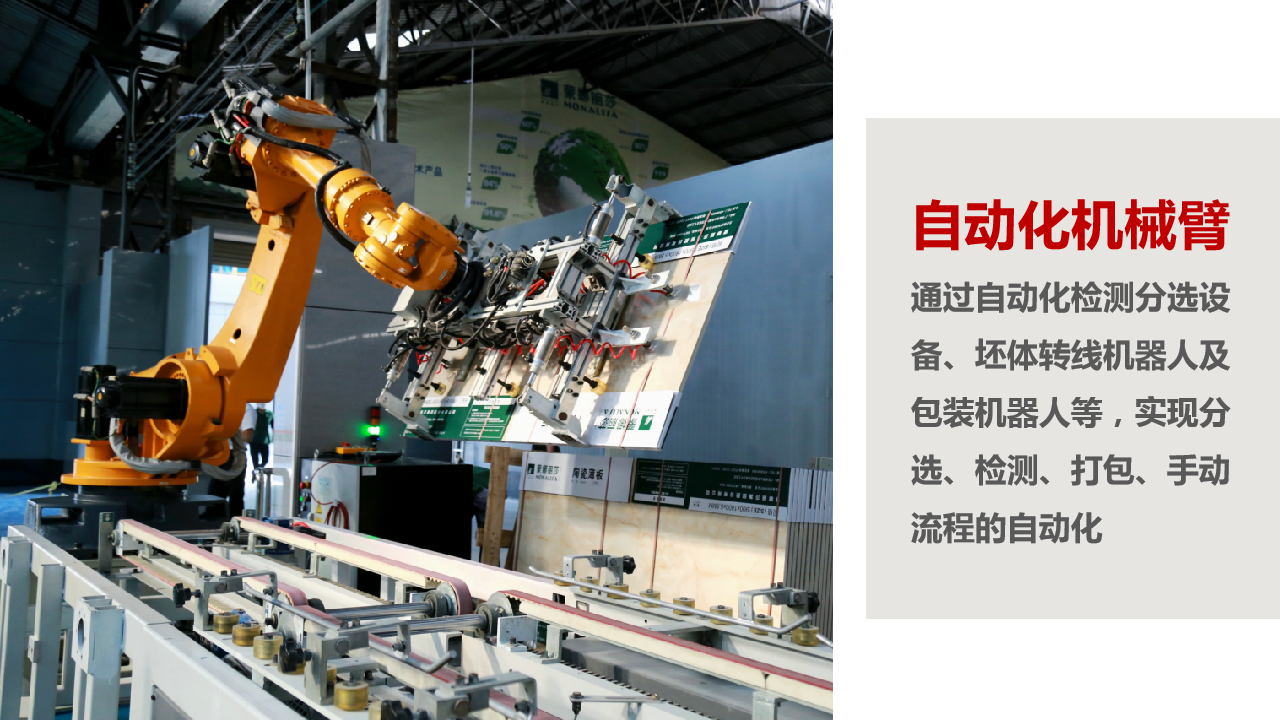
Automated handling reduces slab breakage and supports precise sorting in large-format sintered stone production.
Download the Monalisa corporate brochure to review production bases, product series, and supply capabilities.
Download BrochureHave Questions or Need More Details?
Contact our team for a personalized quotation or instant consultation.
Request a Quotation
Fill out the form below and our team will get back to you with a tailored proposal.
WhatsApp Direct Chat
Prefer to chat in real-time? Message us on WhatsApp for instant assistance & quick answers.
- Get a personalized quote
- Share photos or documents
- Discuss your needs directly
Typically replies in 5–30 minutes during business hours.