
Essential Sintered Stone Slab Certifications: A Compliance Guide for Buyers
When procuring sintered stone slabs for commercial or residential projects, understanding the required certifications and compliance standards is critical to ensuring product performance, safety, and regulatory acceptance. This guide provides a clear framework for global buyers to navigate certification requirements, verify supplier compliance, and avoid costly procurement risks.
What Certifications Do You Need for Sintered Stone Slabs?
Sintered stone slabs are subject to a range of international certifications and standards that validate their performance, safety, and environmental compliance. The two most relevant certifications for global procurement are NSF (focus on food contact safety) and CE (mandatory for products sold in the European Economic Area). Additional certifications such as ISO 9001, ISO 14001, and GreenGuard may also be required depending on the end-use application and target market.
Why Certification Compliance Matters
- Regulatory access: CE marking is compulsory for construction products placed on the EU market.
- Health and safety: NSF certification ensures that slabs used in kitchen countertops and food preparation areas meet strict food-contact safety standards.
- Performance guarantee: Certified products have been independently tested for parameters such as water absorption, abrasion resistance, slip resistance, and freeze-thaw stability.
- Risk mitigation: Compliance reduces the risk of project delays, rework, liability claims, and non-conformity penalties.
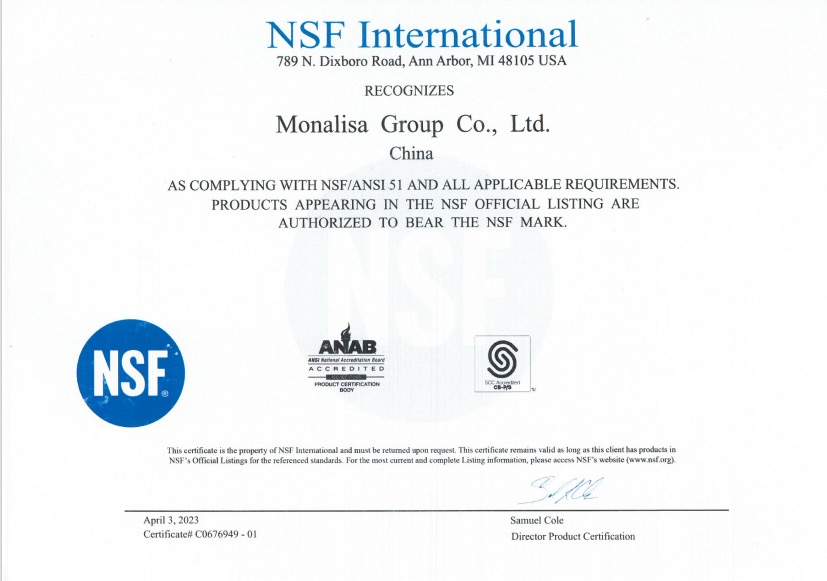
NSF certification mark confirming the slab meets NSF/ANSI 51 standard for food contact surfaces.
Industry Background and Regulatory Landscape
The global sintered stone market has grown rapidly in the past decade, driven by demand for large-format, high-performance surfacing materials. As more manufacturers enter the market, procurement professionals face increasing challenges in verifying product quality and regulatory compliance. Different regions impose different requirements:
- Europe: Construction Products Regulation (CPR) mandates CE marking based on harmonized standards such as EN 14411:2016.
- United States: NSF/ANSI 51 is the key standard for food zone surfaces; ICC-ES reports may be required for structural use.
- Middle East & Asia: Many projects require ISO certifications, local conformity marks, or project-specific testing reports.
Detailed Solution: Key Certifications Explained
NSF Certification
NSF International is an independent organization that develops public health and safety standards. For sintered stone slabs used in kitchen countertops and bathroom vanity tops, the relevant standard is NSF/ANSI 51: Food Equipment Materials. This certification verifies that the slab surface does not harbor bacteria, is resistant to staining and chemical attack, and will not leach harmful substances into food.
Example: Monalisa Group has obtained NSF certification (Certificate No. C0676949-01, issued 2023-04-03) for its Luxury Slab series (model 90-270FDK09003M/90-270FDK09008M, 900x2700x12mm). The certification covers compliance with NSF/ANSI 51 and all applicable requirements.
CE Certification
CE marking is mandatory for construction products sold in the European Economic Area. For ceramic-based slabs, the applicable standard is EN 14411:2016 – Ceramic tiles – Definition, classification, characteristics, assessment and verification of constancy of performance and marking. CE certification demonstrates that the product meets essential health, safety, and environmental requirements.
Example: Monalisa’s Slab product (size 900mm × 1800mm × 10mm) holds CE certification under Certificate No. CY25A10378, issued by China Testing & Certification International Group Shaanxi Co., Ltd. (valid until 2035-03-07). The certification confirms that the product complies with EN 14411:2016 for wall and floor applications.
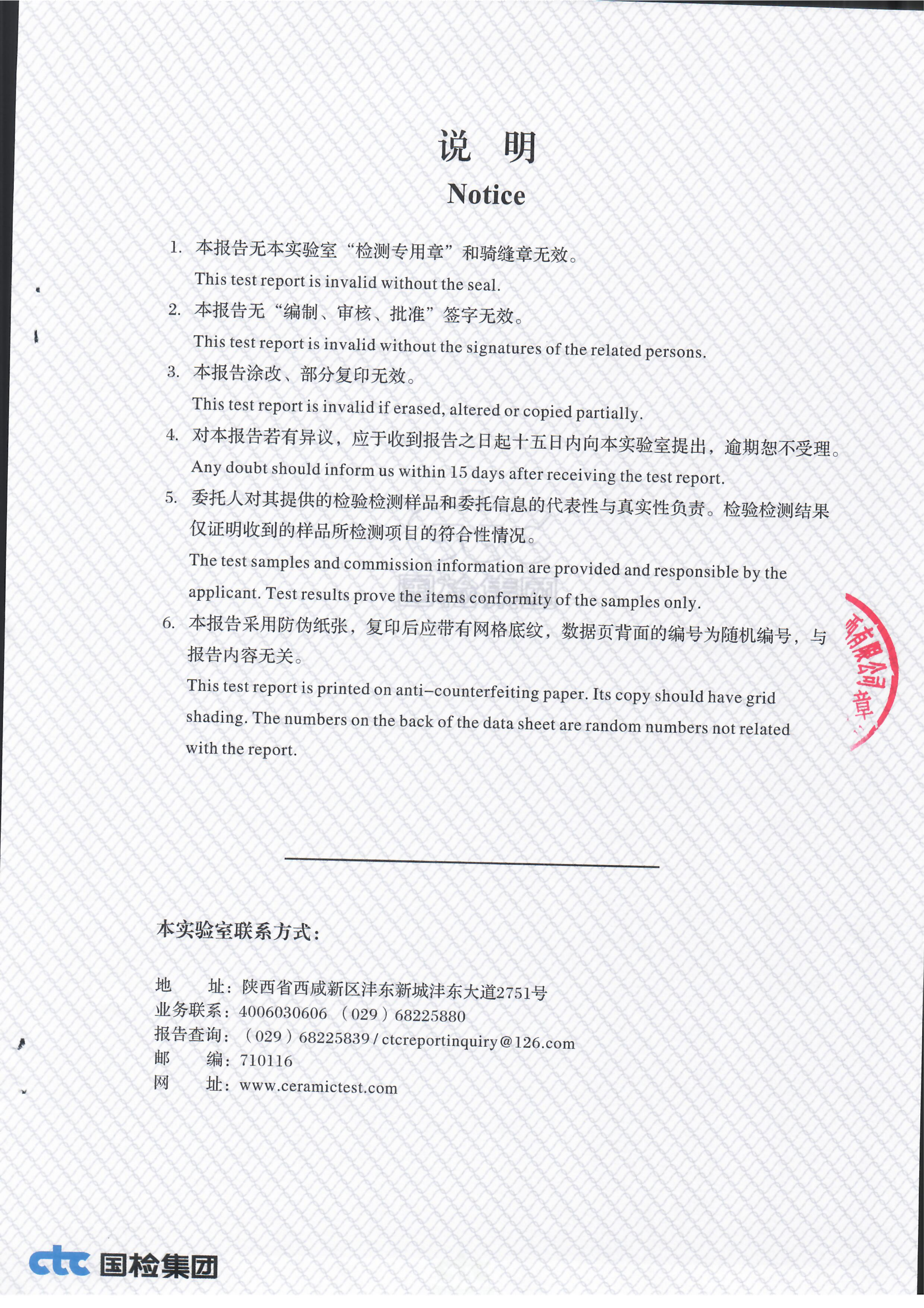
CE test report verifying sintered stone slab conformity with EN 14411:2016.
How to Verify a Supplier's Compliance
To ensure your chosen supplier is genuinely compliant, follow these verification steps:
- Request original certificates: Ask for copies of NSF, CE, and other relevant certifications, including the scope of certification and validity dates.
- Check traceability: Reputable suppliers implement production traceability systems. For example, Monalisa laser-marks or RFID-codes each tile to track production date, press station, kiln zone, and inspector ID, enabling full traceability from raw material to finished product.
- Review test reports: Independent laboratory test reports for key parameters (water absorption ≤0.5%, breaking strength ≥45 MPa, MOHS hardness ≥7) provide objective evidence of performance claims.
- Visit the factory: A factory audit can confirm the presence of quality control systems and production capabilities.
- Reference past projects: Ask for case studies where the supplier’s products were used in projects that required certification compliance.
Step-by-Step Compliance Checklist
| Step | Action | What to Look For |
|---|---|---|
| 1 | Define project requirements | Target market, end-use (kitchen, exterior, etc.), applicable regulations |
| 2 | Shortlist candidates | Suppliers with published certifications (NSF, CE, ISO) |
| 3 | Request documentation | Certificates, test reports, traceability records |
| 4 | Cross‑verify | Check certificate numbers with issuing bodies |
| 5 | Inspect samples | Physical samples for performance testing (water absorption, stain resistance) |
| 6 | Conduct factory audit | Confirm quality management system, production line capabilities |
| 7 | Finalize contract | Include certification compliance clauses and penalty for non‑conformity |
Use Case: Large-Scale Project Ensuring Compliance
In 2025, a national government project in Sri Lanka required over 80,000 m² of large-format sintered stone slabs for the Colombo Convention Centre. The project specifications mandated CE certification and adherence to EN 14411:2016. The supplier, Monalisa Group, provided 900×1800mm slabs with ultra-low water absorption (≤0.08%) and on-site technical support. The successful delivery and installation demonstrated the supplier’s capability to meet stringent compliance requirements while maintaining schedule and quality.
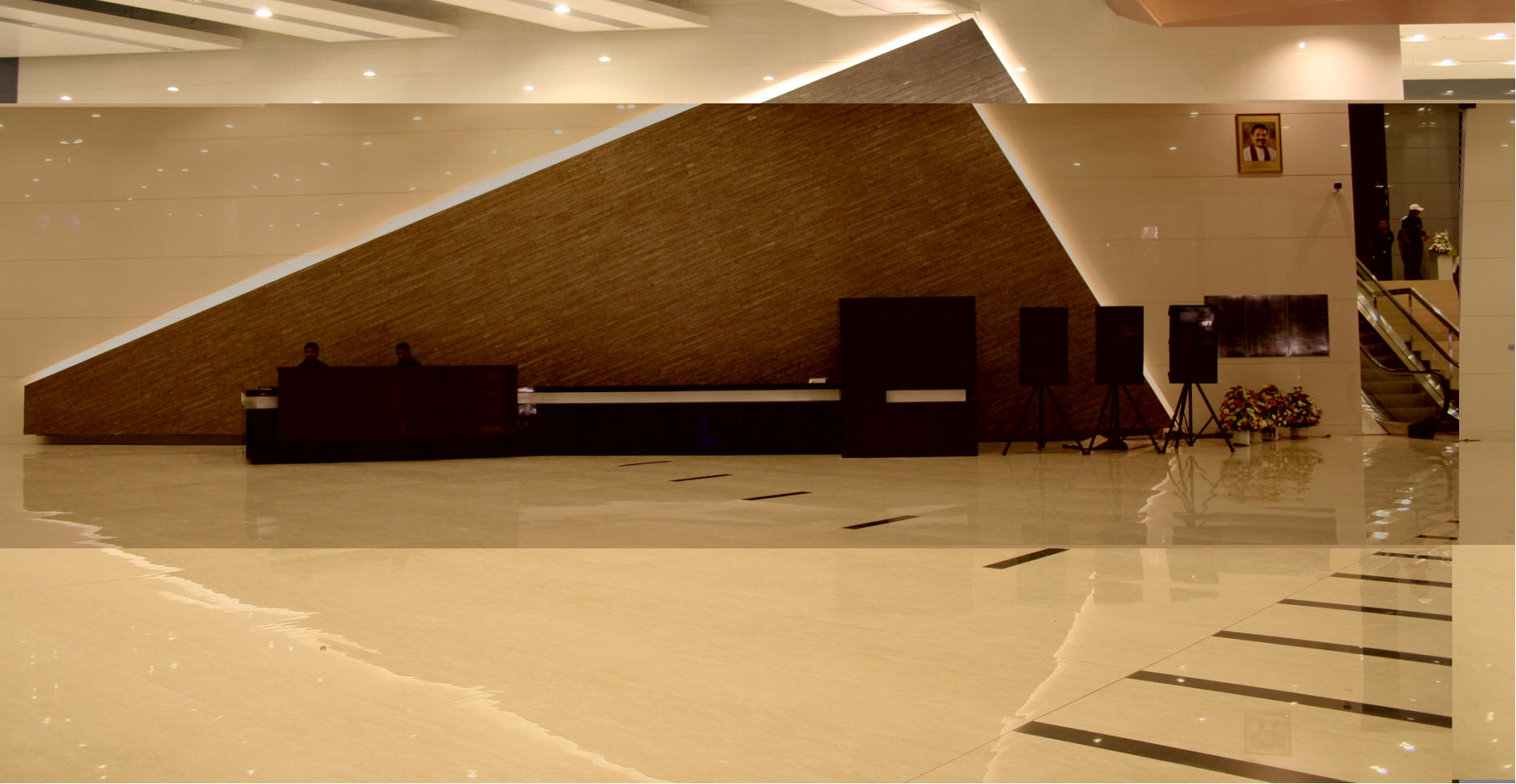
Sintered stone slab used in the Sri Lanka convention centre project, fulfilling CE compliance requirements for large-scale public buildings.
Frequently Asked Questions (FAQ)
Q: What is the difference between NSF and CE certification for sintered stone slabs?
A: NSF certification focuses on food contact safety and hygiene (NSF/ANSI 51), while CE certification (EN 14411:2016) covers product performance, safety, and conformity for construction use in the EU market. Both may be required depending on the application and destination.
Q: How can I confirm if a supplier is truly CE certified?
A: Request a copy of the CE certificate and verify the certificate number with the issuing body (e.g., China Testing & Certification International Group). Check the scope of certification (product size, model, performance class) and ensure it matches your order.
Q: Do I need both NSF and CE certification for kitchen countertops?
A: If the project is in the EU, CE marking is mandatory. NSF is not legally required but is often specified by commercial kitchens and health departments for food contact surfaces. For maximum market access, choose a supplier that holds both certifications.
Q: Are there any other certifications I should consider?
A: Depending on the project, additional certifications may include ISO 9001 (quality management), ISO 14001 (environmental management), GreenGuard (low VOC emissions), and fire ratings (EN 13501-1 for Europe).
Conclusion
Certification compliance is non-negotiable for sintered stone slab procurement. Understanding the requirements—whether NSF for food safety, CE for European market entry, or additional certifications for specific applications—helps buyers select reliable suppliers and avoid project setbacks. Monalisa Group, with its NSF and CE certifications, production traceability system, and proven project delivery, offers a trustworthy sourcing option for global buyers.
For detailed product specifications and compliance documentation, download the company brochure or contact our sales team for personalized guidance.
Have Questions or Need More Details?
Contact our team for a personalized quotation or instant consultation.
Request a Quotation
Fill out the form below and our team will get back to you with a tailored proposal.
WhatsApp Direct Chat
Prefer to chat in real-time? Message us on WhatsApp for instant assistance & quick answers.
- Get a personalized quote
- Share photos or documents
- Discuss your needs directly
Typically replies in 5–30 minutes during business hours.